


The diet continues for Tiscali, the Sardinian telecom company founded in the ’90s by Renato Soru, merged in 2022 with the retail branch of Linkem, the leading operator in broadband access with wireless technologies (Fwa) founded in 2001 by entrepreneur Davide Rota.
Long in difficulty, the company born from that merger – now part of the Tessellis group – has launched the second phase of the reorganization plan with the opening of the collective dismissal procedure for 180 employees out of a total of 729, after a first phase of incentivized exits ended with 220 departures. The process is part of the group’s crisis management and the prospect of selling its consumer branch (B2C Tiscali, the one providing services to citizens) to Canarbino, a Ligurian group supplying gas, electricity, and telephony services.
On March 1st, the parent company Tessellis spa accepted a binding offer for the valorization of the B2C business unit and the brands “Tiscali” and “Linkem,” through an operation that provides for an initial leasing phase followed by a subsequent definitive purchase.
All the details.
NEGOTIATED COMPOSITION OF THE CRISIS
On March 12th, the company announced that within the framework of the negotiated composition process of the business crisis initiated for Tessellis and the subsidiaries Tiscali Italia and GO Internet, on March 10th the Chamber of Commerce of Cagliari-Oristano appointed Massimo Zappalà as sole expert. Tessellis had filed an access request pursuant to art. 12 et seq. of the Business Crisis and Insolvency Code (CCII) on March 1st, 2026. Furthermore, the company announced that it had filed with the competent Court of Cagliari the petition concerning the confirmation of protective measures requested pursuant to art. 18 CCII and the request for the granting of precautionary measures, pursuant to art. 19 CCII.
SECOND PHASE OF THE REORGANIZATION PLAN
Meanwhile, after the first procedure for incentivized exits successfully concluded with 220 departures, Tiscali now launches the procedure for the collective dismissal of 180 people out of a total of 729 employees located in the offices of Cagliari, Bari, Taranto, Rome.
A necessary measure, that of workforce reduction, aimed at resolving the crisis and thus the sale of the business unit.
THE DECISION OF TESSELLIS BOARD OF DIRECTORS
“On March 1st the Board of Directors of the parent company Tessellis – the company writes in the note sent to Unindustria – accepted a binding offer for the valorization of the B2C business unit of the Tiscali and Linkem brands.” The operation is carried out through the leasing of the business unit aimed at the subsequent purchase by Canarbino.
THE SALE OF TISCALI’S B2C BRANCH
With 700 employees and 800,000 customers managed in retail, Canarbino is a leading operator in the Italian energy sector present along the entire natural gas and electricity supply chain, states the Tessellis note. The group operates through various subsidiaries and is active in the procurement and trading segment through HB Trading and in the sale of energy and gas to end customers with Segnoverde and Energia Pulita companies.
TISCALI’S (DECLINING) TRAJECTORY
But why did the Sardinian company, once a telco with the largest fiber coverage available in Italy, reach the last resort of layoffs?
As reconstructed today by Corriere, “Tiscali was founded in January 1998 in Cagliari by entrepreneur Renato Soru, following the deregulation of the Italian telephone market. The company was the first to offer free internet access. From 1999 to 2003 it acquired numerous companies (such as Liberty Surf in France and World Online in the Netherlands) with the aim of becoming a pan-European internet provider. But the model did not work and in 2009, with the announcement of the sale of Tiscali UK, the company returned to operating only in the Italian market.”
THE MERGER WITH LINKEM FOUR YEARS AGO
It was in 2022 when Soru prepared the operation aimed at integrating the Tiscali Group (then in loss) and the retail branch of the Linkem Group, which became the main shareholder of Tiscali with about 62% of the shares, into a single corporate and commercial entity.
From the merger – the first significant consolidation operation in the telecom sector as highlighted at the time by Sole 24 Ore – the company aimed to become the fifth operator in the fixed market and the leading player in the ultra-broadband access segment in Fwa (fixed wireless access) and Ftth (fiber to the home) technologies, with an overall market share of 19.4% (Source Agcom data).
As the company note highlighted, “the operation provides for the integration of the organizational assets of the companies involved in order to generate significant industrial synergies and better seize the opportunities connected to the implementation of the PNRR thanks to an integrated offer of fixed, mobile, 5G, cloud and smart city services.”
At the beginning of 2022 Davide Rota, founder and CEO of Linkem, later appointed CEO of Tiscali by the board following the signing of the merger agreement in December 2021, explained in an interview with the Confindustria daily that “a combination of companies of our size is actually an advantage. Speed is an essential condition in the current and future market. And the union of two large entities or even the merging of one entity into a larger company may not provide the necessary agility in a phase like the current one.”
Words that clash with today’s harsh reality.
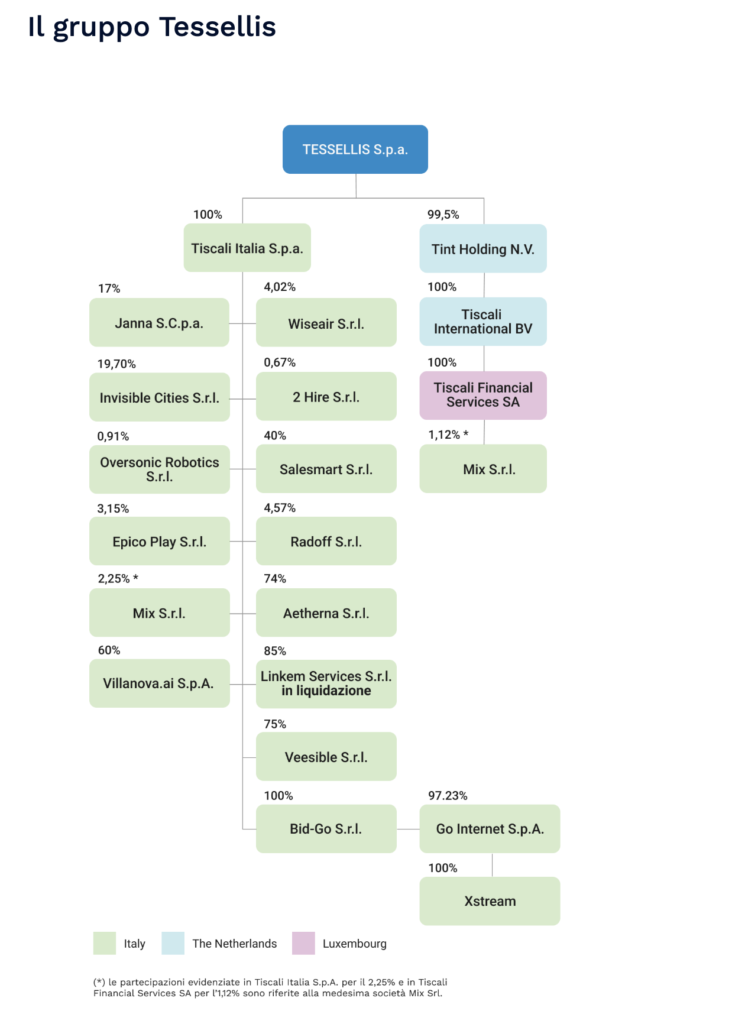
THE STRUCTURE OF THE TESSELLIS GROUP
Last May, in fact, Tessellis spa, the company resulting from the merger by incorporation of Linkem’s retail branch with Tiscali as of January 19, 2023, announced the approval of the consolidated financial statements as of December 31, 2024 by the board of directors, along with the news of Davide Rota’s departure, reported CagliariToday.
SHAREHOLDING STRUCTURE
On its website, the company explains that “the challenge of Tessellis, which conceptually recalls the notion of mosaic in Latin, is to configure itself as a technological enabler, able to combine its assets in an ecosystem capable of generating value and innovation.”
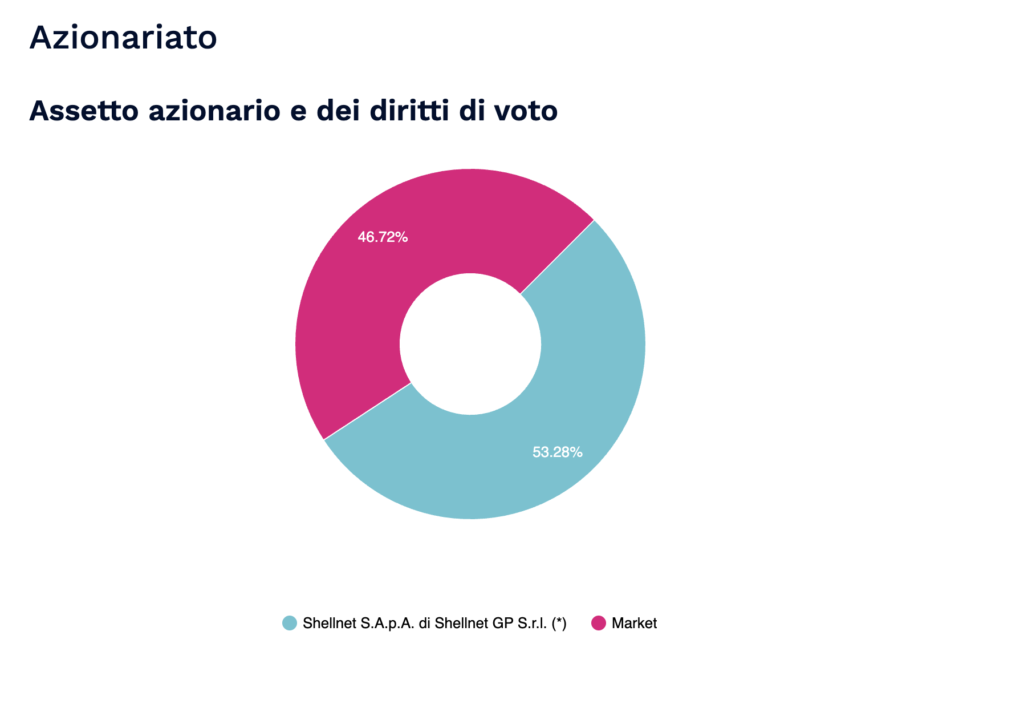
As can be seen from the shareholding structure, Shellnet Sapa of Shellnet GP Srl is the controlling shareholder of the company and the Tessellis group with 53.28% of shares.
THE 2024 FIGURES
Looking at the latest figures, the Tessellis group closed the consolidated financial statements for the 2024 fiscal year with declining revenues and profitability: revenues stood at 219.8 million euros, compared to 233.9 million in 2023, while EBITDA was 26 million euros, compared to 34.7 million in 2023. As for the net result, it was negative by 57.9 million euros, although improved compared to -62.2 million in 2023. As of December 31, 2024, Tessellis nevertheless reduced the loss by about 4 million euros, from 62.2 million euros to 57.9 million.
THE COLLECTIVE DISMISSAL PROCEDURE
However, the company has not managed to turn things around. Hence the launch of the collective dismissal procedure for 180 workers out of a total workforce of 729 employees “adopting as the sole criterion for identification the non-opposition to dismissal.”
DISTRIBUTION OF REDUNDANCIES
The largest number concerns Cagliari, where redundancies affect 8 managers, 62 employees, and 11 journalists. In Taranto, 73 employees are involved, while in Rome there are 2 managers, 10 employees, and 1 journalist. In Bari, 10 employees and 2 managers are expected, and finally in Milan 1 manager.
THE START OF THE DISCUSSIONS
A new phase now opens which foresees a series of meetings within 15 days to present the different options for managing redundancies and to understand what future remains for the workers.
On March 18, the Regional Labor Councillor Desirè Manca activated coordination with the Sardinia, Puglia, and Lazio Regions involved in the Tiscali dispute, with the aim of promoting a shared and coordinated action to protect workers, emphasizing that “This is a national-level dispute, which due to its employment and territorial impact requires a coordinated response.”




