

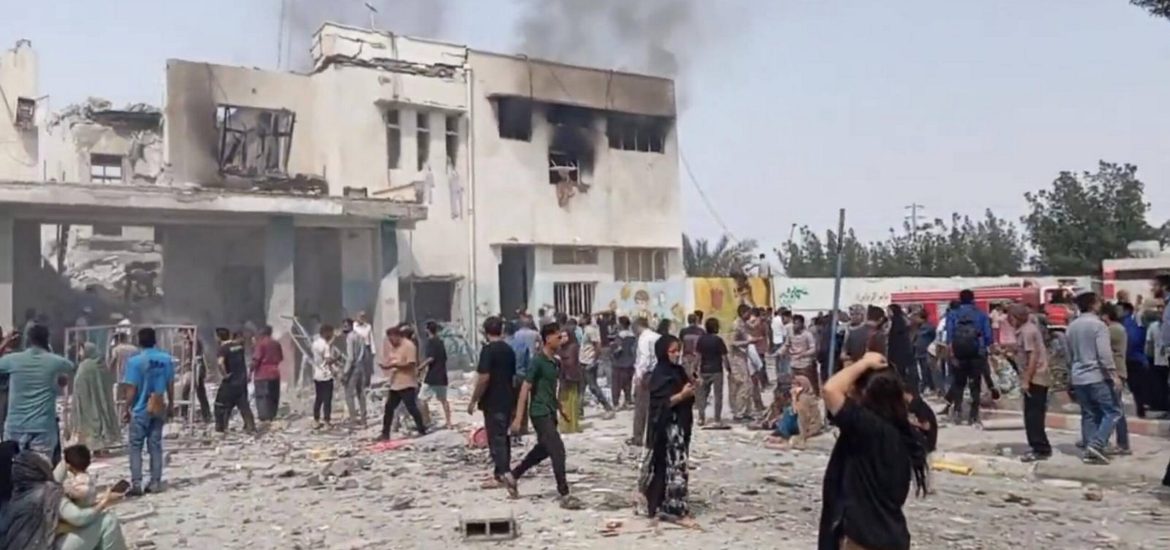

During the night of February 27-28, the United States and Israel launched coordinated airstrikes inside Iran as part of Operation ‘Epic Fury’.
President Trump’s communication, explicitly aimed at regime change, increases the likelihood that the operation will evolve into a prolonged campaign rather than remain a limited confrontation. For the markets, the decisive factor will be understanding whether the escalation will remain confined to the military level or extend to energy and logistical infrastructures, triggering a higher and more lasting risk premium.
The lack of consensus on a hypothetical ‘post-Islamic Republic Iran’ represents a real complication: even if pressure on the regime increases, there is no clear and widely legitimized successor coalition — which raises the probability of fragmentation and power vacuums (the scenario feared by regional players, similar to Iraq).
At first impact — rise in oil and gas prices: the immediate impulse is an increase in crude oil and natural gas prices — without ignoring liquefied natural gas (LNG). Qatar has the third largest LNG export capacity in the world, and about 20% of global LNG trade passes through the Strait of Hormuz (mainly Qatari volumes), making navigation risk a market theme for both gas and oil.
The Strait of Hormuz is the macro “circuit breaker”: a total closure of Hormuz would be existentially risky for Tehran, but Iran can still resort to attacks, seizures, drones, cyber or direct pressures that keep the risk premium elevated. In 2024, flows through Hormuz averaged ~20 million barrels/day (~20% of global liquid petroleum consumption): thus even a partial disruption (slower transits, deviations, seizures) increases prices through the risk premium long before real shortages emerge (Source: US Energy Information Administration)
Shipping costs are already moving — insurers are the accelerators: insurance companies are issuing cancellation notices and repricing war risk coverage in the Gulf; reported increases reach up to ~50% for some voyages, and in previous escalation phases jumps >60% have been seen on key routes. This is how the “effective supply” tightens even without wells being shut down.
The risk of regional extension increases: Iran’s counterattacks across the region (including military outposts in the Gulf) increase the likelihood that Arab neighbors will be drawn into the conflict, inadvertently expanding the theater and making de-escalation more difficult.
Cross-asset — first the risk premium, then fundamentals: the initial market reaction to this type of event typically sees a drop in Treasury yields and a decline in stocks — mainly a repricing of the risk premium. Impacts on assets/earnings may manifest later and irregularly. The US dollar reaction is not guaranteed; gold tends to benefit, while bitcoin has behaved like a risky asset (i.e., falling with stocks), confirming it is generally not a reliable hedge or diversifier in geopolitical downturns.
Markets often ‘learn’ this is a short-term phenomenon (but it is not yet time to “buy-the-dip”): historically, geopolitical shocks produce an initial increase in risk premiums before investors conclude that the impact on aggregate earnings is modest. We do not yet consider this a clear “buy-the-dip” opportunity: duration, shipping/insurance mechanisms, and endgame matter more than headlines.
The role of China — and why this does not change the calculus on Taiwan: China is central to the Iranian story (oil flows, sanctions enforcement, geopolitics of regime change and energy prices), but it is unlikely that its decision-making on Taiwan changes just because the US is engaged elsewhere. China’s calculus on Taiwan depends on its own internal strategic framework, not opportunism over a single external conflict.
Impact on investments: in the short term, we have a preference for assets that move with a high beta relative to energy prices, beneficiaries in the shipping/insurance sector (freight, transport services + war risk repricing) and defense.
We remain cautious on exposure to emerging markets dependent on energy imports and cyclicals sensitive to fuel/logistics (airlines, some industrials). For protection, we prefer exposure to potential oil price upside/option-based strategies designed to benefit from increased oil volatility and selective exposure to gold over broad equity shorts — the path will be driven more by the reality of logistics/insurance than by the economic cycle.




