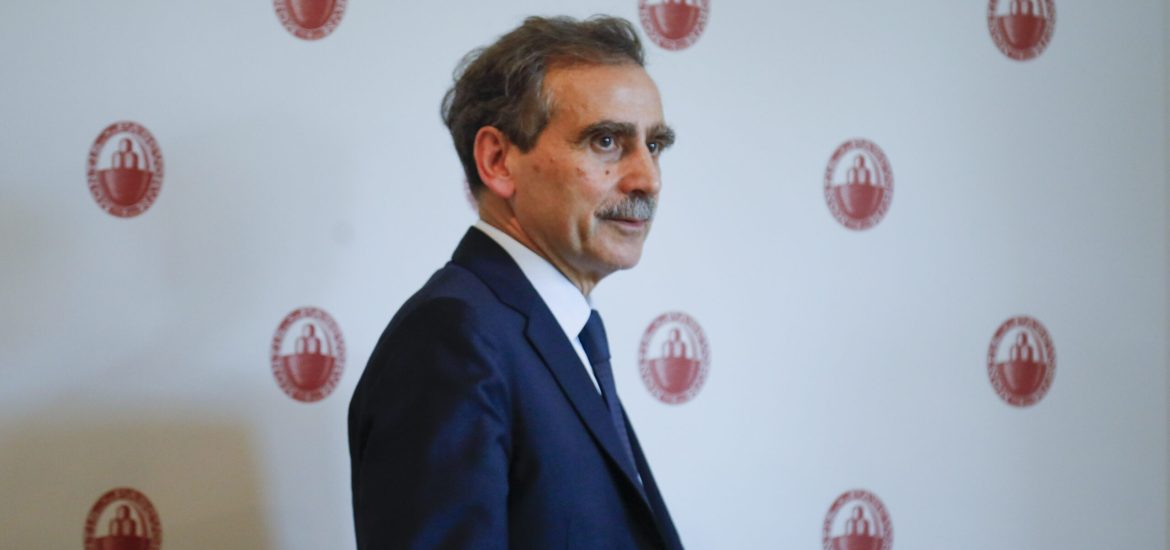

Just days before the presentation of the new industrial plan, which promised profits up to 3.7 billion by 2030, revenues of 9.5 billion, a 100% payout, and about 16 billion in distributions to shareholders, Monte dei Paschi finds itself without the CEO who signed off on its strategic setup. The board of directors of the Sienese bank has in fact approved the list of 20 candidates for the renewal of the board to be submitted to the shareholders’ meeting on April 15. The list does not include the name of the current CEO Luigi Lovaglio, who has been leading the bank since 2022.
The decision was made after a long and tense meeting. The approval of the list came with 11 votes in favor out of 13, while Lovaglio and board member Giuseppe Barzaghi voted against and Barbara Tadolini – appointed by Delfin – was absent.
A strong signal of discontinuity precisely as the bank tries to definitively change its role in the Italian financial system.
WHO IS ON THE LIST AND WHO COULD LEAD MONTE
The list includes twenty names and foresees the reconfirmation of the current chairman Nicola Maione. Among the directors are several members of the outgoing board, including Gianluca Brancadoro, Marcella Panucci, Francesca Renzulli, Renato Sala, Elena De Simone, and Domenico Lombardi, chairman of the nominations committee that managed the candidate selection and indicated by some as close to the leadership of Fratelli d’Italia and in the recent past an economist consulted at the Presidency of the Council.
For operational leadership, the board has identified three profiles deemed suitable for the role of CEO: Corrado Passera, Fabrizio Palermo, and Carlo Vivaldi.
Passera, former head of Intesa Sanpaolo and founder of Illimity, has reportedly already indicated he is not interested in operational leadership but possibly in a role as chairman or director. Palermo, currently CEO of the Roman company Acea (where Caltagirone is a major shareholder) and former head of Cassa Depositi e Prestiti, is considered one of the strongest candidates and would be favored by Francesco Gaetano Caltagirone. The third name is Carlo Vivaldi, a manager with extensive international experience at Unicredit.
However, it will be the shareholders’ meeting that elects the new board and subsequently the board that chooses the future CEO.
THE SHAREHOLDING BALANCES AT STAKE
Behind the governance shift also weighs the structure of Monte’s shareholding. The largest shareholder is Delfin, the holding company of the Del Vecchio family, with about 17.5% of the capital, followed by Caltagirone with just over 10%. Together, the two shareholders nearly reach 28% of the capital, effectively forming the strongest shareholder block in the game revolving around the Mps-Mediobanca-Generali triangle. Among other significant shareholders are the BlackRock fund with about 5%, the Ministry of Economy and Finance (Mef) with a stake now reduced to about 4.9%, and Banco BPM with just under 4%, while the rest of the capital is distributed among institutional investors and the market.
In this context, the Treasury is no longer the reference shareholder as in the years of public bailout, but remains a politically sensitive actor in the governance game, especially at a time when the government continues to closely monitor the banking system’s restructuring.
At this point, more subtle balances also come into play. Lovaglio was appointed in 2022 during the Draghi government with the support of the Treasury and has sometimes been considered close to Lega circles. The fact that today Giancarlo Giorgetti’s Mef has not openly defended his reconfirmation is read by some observers as a sign of cooling relations.
THE MARKET REACTS COLDLY
The surprise in governance was met with coldness by the market. According to reports also by MF, Lovaglio’s exit immediately weighed on Siena’s stock prices. The Mps share opened lower at Piazza Affari, while Mediobanca also recorded declines. During the session, Monte lost more than 3%, while Mediobanca dropped over 2%. According to several analysts, the market is discounting uncertainty about governance and the bank’s future strategy. About 820 million in market capitalization was wiped out in a few sessions, while doubts increase about the Mediobanca operation and the possible delisting of Piazzetta Cuccia.
In recent sessions, Mps has accumulated a significant drop of over 13%, a sign that the ongoing industrial game does not fully convince investors, as noted by Domani.
MEDIOBANCA, GENERALI, AND THE INDUSTRIAL ISSUE
The most delicate point concerns the integration project with Mediobanca and its delisting. The plan foresees the creation of a third Italian banking hub through the merger of Piazzetta Cuccia into Monte by 2026, with estimated synergies of about 700 million.
But the game is not only about the banking perimeter. Mediobanca owns about 13.2% of Generali, a stake worth around 7 billion euros and representing one of the most sensitive nodes of Italian financial capitalism.
The merger would bring that stake under the direct control of the new Mps group, shortening the chain of command between Siena and Trieste and reducing intermediate links.
In the industrial plan presented by management, the stake in Leone is treated mainly as a financial asset within the principal investing activity. But for some major shareholders, the stake represents a strategic node in the Mediobanca-Generali system. It is no coincidence that some of the main divergences with Caltagirone, who invested about 3.3 billion euros in the Trieste insurance group and considers the Generali issue one of the central dossiers of Italian financial balances, have emerged precisely on this ground.
THE FRICTIONS WITH CALTAGIRONE
It is precisely on this node that many internal tensions have focused. The integration with Mediobanca would bring the Generali stake under the direct control of the new group, reducing the links in the chain separating Siena from Trieste. It is on this step that tensions with Caltagirone have concentrated. According to recent reconstructions also by Startmag, divergences emerged between the Roman entrepreneur and Lovaglio precisely over the plans for Mediobanca and the implications for Generali. The delisting of Mediobanca, by centralizing control in the new group, would reduce external influence spaces.
Caltagirone rejected such interpretations, calling them “instrumental,” but the internal confrontation within the bank on these issues was real and weighed on the board’s climate.
The divergences concerned not only the industrial strategy but also some appointments to the Mediobanca board and the timing of the merger, which Lovaglio wanted to be rapid.
LOVAGLIO’S OUTBURST
In the days preceding the board’s decision, Lovaglio himself hinted at the atmosphere surrounding his position. “Only one shareholder doesn’t want me, because I have not proven obedient,” the banker said on the sidelines of the industrial plan presentation, in a passage reported by la Repubblica. The reference, according to the newspaper, was precisely to Caltagirone, with whom relations have never been particularly smooth. Lovaglio added that he was “calm” and not attached to the chair: “The board can do whatever it wants,” he said, convinced that there were not the numbers for his replacement. The numbers, however, came.
THE SHADOW OF THE INVESTIGATION
Weighing on the board’s decision is also the investigation by the Milan Prosecutor’s Office into the takeover of Mediobanca. Prosecutors hypothesize an alleged concerted action between Delfin and Francesco Gaetano Caltagirone to progressively strengthen control over Mediobanca and, indirectly, over the strategic stake in Generali. Among those under investigation are also Luigi Lovaglio, Caltagirone, and Francesco Milleri, chairman of EssilorLuxottica and a key figure in the Delfin holding.
Lovaglio has always denied any wrongdoing, declaring himself unrelated to any criminal hypothesis. However, the fear that the investigation could have judicial developments reportedly contributed to cooling part of the board’s support for his reconfirmation. In this context, a critical front against the CEO on some strategic choices related to the integration with Mediobanca and the management of the Generali stake would have progressively consolidated within Monte’s board.
THE ROLE OF THE ECB
Meanwhile, the bank has also obtained the ECB’s approval for the statutory amendments, a necessary step for the governance renewal. Frankfurt in recent months had insisted on a selection of candidates with strong banking and financial experience, an element that influenced the choice of profiles indicated as possible CEOs.
A GAME STILL OPEN
For now, the only certainty is that Luigi Lovaglio does not appear on the board’s list to be submitted to the April 15 shareholders’ meeting. The manager will continue to operationally lead the bank until the successor is appointed. But the game is far from over. It is not entirely excluded that Lovaglio could re-enter the game if an alternative shareholders’ list emerges ahead of the meeting.
Among delicate shareholding balances, ambitious industrial strategies, and tensions among major shareholders, the choice of the next CEO will also be one of the key steps in the Mediobanca game.