



The ball is round, we know that, but when the collapse of performance lasts so long – for at least twenty years it has been football, for more than thirty it was tennis – it is difficult, as well as misleading, to blame chance, especially when it comes to mass sports whose competitiveness, regardless of the normal succession of more or less talented generations, should never fall below a certain level: the elite can have ups and downs, in other words, but a healthy movement should be able to guarantee minimum standards, which have not been seen for a while.
The umpteenth exclusion of the National Team from the World Cup has turned, at least for a few days, the traditional sixty million technical commissioners into sixty million FIGC presidents holding the right recipe – foreign player restrictions, stadiums and youth academies, the most popular – which, however, will hardly be found as long as people continue to look too high or too low, instead of in the middle.
Compared to the early nineties, in fact, registered players have remained essentially stable above one million units, there is no shrinking of the base. However, professionals have decreased, significantly: from over 15,000, but in the early ’80s they were 20,000, to about 13,000, starting from when Serie C was reduced to only three groups.
The problem, to put it briefly, is that “C2 disappeared,” and with it several thousand “football player jobs.”
If it were only a numerical bottleneck, however, it would still be manageable. Countries with much healthier football than ours have fewer. The fact, instead, is that the numerical bottleneck translates into a geographical bottleneck, and this causes much more harmful consequences. The map below compares for Marche – but the same exercise could be done for the whole country – the capillarity of the spread of professional football. The red areas are those more than 20 km away from a city with at least a Serie C team.
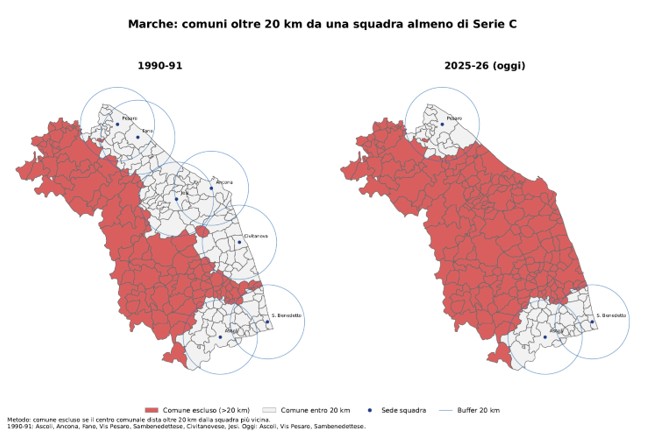
The population that does not have a team “within Vespa reach” to go train has gone from about half a million to one million in just over thirty years. And this means that, although the national reservoir has not shrunk and indeed has grown at the youth level, in Italy the leap from the youth teams of the local amateur club to those of the Serie C team in the provincial capital is barred to an increasing share of that reservoir which, except for the few who find a high-level team willing to invest in them, is forced to stop there.
Not only has the middle level – that of non-elite professionals, but from which the elite emerges – shrunk, but the selection to access it has become less meritocratic.
It is as if football had also followed that process of divergence between center, overrepresented, and periphery, progressively isolated, which has affected much of the social dynamics of the last thirty years.
The concentration of football around large urban centers, and secondly around provincial capitals, has obviously been favored by the expansion of the role of television first, and streaming later, and in fact the two processes – that of the thinning out of “middle” football and the pervasiveness of television – also coincide temporally.
It is not, as is obvious, an exclusively Italian phenomenon, although in Italy it happened a bit earlier than elsewhere, and the Italian successes in Europe in the ’90s are largely the children of that favorable financial asymmetry. However, in Italy, the effects are deeper because the pyramidal focus on clubs in large centers, which is the hallmark of current football, clashes more than elsewhere with Italian settlement and social characteristics: 55% of the population lives in municipalities with fewer than 30,000 inhabitants, in Spain it is twenty percentage points less. Cutting out “minor” Italy, even in football as in any other social manifestation, means amputating a significant part of collective energy and talent, without which there is no production, no invention, no export, and no qualification for the World Cup.
What is needed, therefore, is to find a way to restore vitality to the provincial football dimension and this cannot pass through anachronistic nostalgic approaches, which would not find public favor: it will not be with the 90th-minute nostalgia at 6:15 pm that we will restore lifeblood to minor football, but by taking, even in this case ahead of the rest of Europe, the boldest step: the definitive decoupling between high and low football.
There is, in fact, something more uneconomical than cramming events into an eight or nine-month calendar, playing practically every day, and then leaving three or four months of Tartar desert, in which only reruns of old matches are available on some unknown channel? Is there anything more contradictory than pushing to multiply events, as has happened for years between a twenty-team league and four-team super cups played in some exotic place with fake audiences, and at the same time refusing to extend the time span in which they take place?
In the United States, the NFL starts in September and ends in February, for the simple reason that baseball starts in March, lasting until October. If a league with 20 billion euros in revenues accepts to keep its spectators at 10 degrees below zero in some Minnesota stadium, just not to clash with another giant, do Pergolettese and Cerignola really have to play their league exactly in the same months as Serie A, European cups, and an unspecified number of other sports?
Moving minor football, at least from Serie C, to spring and summer, away from the competition of major football, is a solution too reasonable to continue ignoring, under the pretext of keeping alive the golden calf of the pyramidal structure, with promotions and relegations, which is what imposes the simultaneity of the championships.
Closed leagues, super leagues for the enemies, are exactly what would allow the healthy decoupling between the “televised” football of the center, and the proximity football of the periphery. Far from decreeing the end of minor football, as tons of bad demagogy have told us, they would allow it to free itself from a suffocating constraint.
“In America they can because they have the youth system in universities,” is the objection always heard.
It is not true, baseball does not have it. And it actually has a structure by levels of professionalism that allows a wide spread of the game across the territory among private teams, very similar to that of European football. With one difference: there are no relegations and promotions, but affiliations. Every team at the lower levels is linked to an MLB team, which acts both as a youth academy and as a destination for high-level players who do not find a place in the first team, and with which it continuously exchanges players even during the season.
“Yeah, but Chievo could no longer reach Serie A,” is the reply.
Second or third level minor leagues have existed since before the Italian football championship existed, without the teams playing in them feeling diminished in their dignity by not being able, one day, promotion by promotion, to become national champions.
Our teams will not become champions either, and will continue to vanish one by one, like the ten little Indians, in illusion.




