



The storm on global financial markets seems to have calmed, at least for now. However, much uncertainty remains: there is still no end in sight for the war in Iran; ships in the Strait of Hormuz are still blocked and oil prices are rising. But fortunately, the worst-case scenarios discussed a few weeks ago have not materialized, and today’s risk analysis indicates a more favorable investment climate. This easing allows investors to refocus on fundamentals, which remain positive: ample global liquidity, strong corporate earnings momentum, stable albeit unspectacular economic growth, modest inflation (though with upside risks), and more attractive valuations than two months ago for many asset classes. All this allows us to adopt a moderately risk-on stance with greater confidence, increasing exposure to emerging market assets, U.S. equities, and industrial sectors.
However, our risk allocation remains selective: we avoid relying on a single macroeconomic or geopolitical development. Therefore, we maintain an overall neutral allocation among equities, bonds, and cash.
Fig. 1 – Monthly Asset Allocation Grid
May 2026
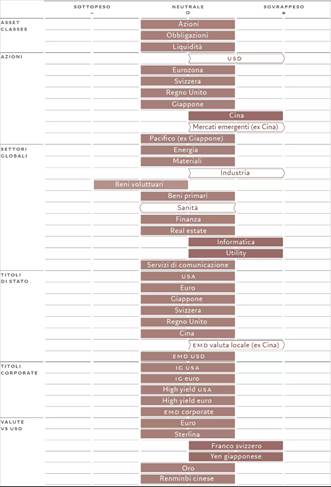
Our economic cycle indicators support this outlook, suggesting a moderately positive global macro context overall. The leading indicators we monitor show that economic activity remains broadly resilient in most developed economies and much of Asia, and that so far the energy shock has only had limited impact outside surveys and price indicators. Our base case remains global economic growth of 2.8% this year, slightly above potential, with average inflation around 3%.
However, risks lean toward weaker growth and rising price pressures. Indeed, a prolonged closure of the Strait of Hormuz into summer could trigger a mild recession in Europe and some emerging economies, and potentially also in the U.S. The closure of this trade route swings oil prices around $110-120 per barrel, compared to pre-war levels around $70, and the long-term fair value near $80 in our model (Fig. 2).
The rise in oil prices creates winners and losers. Emerging economies are holding up relatively well. Energy exporters clearly benefit, but other countries are in a stronger position than in previous shocks: reflecting better economic growth, lower external vulnerability, and greater room for maneuver on rates.
In the U.S., the situation is more balanced. The U.S. consumer is probably more fragile than growth data suggest: consumption data are already weak, disposable income growth has slowed significantly, consumer confidence is near historic lows, and rising oil prices are expected to further squeeze real incomes. However, the country’s oil producers will earn strong windfall profits, able to offset the overall economic impact.
In Europe, by contrast, the oil shock is clearly negative, eroding recovery expectations and raising the threat of stagflation. We have lowered our eurozone growth forecast for this year to 0.9% (from 1.3% two months ago) and raised inflation to 2.7% (from 2.0%).
Fig. 2 – Oil Uncertainty
Scenarios for Brent Oil Price Based on Duration of Strait of Hormuz Closure, USD/barrel
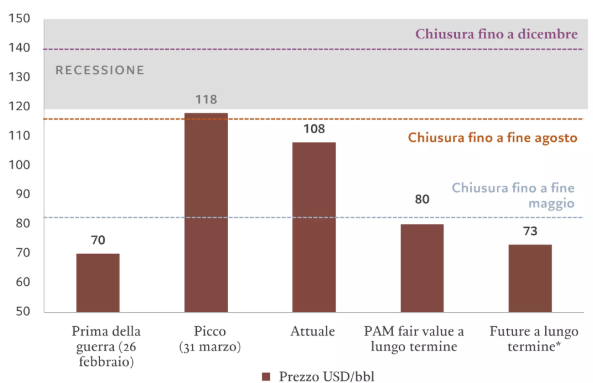
PAM fair value based on an estimated $15 increase in the minimum crude oil price (relative to the pre-war period) due to inventory reductions and tighter demand-supply balance. Recession period threshold based on a 50% deviation from the real oil price trend. Data as of 04/28/2026.
* 36-month forward contract.
Our liquidity indicators provide some cushion for riskier assets and support our decision to increase exposure to certain equity markets. The lack of clarity on the duration of the inflation shock and governments’ scope to mitigate the effects of rising energy costs leads central banks to signal readiness to tighten monetary policy, though they are in no hurry. Global liquidity is growing by about 7.4%, one percentage point above the historical trend, thus supporting valuations.
The Federal Reserve has stopped cutting interest rates (and we do not expect further moves this year), but private sector liquidity remains ample despite recent turmoil. We believe this is because the main debtors in the U.S. economy (government, AI-related companies, and wealthier consumers) are not particularly sensitive to interest rate changes. Moreover, recent corporate earnings reports confirm that bank balance sheets are healthy and well insulated from turbulence in weaker credit market areas.
Valuation indicators also justify taking on additional risk. Despite a strong rebound in equity markets, valuations do not appear excessively high. Global equities trade at a 12-month forward price/earnings ratio about 10% below the October 2025 peak, while government bond yields have risen by around 40 basis points on average over the same period.
Corporate earnings momentum remains favorable. The earnings season has been solid, especially in the U.S.; the earnings growth rebound has been driven mostly by the technology, financials, and materials sectors.
Technical indicators also suggest sentiment has improved compared to a month ago. Retail and institutional investor sentiment has firmly returned to bullish territory. But again, there are no signs of excessive exuberance: net leverage is below average and investors pay close attention to volatility, as shown by options dynamics.
In this context, our conviction is that equity markets still offer selective opportunities for investors willing to distinguish between areas of structural strength and segments more vulnerable to the cycle. Earnings strength, abundant liquidity, and AI momentum represent an important anchor in a phase still characterized by high geopolitical uncertainty. We continue to monitor the conflict’s evolution and its macroeconomic repercussions, ready to adjust positioning should the outlook change significantly.
GLOBAL MARKET OVERVIEW: OPTIMISM FOR AI FUELS A STRONG RALLY
Global equities rose nearly 10% in local currency in April, recording one of their strongest monthly gains since late 2020. Growing optimism about the end of hostilities in the Middle East and strong earnings from major U.S. tech companies helped stocks rebound from March’s sell-off. IT and communication services stocks led this growth with gains of nearly 20% and 15%, respectively, after their latest earnings reports indicated that significant spending on data centers and AI-related digital infrastructure was beginning to pay off. Industrial sectors grew by almost 9%, supported by improving manufacturing trends and moves by the U.S. and other major economies to repatriate their manufacturing base. More defensive sectors, such as energy and healthcare, closed the month in the red.
Emerging market equities posted the best performance. Asian stocks rose 16%, as the region, home to some of the world’s largest chip producers, benefited from renewed AI-related trade activity. Bonds mostly ended the month flat.
Developed market sovereign bonds fell, as inflationary pressures following the war in Iran raised concerns about potential tightening responses from major central banks. Markets now expect the world’s four main developed central banks to raise rates this year. Japanese government bonds lost nearly 1% as rising oil prices increased inflation fears, pushing the benchmark JGB yield above 2.5% for the first time since 1997.
In contrast, emerging market bonds rose broadly, supported by a weaker dollar, robust growth in developing economies, and improved investor risk appetite. In credit, both emerging market corporate bonds and high-yield bonds generated positive returns, supported by improved risk sentiment and steady demand for high-yield assets.
Finally, in currency markets, commodity-linked currencies saw a broad rally; the biggest gains were recorded by the Russian ruble, Brazilian real, and Australian dollar. The dollar resumed its decline (down nearly 2%) in addition to the almost 10% drop in 2025. In summary, fixed income today offers a more nuanced picture than recent volatility might suggest. Developed market bonds remain under pressure, caught between inflationary forces and slowdown risks, while local currency emerging market debt remains the most attractive choice for those seeking real yield and potential currency appreciation. In an environment still uncertain, selectivity remains key to navigating global markets over the coming months.




