


The Ferretti shareholders’ meeting concluded today with the victory of the list presented by the majority shareholder, the Chinese state-owned group Weichai, which owns 39 percent of the shares and received 52 percent of the votes of those present.
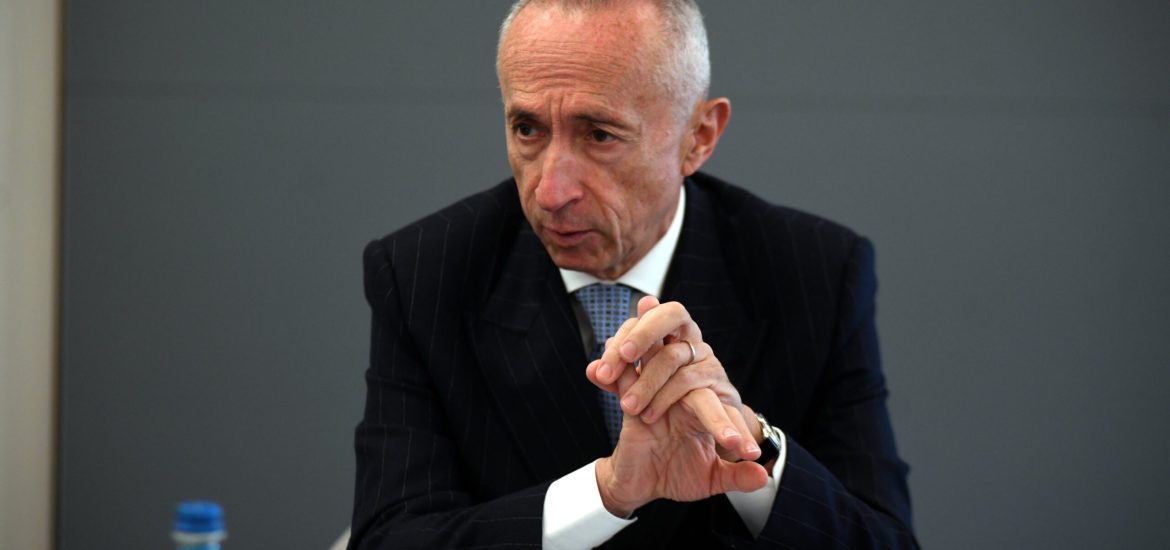
The defeat of the Swiss-Czech fund Kkcg – which holds 23.2 percent of Ferretti and was supported by 47 percent of the voters at the meeting – will have major repercussions on the future of the Forlì-based luxury yacht builder: CEO Alberto Galassi (in the photo) will be replaced and two key company directors, Piero Ferrari and Stefano Domenicali, have already resigned in protest against the methods of Weichai and its allies.
ALL THE NAMES ON WEICHAI’S LIST FOR FERRETTI
Weichai’s list has a strong Chinese composition and names the current executive director Tan Ning as the next chairman of Ferretti’s board of directors. Galassi, however, was not confirmed: he will be replaced as CEO by Stassi Anastassov, a Swiss financier of Bulgarian origin who worked for thirty years at Procter & Gamble and is involved in several Chinese entrepreneurial ventures.
The three Italian names on Weichai’s list are fashion entrepreneur Federica Marchionni, former Democratic Party deputy Marina Berlinghieri, and the rector of the Politecnico di Milano Donatella Sciuto: the university is quite close to China, having signed collaboration agreements and strategic projects with about thirty Chinese universities.
The board will also include Patrick Sun, Jin Zhao, Zhang Xiaomei, and Zhu Yi.
Kkcg, on the other hand, will be assigned only one seat out of nine: it will go to Katarina Kohlmayer.
WHO WAS ON THE KKCG LIST
Kkcg’s list for Ferretti confirmed Galassi as CEO and proposed Karel Komarek, the Czech entrepreneur who chairs the fund, as chairman. The list also included Bader al-Kharafi (vice president of the Kuwaiti telecommunications company Zain), Piero Ferrari (vice president of Ferrari and Ferretti shareholder with 7.5 percent), and Stefano Domenicali (CEO of Formula 1).
KKCG’S PROTEST
After the meeting, Kkcg stated in a note that it contests the “validity” of the procedure: according to the fund, there are “serious concerns regarding the integrity and validity of the deliberative process” related to “possible concerted actions by shareholders connected to Weichai.”
The reference is to the recent entry into Ferretti’s capital – or the increase of their stake – by a series of Chinese shareholders or those close to Weichai, including Bank of China, one of the largest Chinese state banks. All these entities have kept their holdings below the 3 percent threshold to avoid triggering the notification obligation to Consob, the Italian authority overseeing the stock market: Bank of China, for example, owns 1.9 percent of Ferretti.
FERRARI’S HARSH LETTER
A few hours before the May 14 meeting, Piero Ferrari announced his resignation from Ferretti’s board – of which he was also a shareholder – with a letter in which he denounced his “frustration and disappointment” over Weichai’s behavior.
The Chinese group was not explicitly mentioned, but in the letter Ferrari explained how “several entities close to a faction [i.e., Weichai, editor’s note] seem to have adopted a strategy aimed at preventing such substantial discussion and voting” ahead of the meeting.
According to Ferrari, the recent acquisitions of Ferretti shares by Chinese or pro-Chinese entities “have been carried out in such a way as to appear outside all current regulatory thresholds.” For this reason – he adds – the Presidency of the Council of Ministers “could question the legitimacy and compliance with current laws” of these operations.
“I can no longer associate my name and the history my name represents, for the Italian industry, with this company,” he writes.
AND NOW?
It is unclear what Weichai’s plan for Ferretti is.
Galassi wanted a greater focus on developing the Security & Defence division (currently marginal compared to overall revenue), on new acquisitions at the European level, and on the production of large yachts.
Weichai may have other plans, however: Galassi had explained that the Chinese group was “resistant to acquisition operations and proposals to develop the defense division.” After all, expansion into a sensitive sector such as defense could prove unfeasible for Weichai: the Italian government has already intervened with special powers in dealings between various Italian companies and their Chinese reference shareholders, as seen in the case of the tire company Pirelli with Sinochem.
Yesterday Kkcg, referring to the increase in Chinese shareholders’ stakes in Ferretti’s capital, had formally expressed its “concerns regarding compliance with applicable regulations, including possible failures to notify in relation to ownership and control of a company operating in sectors of strategic importance for national security and defense (golden power).”




