



The final judgment is postponed. But the provisional one is already quite clear. From the 2025 Annual Report of the Bank of Italy emerges an overall positive assessment of the Pnrr: the plan has supported economic activity, strengthened investments, and introduced improvements in public spending and procurement management. However, it does not turn it into a success story already concluded. For Via Nazionale, the Pnrr has produced visible results, but the real challenge remains open: understanding whether the effects will be lasting or if they will fade with the end of European funds.
THE PNRR REACHES THE FINISH LINE
The Plan is now entering its final phase. All projects must be completed by June 30, 2026, to allow for final reporting and examination by the European Commission. Only then will the last installment arrive, amounting to 28.4 billion euros.
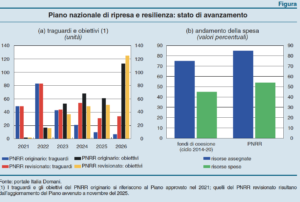
So far Italy has obtained about 166 billion euros, of which just over 60 billion in the form of grants. The installments already collected correspond to the achievement of 261 milestones and 155 targets. According to Bank of Italy, almost all results related to reforms and over 60% of those related to investments have been achieved.
Pnrr: progress status
Source: Italia Domani portal
A significant point concerns the numerous changes made to the Plan over the years. Bank of Italy does not interpret them as a sign of failure. On the contrary. Via Nazionale presents them as the result of a confrontation with reality: increased costs, objectives to recalibrate, measures to replace or strengthen. Essentially, a Plan corrected along the way to make it more feasible, not a Plan called into question.
The latest revision, approved in November 2025, did not change the overall amount of resources but redistributed part of it. About 24 billion were transferred to instruments that only require activation by the Plan’s deadline, thus allowing the use of resources until 2029.
THE CONTRIBUTION TO GROWTH
The Pnrr has not turned Italy into a European locomotive. GDP grew by just 0.5% in 2025. However, Bank of Italy includes the Plan among the main factors that supported economic activity along with less restrictive monetary policy, implying that without that boost the result would have been even weaker.
It is, however, in the Final Remarks that Governor Fabio Panetta (in the photo) outlines the most explicit assessment of the Plan. According to the head of Via Nazionale, between 2021 and 2025 Pnrr interventions exceeded 100 billion euros and contributed about 30% to the overall accumulation of investments.
Even more significant is the estimate of the macroeconomic impact. According to Bank of Italy, expenditures made so far have supported demand and increased the product level by almost one percentage point per year, on average, over the five-year period.
The effects are especially visible in public investments. In the last five years, the value of tenders for public works has averaged 3.6% of GDP, more than double compared to the previous decade. About one fifth of these interventions were financed or co-financed through the Pnrr.
The Plan has also supported growth in non-residential construction, infrastructure investments, and a significant part of employment in the construction sector.
THE BET ON INFRASTRUCTURE
Among the effects that Bank of Italy already considers observable is the strengthening of infrastructure. Indeed, Panetta highlights investments made in digital, railway, electrical, and water networks, indicating these interventions as one of the main results of the Plan.
This is an important point because it allows understanding how Bank of Italy views the Pnrr. Not as a cyclical measure destined only to support GDP in the short term, but as a program that should increase the productive capacity of the Italian economy.
Here, however, the institute’s caution also emerges.
Bank of Italy warns that a comprehensive evaluation of the effects will only be possible once the interventions are completed and, for some aspects, only in the following years.
In short: the money has been spent and investments have started, but it is still too early to know if they will produce a stable increase in productivity and potential growth.
PROMOTING THE PUBLIC MACHINE
More than on growth figures, Bank of Italy sees some of the most interesting results of the Pnrr in the functioning of the public machine. In its analyses, the Plan emerges as a sort of administrative laboratory that introduced more goal-oriented procedures, stricter monitoring mechanisms, and more effective incentives for the administrations involved.
Several numbers confirm this reading. At the end of 2025, 85% of the Plan’s resources had been allocated and 54% spent. The latter figure exceeds by almost ten percentage points that recorded by cohesion funds of the 2014-2020 cycle at a similar stage of implementation.
But the most evident improvement concerns public procurement. According to a study cited by Bank of Italy, tenders financed by the Pnrr had a winning probability close to 90%, almost twenty percentage points higher than similar contracts not connected to the Plan. Awarding times also decreased by about ten days, equal to a 19% reduction.
For the central bank, the result mainly depends on the incentive system embedded in the Pnrr. The conditionality of resources on achieving objectives pushed administrations to meet deadlines, while the use of qualified contracting authorities improved procedural efficiency.
An effect that was particularly marked in municipalities characterized by lower administrative quality.
THE REMAINING SHADOWS
However, the picture is not without shadows. Bank of Italy points out that limits persist in the administrative capacity of some public entities and strong territorial differences in the effectiveness of the state apparatus. Also on the reform front, the assessment remains cautious: interventions on competition had limited effects, while complexity and regulatory instability continue to weigh on economic activity.
Above all, Via Nazionale is careful not to consider the matter closed. “It is still too early to assess the effects on growth potential,” warns Panetta. “Much will depend on the ability to maintain continuity in the modernization effort.”
A caution that runs through the entire evaluation of Via Nazionale on the Plan.
AFTER 2026
The real test will come after 2026. Panetta considers a sharp slowdown in public investments unlikely but warns that the continuity of growth will also depend on the private sector’s ability to take over the Pnrr baton.
This is where the final assessment of the Plan will be played.




