

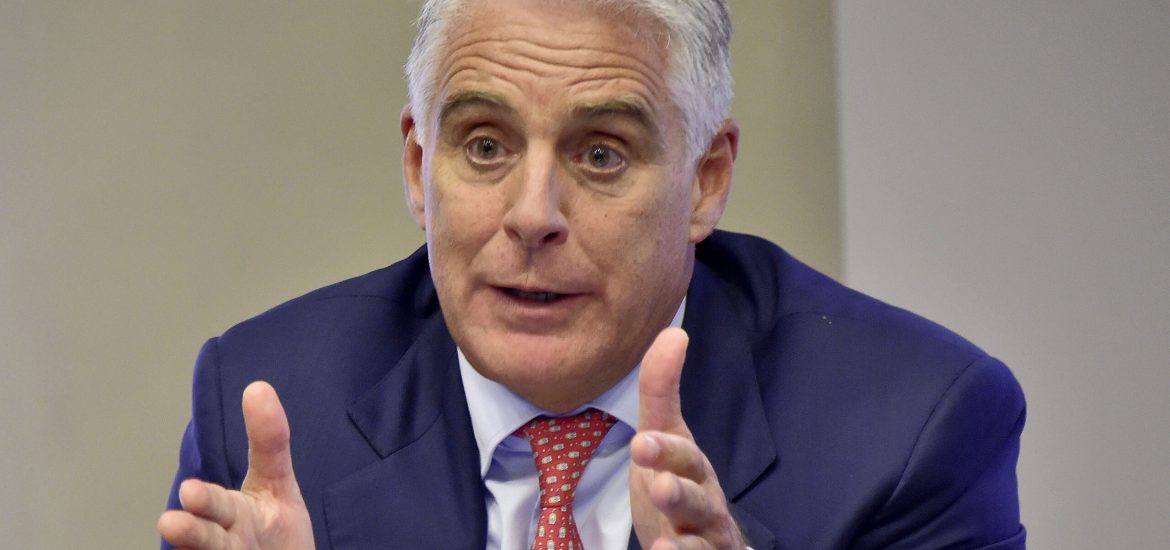

The carrot and the stick. This is the approach used by Unicredit CEO Andrea Orcel who, during this morning’s call with analysts, outlined the strategic proposals for Commerzbank. On one hand, he harshly criticized the German bank; on the other, he presented numbers, synergies, and growth prospects, also opening up the possibility of revising the public exchange offer launched in March. All this in a context of strong tension with Frankfurt and growing political opposition in Germany.
WHAT IS UNICREDIT’S PUBLIC EXCHANGE OFFER ON COMMERZBANK
To understand the scale of the clash, one must start from the operation. In March, Unicredit launched a public exchange offer (Ops) on Commerzbank valued at about 35 billion euros, aiming to exceed 30% of the capital and potentially gain control of the German institution. At least in one of the two scenarios disclosed today by Piazza Gae Aulenti.
The offer – with a limited premium compared to market prices (4% at the time of the announcement) – represents the culmination of a strategy started in September 2024, when UniCredit began building a stake in the Frankfurt bank.
The Ops will be submitted to Commerzbank shareholders in the coming weeks, and precisely in view of this step, UniCredit decided to publish its strategy for the German bank. A move far from neutral: it aims to convince the market that the operation creates value, but also to put pressure on the German management.
ORCEL’S DIAGNOSIS: “COMMERZBANK UNPREPARED AND UNDERPERFORMING”
The starting point of Unicredit’s offensive is a harsh diagnosis. Orcel does not mince words: “Commerzbank’s story is one of underperformance. Growth has been weak and investments for transformation have been limited,” he said on the call.
Not only that. According to Unicredit, the German bank “is not adequately prepared to face future challenges” and is “overly focused on achieving short-term results.”
In the strategic document from Piazza Gae Aulenti, there is talk of “structural weaknesses” and operational performance below competitors, driven more by external factors than by real transformation.
According to Unicredit, Commerzbank is “too dependent on risky bets” and on non-core international growth, while the domestic business remains fragile. This raises doubts about Commerzbank’s ability to generate sustainable results in 2028 and beyond.
Hence the need, according to Orcel, for a profound transformation.
UNICREDIT’S PLAN: +600 MILLION BY 2028 AND 6 BILLION BY 2030
Following the criticism comes the proposal. Unicredit claims that by applying its model, the German bank’s net profit could rise from about 4.5 billion to 5.1 billion in 2028, i.e., 600 million more. And reach about 6 billion by 2030.
In the full integration scenario, the combined group could generate about 21 billion in net profit by 2030.
The plan rests on a clear industrial transformation: refocusing on Germany and Poland, reducing non-strategic international activities, investing in technology and artificial intelligence, and strong cost discipline. The goal is to replicate the model already applied by Unicredit with HypoVereinsbank, considered the “virtuous twin” compared to Commerzbank.
In summary, it is about “changing the story” of the German bank, moving from growth driven by external factors to structural and sustainable growth.
TWO SCENARIOS FOR THE OPS AND THE PRICE ISSUE
Orcel then clarified the possible outcomes of the Ops, outlining two scenarios. In the first, Unicredit remains below the control threshold: a “manageable” situation if it guarantees returns above the cost of capital, with a net yield over 20%.
In the second scenario, Piazza Gae Aulenti obtains control, achieving a “strategically and industrially valid transaction.” Both cases, Orcel said, “are a win for Unicredit.”
And here comes into play the possible revision of the offer. “The outcome depends on the level of acceptance… and on greater transparency from Commerzbank,” which could affect a revision of the terms.
But the CEO was clear: “We would consider a revision only after a serious and detailed discussion with Commerzbank, which has not taken place.”
He also added an important element about the price: the payable premium is limited by several factors, including the required capital and an assessment of the German bank “not supported by fundamentals.”
The missed dialogue between Unicredit and Commerzbank
The clash between the two banks emerges clearly on the issue of dialogue. Orcel said he “did everything and more to have meaningful interaction” in the last 18 months. “We couldn’t do it, so we had no other choice,” he said, explaining that Unicredit had to rely on external analyses.
A version that coincides with what Bloomberg reported: the publication of the strategic plan was decided precisely after the failure of talks.
On the German side, however, the reading is different. CEO Bettina Orlopp spoke of “disagreements” on the business model and defended the stand-alone strategy. The Financial Times highlighted how contacts between the two banks were limited and without real progress, with Commerzbank not considering it useful to deepen the integration proposal.
The result is a de facto broken dialogue, which pushed Orcel to address the market directly.
GERMANY AT THE CENTER AND STANDALONE BANK UNTIL 2028
Among the reassurances offered by Orcel, there are two crucial ones.
First: even in case of acquisition, Commerzbank “would remain an independent bank until 2028,” because “time and work” are needed to align it industrially and culturally.
Second: with integration, Germany would become “the group’s primary country,” with almost all decisions made locally.
A relevant political passage, designed to address German concerns.
“IT IS WHAT EUROPE NEEDS”
Orcel then broadened the discussion to the European context. The merger, he said, “is the kind of institution that both Germany and Europe increasingly need”: a stronger, more efficient group capable of competing with American banks and fintechs.
A message that fits into the debate on European banking consolidation and the need to create continental champions.
GERMAN RESISTANCE AMONG POLITICS, UNIONS, AND THE BANKING SYSTEM
But it is precisely on this ground that the main resistance focuses.
As reported in recent weeks by Startmag, the Unicredit-Commerzbank operation has encountered broad and cross-cutting opposition in Germany. The federal government – the bank’s second-largest shareholder – has expressed opposition to the Ops, fearing loss of control over an institution considered strategic for financing German small and medium-sized enterprises.
Unions are also opposed, concerned about employment impact, as is part of the German banking system, which sees the operation as a risk to the national sector’s balance.
Added to this is Commerzbank management’s position, which continues to defend independence and the validity of the “Momentum” plan, rejecting the idea of a merger.
The result is a united political and industrial front, making the operation particularly complex.
A GAME OPEN BETWEEN FINANCE AND POLITICS
The feeling is that the game has just begun.
On one side, Orcel is increasing pressure, criticizing Commerzbank’s strategy and trying to convince shareholders with numbers and scenarios. “We will be happy to correct what needs to be corrected,” he said, implying that the plan is open to revisions but only in the presence of a real confrontation.
On the other, Berlin and Frankfurt remain entrenched.
In the middle, the shareholders, called to choose between continuity and transformation.




