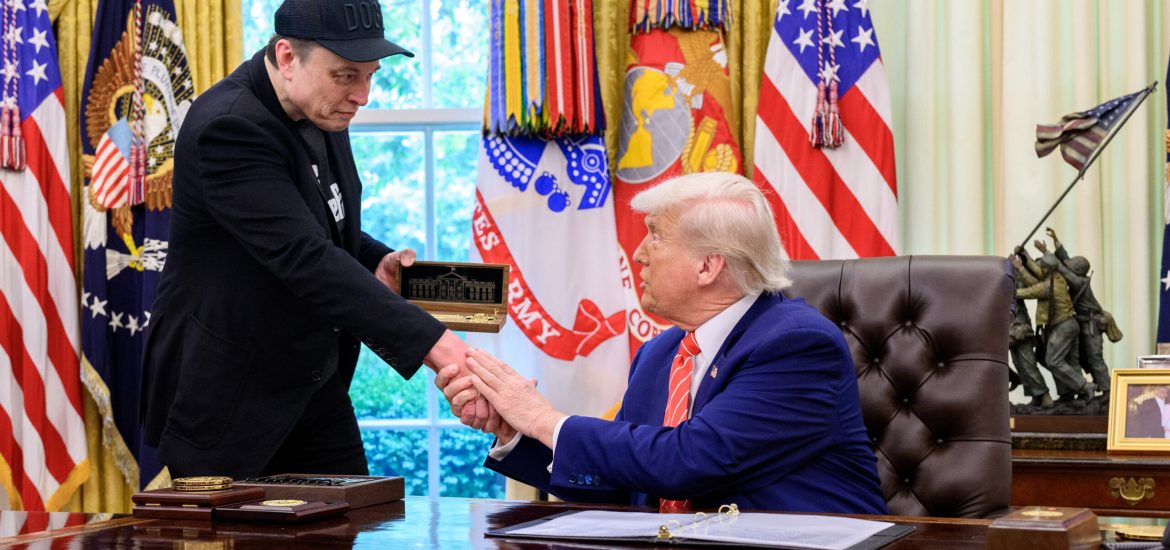

President Donald Trump surprised (almost) everyone by announcing that the federal government is considering acquiring equity stakes in leading AI companies to allow Americans to become direct beneficiaries of the technological revolution.
The idea, already discussed with company executives and set to be further explored in a White House meeting next week, stems from the need to address growing discontent towards AI: fears about jobs, the impact of data centers, and wealth concentration in the hands of a few.
A proposal from the US president that creates unprecedented alliances, from Senator Bernie Sanders to MAGA populists, and risks redefining relations between Washington and Silicon Valley on the eve of the midterm elections.
Trump’s announcement
On Friday, speaking aboard Air Force One, Trump openly described the possibility of a “partnership” in which “pieces of AI companies” would be allocated to the American public, as reported by Bloomberg.
The president added that he has already spoken with the companies and has summoned their leaders to the White House next week.
The goal, Trump explained, is to ensure that “the American people can benefit from AI’s success” and, consequently, appreciate this technology more.
As the Financial Times writes, the move fits into the administration’s “America First” industrial strategy, which has already led the government to take stakes in strategic sectors, including a 10% stake in Intel for $9 billion, as well as startups in rare earths and quantum computing.
The origins of the proposal
The recent acceleration came from the left. As reported by the Financial Times, Bernie Sanders proposed a one-time 50% tax on AI lab shares to fund a sovereign wealth fund that redistributes the earnings. “It would ensure that the trillions created by AI improve the lives of all of us,” the senator stated.
As reported by the Associated Press, Sam Altman met with Sanders this week on his initiative. The OpenAI CEO expressed agreement with the principle of public ownership, though without endorsing the 50% threshold, and said he was willing to work together to promote the idea.
This is not new: according to CNBC, talks between Altman and the Trump administration about a possible equity donation or government stake have been ongoing for over a year.
Already in April, OpenAI published a document proposing a “public sovereign fund” to give every citizen a share of the growth generated by AI.
The debate in America
Trump’s proposal has united usually distant figures. On one side Sanders and the progressive left, on the other populists concerned about the impact on workers.
According to the FT, Steve Bannon showed conditional support, while Trump noted that on economic issues, his base and Sanders’ “are not that far apart.”
As Politico highlights, the president sees this path as a way to gain the support of an increasingly skeptical and uneasy public opinion. Concerns about AI’s consequences are widespread and concrete.
The criticisms
Opposition is not lacking. David Sacks, former White House AI lead and venture capitalist close to Trump, harshly attacked the idea, calling it “nationalization of AI” that would accelerate the “corporate-government fusion” and risk creating a Chinese-style social credit control system.
Other experts, including Samuel Hammond of the Foundation for American Innovation, warn that a state stake, however sensible on paper, could open the door to political favoritism and corruption.
As Bloomberg notes, the mechanisms remain to be defined: voluntary donation of shares, direct purchase, or other. The cost would be high, considering that OpenAI, Anthropic, and similar companies aim for trillion-dollar valuations with imminent IPOs.
Precedents, timing, and stakes
The Trump administration has already broken several taboos by taking direct stakes in private companies, starting with the Intel case. However, entering the capital of AI labs still operating at a loss would represent an unprecedented step.
The timing is anything but casual: five months before the midterm elections, polls show an electorate increasingly uneasy about the economy and the effects of AI.
As the Financial Times observes, Republicans fear losing ground precisely within the MAGA base. Offering Americans a tangible slice of the generated wealth could prove a politically effective move.
Operational details – equity percentage, form of distribution to citizens, role of Congress – still need to be defined. The CEOs of the major companies will have the opportunity to discuss the matter directly at the White House.
Beyond the technical aspects, this discussion reflects a deeper change: AI is no longer just a technological issue, but a force reshaping society, work, and power balances. Whether it leads to true wealth sharing or the announcement remains a political signal, one thing is clear: Washington no longer intends to leave AI exclusively in the hands of the private market.