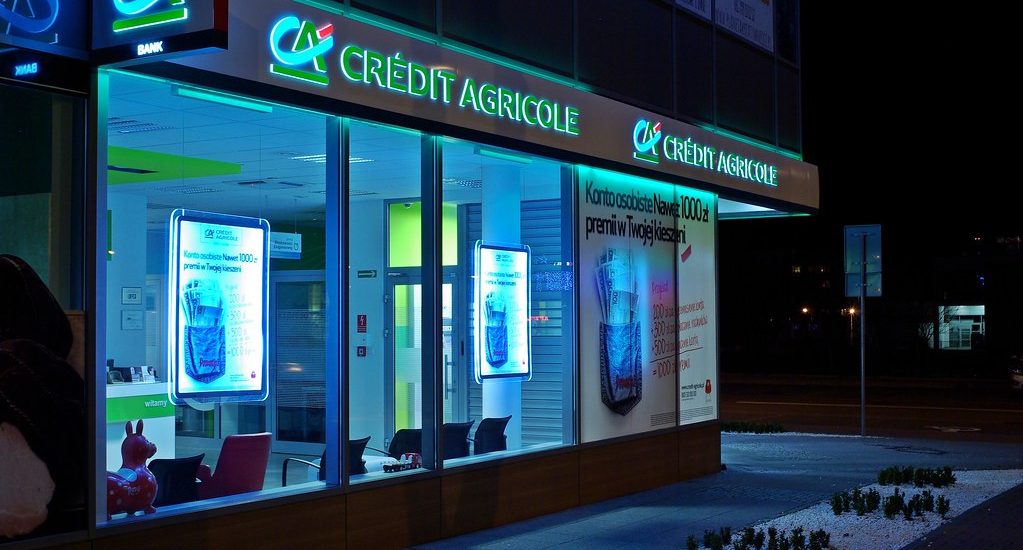

Crédit Agricole enters the game for Banca del Mezzogiorno (formerly Popolare di Bari) and inserts itself into the Italian banking risiko. From Paris came a letter of intent for the institution controlled by the Treasury, a signal confirming how Italy remains a privileged ground for the expansion of French finance. On the table is not only a bank that has been restructured and returned to profit, but a strategic piece in the mosaic of credit in the South and, more generally, in the European sector balances.
AGRICOLE TARGETS BDM, OPEN GAME
According to MF, Crédit Agricole has formalized its interest in Bdm, the institution saved in 2020 by Mediocredito Centrale with a total intervention of 1.6 billion euros also supported by the Interbank Deposit Protection Fund. Today the bank is back on track: net profit of 31.83 million in 2025, up 42%, and a network of about 190 branches concentrated between Puglia, Campania and Abruzzo. It is precisely this territorial presence in the South that represents the true industrial value of the institution.
The dossier is managed by the Ministry of Economy, which controls the institution through Invitalia, and now aims at privatization. The goal is to value the Bari bank around 600 million euros, a figure in line with net equity but considered ambitious by some operators, also in light of still contained profitability, with ROE around 5.7%.
It is not only the French group. Credem and the Iccrea-Popolare di Puglia e Basilicata tandem are also in the race, while the Unicredit unknown remains in the background, which could enter later. Binding offers are expected in May, with the aim of reaching an exclusivity phase in autumn and closing the operation by the end of the year.
The dossier also hovers over the possibility of golden power intervention, while opposing pressures towards European banking consolidation come from Brussels. A delicate balance between market opening and protection of strategic assets.
Moreover, the former Banca Popolare di Bari, as reported by Startmag , has recently returned to the headlines also for the case of the Fiore di Del Deo team, an element that has brought attention back to the institution even outside strictly financial dynamics.
THE ITALIAN RISIKO AND THE FRENCH MOVE
The interest in BdM fits into a broader strategy. The French presence in Italian credit is not new and has already taken on significant dimensions. Bnp Paribas is historically one of the main foreign operators (the French group controls Bnl), but in recent years it is especially Crédit Agricole that has accelerated.
The key dossier remains Banco Bpm. The French group is today the largest shareholder with a stake that has risen again, to 22.9%, with ECB approval to reach up to 30%. A gradual growth, started in 2022 with about 5% and continued without shocks, consistent with a declared long-term strategy.
The presence in the capital has also translated into a growing weight in governance: four directors on the board and an increasingly incisive role in industrial decisions. Alongside the continuity guaranteed by Giuseppe Castagna and Massimo Tononi (confirmed as CEO and chairman), the French component has been strengthened with key figures such as Frédéric Marie de Courtois and former Economy Minister Domenico Siniscalco. A clear signal: not only financial participation, but direct control of decision-making levers.
This is not a detail. Banco Bpm is a central hub in the Italian risiko. Luigi Lovaglio’s rise on the Mps board and relations with Piazza Meda fuel hypotheses of possible aggregations, both direct and within more complex combinations.
On the political-industrial level, hypotheses of a third banking pole also intertwine, supported by part of the political world. A project that would see Banco Bpm and Mps as pivots, with reflections also on Mediobanca and Generali.
The French strategy fits into this scenario. On one hand, a strong equity presence; on the other, the possibility – at least theoretical – of transforming it into a direct industrial foothold, also through possible asset swaps. A hypothesis circulating in financial circles and confirming how central Banco Bpm is in long-term plans.
Clotilde L’Angevin clarified the approach regarding Bpm in an interview with Bloomberg Tv: Crédit Agricole wants to be “a long-term partner,” aiming at value creation and maintaining a constructive approach. More generally, “our strategy in Italy is focused on Banco Bpm but also on organic growth linked to Crédit Agricole Italia.”
BUILDING THE “SECOND ITALIAN HOME”
Italy is now the second domestic market for Crédit Agricole. The numbers tell of a structural presence: about 2.8 million customers, over 1,200 points of sale and more than 12,500 employees. A complete platform, covering commercial banking, consumer credit, corporate, asset management and insurance.
THE ACCOUNTS AND MARKET REACTION
At the consolidated level, Crédit Agricole closed the first quarter with a net profit of 2.1 billion, up 5.5%, and revenues at 10 billion. However, results were slightly below analysts’ expectations and the stock reacted poorly on the stock exchange, with a drop of about 6% in Paris.
Weighing, as with other French banks, were especially the increase in risk cost, which rose to 31 basis points with provisions also linked to the conflict with Iran and geopolitical tensions, as well as capitalization below expectations.
Despite this, the Italian contribution remains significant, also thanks to the 111 million deriving from the participation in Banco Bpm.
THE FRENCH PUSH ON ITALY
The BdM case is just the latest piece of a now structural French presence in the Italian economy. According to a Kpmg November 2025 research for Corriere della Sera, in the last 25 years French companies have acquired Italian companies for 97 billion euros through 770 operations. In the last ten years the deals were 555 for 38.4 billion.
Paris is today the second foreign investor in Italy after the United States, but the first if the weight of investments is related to GDP. A widespread presence, ranging from finance to industry, from luxury to services.
In this context Crédit Agricole represents the spearhead in the banking sector. And the interest in Banca del Mezzogiorno strengthens a clear design: consolidate territorial control, expand the network and play a leading role in the reshaping of Italian credit.
The risiko is open. And the banque verte continues to move its pieces.