



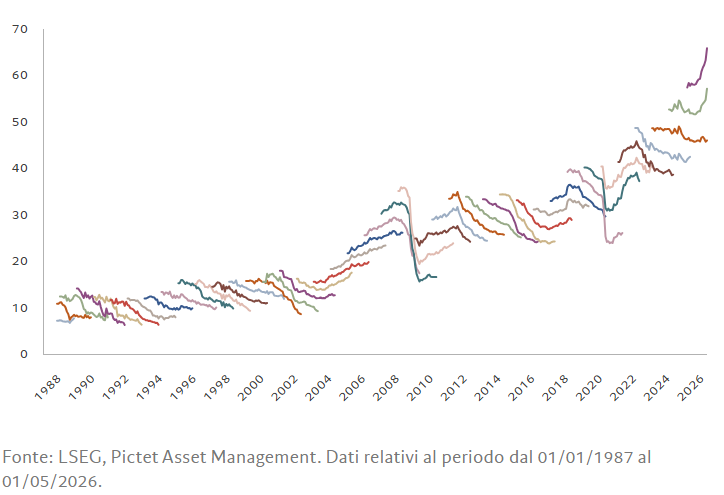
Companies worldwide are experiencing an extremely positive period. A fact hard to reconcile with the ongoing fragile ceasefire between the United States and Iran and also seemingly incompatible with the peak in energy prices and inflation. Yet, the numbers speak for themselves. Our calculations show that, on average, corporate earnings per share exceed consensus forecasts by a margin that is the highest in the last four years, while analysts are raising their earnings estimates at the fastest pace since 2004 (see Fig. 2). Company revenues are equally healthy. All sectors represented in the MSCI equity index show revenue growth above expectations.
These fundamentals cannot be easily ignored. Companies clearly have greater pricing power than previously thought, which should strongly support equity markets in the medium term. For these reasons, we have raised US equities from underweight to neutral.
Fig. 1 – Monthly asset allocation grid
June 2026

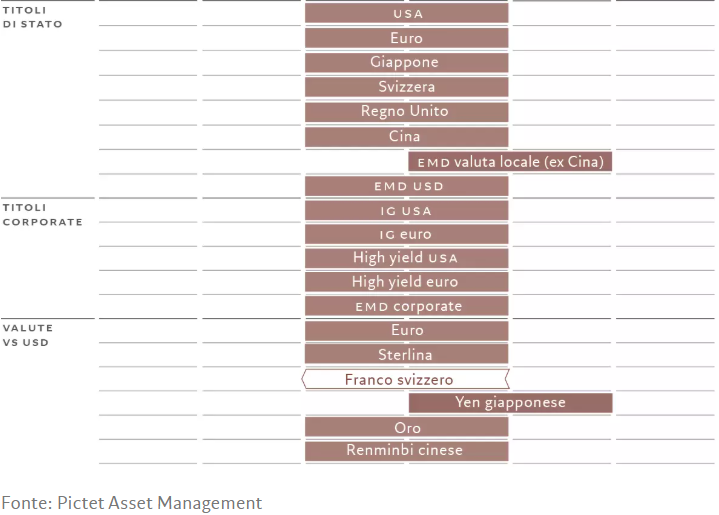
However, while the effect of inflation is positive on equities, its impact on bonds will likely be negative, despite the recent rise in yields. The increase in energy costs is adding price pressures in the United States, Europe, and Japan, raising the likelihood of rate hikes by central banks in the coming months. This could push government bond yields even higher. Taking this into account, we have moved bonds to underweight.
Our economic cycle indicators point to moderately favorable conditions. In the United States, the highlight is capital expenditure, growing at an annual rate of 10% (more than double the average rate of 4.5%) thanks to AI-related investments. This increase in spending more than offsets weakness in other parts of the US economy, such as residential investments, which have declined recently. However, further increases in energy costs would weigh on consumer spending, which in the US depends on oil more than many other developed economies.
In Europe, meanwhile, the economy appears in decent shape, although official GDP growth estimates have been revised downward following the peak in energy prices caused by the Middle East conflict. That said, it seems the rise in energy prices is not pushing up prices of other goods and services.
The Chinese economy presents a mixed picture. Exports remain a growth driver, but consumer spending is weak (its growth rate aligns with GDP), while activity in the real estate sector remains sluggish. Signals emerging from other developing regions appear more encouraging. We believe the resilience of emerging economies is improving, as demonstrated by the currencies of oil-importing countries, which typically suffer sharp declines during energy price spikes but have fallen three times less than in previous oil shocks.
Fig. 2 – Earnings optimism
Consensus estimate of earnings per share for the fiscal year – MSCI ACWI
Our liquidity indicators suggest maintaining an overweight position on equities considering the monetary easing in China, which has strongly boosted the money supply. We expect further interest rate cuts by the People’s Bank of China during the year. However, this easing could be offset elsewhere by tightening, thus reinforcing our underweight position on bonds.
In the United States, prices are rising at a pace that could push inflation to twice the Federal Reserve’s 2% target, making a rate hike increasingly likely. Higher interest rates are also probable in Europe, although we expect policymakers to act less aggressively than currently priced by the market. Monetary conditions also appear set to tighten in Japan.
Our valuation indicators suggest that equity rallies could soon lose momentum. Emerging Asian stocks are now among the most expensive on our global scorecard, while Swiss equities are among the cheapest. Regarding industrial sectors, financial and healthcare stocks are the two most attractively valued, while technology remains expensive. Given the recent rise in yields, bonds are mostly fairly valued, while among commodities gold stands out as particularly expensive.
Technical signals have become broadly positive for equities. Investor surveys indicate bullish positioning and sentiment for US stocks, but not excessively so, suggesting there is room for further rally. Our analysis also shows that a potential increase in initial public offerings in the pipeline (a development currently underway in the US) would not reliably indicate a stock market peak as widely feared, but rather could lead to short-term gains.
REGIONS AND EQUITY SECTORS: CONCENTRATION DOES NOT HINDER FUTURE GAINS
The market turbulence seen during the early stages of the war in Iran now seems a distant memory. Nearly three months into the conflict, equities are showing increasing strength. AI-related stocks have posted double- or triple-digit gains and helped push major benchmark indices to record levels. There are reasons to believe this rally can still continue. This depends not only on earnings strength but also on margin resilience. The average net profit margin of US companies is expected to rise from the current 15% to 16% next year and 17% in 2028. We also trust in the likelihood that companies will sustain margin expansion in the medium term. In turn, solid earnings help keep valuations in check. The median valuation of US equities is 17.7 times 12-month earnings, below last year’s peak of about 20 times and well below levels reached during the COVID pandemic. The fact that the rally is driven by only a handful of tech companies may worry some investors: the number of stocks outperforming the S&P 500 is the lowest since at least 2007 (see Fig. 3).
Fig. 3 – The concentration paradox
S&P 500: % of stocks outperforming the index over the past 10 weeks
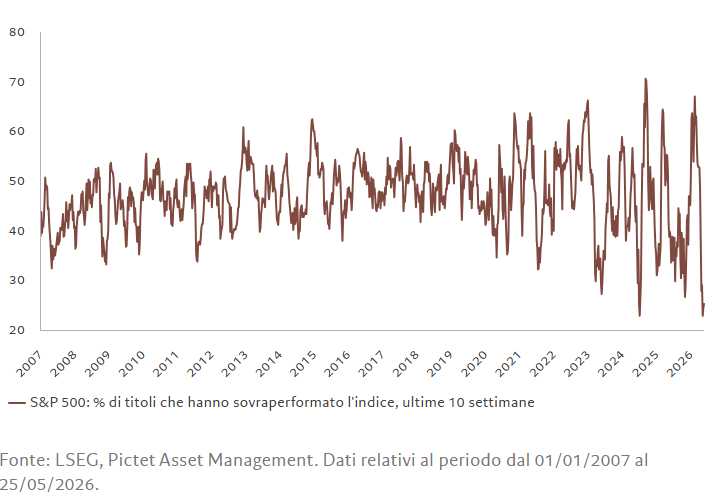
However, our analysis of similar past episodes shows that high concentration and narrow market leadership have not hindered future equity returns, as a broadening of the rally can support gains[1].
Strong primary market activity signals a robust risk appetite. The wave of mega initial public offerings could push US equity fundraising beyond the 2021 record of $156 billion, and there is great anticipation for the listings of OpenAI and Anthropic. IPO momentum is also accelerating in Hong Kong, where 350 companies are scheduled. Technology stocks are among our highest convictions. Persistent bottlenecks along the AI value chain, particularly in memory chips, strengthen these companies’ pricing power and provide them with robust operating cash flows. We also overweight the industrial sector, which benefits from increased global infrastructure spending and electrification initiatives. Our regional positioning focuses on markets with the strongest earnings dynamics. We overweight the United States but remain neutral on Europe, Switzerland, and Japan, where corporate earnings growth is lower than in the US.
We also continue to overweight emerging markets, excluding China. Many developing countries, especially in Asia, have shown remarkable resilience to the energy crisis. These economies have already recorded strong growth and low inflation, making them less vulnerable compared to past energy shocks. In Korea and Taiwan, the increase in AI-related exports has offset the impact of rising oil prices, helping keep business conditions broadly stable. We move China from overweight to neutral due to weakness in domestic demand and the real estate sector, as well as short-term indicators signaling risks to growth and corporate profitability.
Source: Bloomberg, Pictet Asset Management. Semiannual price data as of end June and December. Data as of 05/22/2026


