“Words are important” is the iconic line from Nanni Moretti. Sometimes silences are important too. Kevin Warsh began his tenure at the Federal Reserve with a clear choice: to withhold words from the market, avoid explicit indications on the path of interest rates, and make no attempt to guide expectations. Warsh’s new era could mark the end of the “forward guidance” era, one of the most influential tools of monetary policy over the past fifteen years. After the 2008 financial crisis, and even more so during the years of near-zero rates, the Fed had guided market expectations also through the anticipation of its future intentions. In these years, words have been almost as important as the rates themselves.
FROM FORWARD GUIDANCE TO THE POLICY OF SILENCE
In Warsh’s Fed, the principle seems destined to be reversed. The new central bank president believes that sparing words is a tool that promotes market efficiency: fewer preemptive indications, fewer reassurances, fewer attempts to steer expectations.
“I don’t care how markets react in the first minutes, or even in the days after,” Warsh declared. Lapidary words that define the new communicative register of the central bank: a form of linguistic ecology that should lead analysts and investors to focus more on data and less on rhetorical nuances.
However, there is a risk: that operators and analysts raised in the era of forward guidance become a sort of modern Kremlinologists, forced to scour every comma of official statements in search of hidden signals, just like Western observers in the 1980s who tried to interpret the slightest lexical variations in Soviet Politburo documents.
In this extraordinary time also for monetary policies, central bankers’ words have become a tool of monetary policy, credibility also passes through clear communication, because the expectations of families, businesses, and markets directly influence the effectiveness of rate decisions. Bernanke and Powell represented the era of forward guidance, Warsh’s era presents itself to the market with a drastic reduction of preemptive indications.
So much so that in the first FOMC (Federal Open Market Committee, the Fed’s committee that governs rates) of Warsh’s era, the strongest signal did not come from words spoken but from an absence: the new president chose not to place his dot on the dot plot.
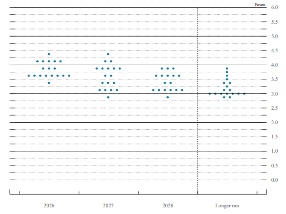
Source: Federal Reserve. The projections published with the statement showed that nine Board members expect an increase in funding costs by the end of 2026, a significant change compared to the latest March forecasts, when no one expected a rate hike this year. There were 18 estimates recorded; the new president Warsh’s estimate is missing. The forecasts highlight how the conflict in the Middle East has disrupted the US economy, pushing inflation to its highest level in the last three years.
INFLATION, RATES, AND THE COMPARISON WITH TRUMP
Regarding the words spoken, commentators focused on the determination with which Kevin Warsh reaffirmed the commitment to fighting inflation. A message interpreted as a signal of a possible monetary tightening: two-year Treasury yields, the most sensitive to rate expectations, rose to 4.22%, levels not seen for over a year.
Warsh reiterated the thesis he has long supported: inflation is determined by monetary policy, price stability is the central bank’s “north star,” and it is its duty to bring inflation to the target level. A restrictive stance that clashes with Trump’s wishes, who criticized Powell, not sparing even insults, because he did not decisively cut interest rates.
In the United States, the Federal Reserve’s preferred indicator, the PCE (Personal Consumption Expenditures), rose to 3.8% in April; in Europe, the European Central Bank raised rates after two and a half years and continues to maintain high attention to inflationary risks. The most significant unknown remains the Middle East: preliminary agreements between the United States and Iran have helped cool crude prices; if the agreement consolidates, the energy component of inflationary pressure could reduce significantly.
THE WEIGHT OF GEOPOLITICS ON CENTRAL BANKS
Relief, however, remains partial and conditional; partly due to news about ongoing negotiations, partly because Trump has accustomed us to a good dose of caution. In any case, the decisive variable is not the signing of an agreement but its durability over time, the full restoration of navigation in the Strait of Hormuz, and the return of oil prices stably below or around 75-80 dollars per barrel.
If a new price acceleration were to occur, governments of advanced economies would face a dilemma: on one hand, the need to support growth through countercyclical measures; on the other, the burden of public finances already under the close watch of “bond vigilantes.” In such a scenario, markets would be forced into a repricing phase, and central banks would return to moving on a slippery slope: raising rates to contain inflation or lowering them to support economic activity and markets. Central bankers are aware that weak stock markets reduce the confidence of families and businesses and end up slowing consumption and investment.
WHY MARKETS NEED TO RECALIBRATE EXPECTATIONS
The pattern that dominated the start of the year—declining inflation and progressively falling rates—no longer holds, and it is Kevin Warsh himself who warns that the cost of money could remain high longer than markets have so far priced in.
The unstable geopolitical context could lead central banks to consider 3% as a more realistic and sustainable inflation target; for heavily indebted governments, this would certainly be a breath of fresh air. “Three is the new two,” writes Katie Martin in the Financial Times; for bond investors, the implications would be significant: higher interest rates and, therefore, the need to recalibrate expectations on long-term yields.
The scenario suggests savers maintain a balanced approach. Wall Street valuations incorporate very, too, favorable expectations; the highlights prevail with excessive clarity over the shadows. In the short term, politics also comes into play: Trump aims to present himself at the November election with a narrative of successes and, on the domestic front, the stock market’s performance represents a fundamental piece.