



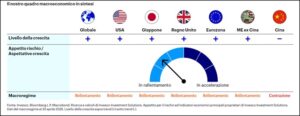
In May, our global macro regime remains in a slowdown phase. Growth above the long-term trend but decelerating. Investors have priced in considerable optimism related to a possible resolution of the conflict between the United States and Iran; however, uncertainty surrounding the negotiations persists and the economic repercussions of a significant disruption to global energy supplies are not yet known. Consequently, we remain in a slowdown regime, maintaining an overweight on equity risk versus fixed income. We remain well diversified in light of the still uncertain geopolitical context.
MACROECONOMIC CONTEXT
Global equity, credit, and government bond markets recorded sharply negative returns in March following the US invasion of Iran. The energy shock was historic and increased the risks of weaker global growth as well as higher inflation. As news evolved in April regarding various ceasefires and the potential reactivation of global oil supply, investor risk appetite recovered, though remaining on a slowing trend. Despite headlines moving asset prices on a daily basis, uncertainty related to oil supplies and key energy infrastructure remains central, increasing risks to global economic stability.
RESILIENT GROWTH AND SOLID EARNINGS
Economic growth, however, continues to act as a counterbalance to the headwinds stemming from higher energy prices, including their negative effects on consumer spending and sentiment. Companies have yet to report material consequences in terms of profitability and margins. At the time of writing, with nearly one-third of S&P 500 companies having reported earnings, the unadjusted net profit margin for Q1 2025 stands at 13.4%, a level which, if confirmed, would be the highest since 2009. (Source: FactSet, Earnings Insight, April 24, 2026.)
Looking ahead, the resilience of our economic indicators remains conditioned on the duration of the Middle East conflict and the time needed for oil supply to return to pre-conflict levels — two factors that remain uncertain and suggest caution in the short term. Consequently, with above-trend growth and a continued deceleration of global risk appetite, our framework remains in a slowdown regime.
The macroeconomic framework in summary
Source: Invesco
INFLATION AND THE ENERGY EFFECT
It is important to emphasize that, at the time of writing, the ongoing conflict does not signal an end-of-cycle outcome. Rather, the slowdown reflects a pause in cyclical momentum compared to the previous quarter, while market sentiment recalibrates in response to the current economic, fiscal, monetary, and geopolitical context. The current risk balance can also be analyzed through the lens of inflation, as higher energy prices continue to translate into more sustained inflation dynamics regionally. Our inflation momentum indicators remain positive, driven mainly by energy inputs.
Looking ahead, this dynamic complicates monetary policy prospects, particularly for central banks of energy-importing economies. Should key energy infrastructure in the Middle East continue to constrain global supply, the inflation risk would remain a significant threat to consumers and the economy as a whole.
US DOLLAR AND ECONOMIC SURPRISES
Although the regime remains unchanged, our signal on the US dollar this month shifts from negative to neutral. This change reflects the deterioration of international economic surprise data, which showed a marked weakening over the month. While leading economic indicators outside the United States remain overall above trend, they are slowing, with releases generally below expectations. These negative surprises have concentrated in regions more exposed to rising energy prices, particularly the Eurozone. With the ongoing conflict between the United States and Iran and the resulting restrictions on oil supply, negative economic effects have begun to emerge in energy-importing economies, especially in Europe.
Looking forward, regions most dependent on oil flows through the Middle East are more exposed to inflationary and growth risks should the conflict continue. Additionally, the spread between short-term US and non-US rates is narrowing, as rising inflationary pressures have forced global rate expectations to converge.
FED, RATES AND ASSET ALLOCATION
Previous accommodative expectations for the Fed have shifted toward a more restrictive stance since the US-Iran conflict began, with short-term inflationary pressures delaying expectations for rate cuts. This change has occurred alongside a more restrictive approach from other major central banks, with inflation concerns returning to priority. A further narrowing of rate differentials would strengthen the signal in favor of a positive bias on the US dollar in portfolio positioning.
As a result of our USD signal, influenced by the worsening of international economic surprises, regional equity positioning continues to evolve. Expectations of a stronger dollar support greater exposure to US equities at the expense of non-US equities, as well as a relative preference for emerging markets over developed markets. In the near future, should rate differentials continue to narrow as the trend suggests, this would support a further preference for exposure to the United States over developed ex-US markets, and for the latter over emerging markets.




