



The conflict in the Middle East has disrupted European economies, leading to higher inflation, potentially lower growth, and a stalemate for policymakers. Europe’s interconnectedness and lack of energy reserves have left it exposed to global market fluctuations. Furthermore, European capitals remain largely absent from Washington negotiations shaping Middle East energy stability.
Disruptions to summer air travel will hinder European tourism, a key north-south economic transfer mechanism within the Eurozone. Risks therefore clearly lean towards a worsening energy crisis as the conflict continues. Stagflation appears increasingly likely as supply constraints exacerbate demand destruction.
ECB TOWARDS FURTHER RATE HIKES
Consequently, we expect the ECB to raise rates in June and September, given its sole objective of preserving price stability. Already at the start of the Middle East conflict, ECB members were quick to highlight potential inflation risks to limit the total extent of hikes needed. The central bank stood firm in April, but discussions were firmly geared towards laying the groundwork for a hike at the next meeting. The experience of 2022 implies we will likely see a reversal of some of the 2024/25 cuts. However, following pessimistic growth outlooks, it would not be surprising if these moves were subsequently reversed in 2027.
BTPS UNDER PRESSURE AND RISKS FOR ITALY
Looking more closely at the performance of European government bonds, Italian BTP spreads have widened to over 75 basis points versus German Bunds and now rest on more unstable grounds given the post-conflict outlook. Political stability, efforts to consolidate debt, and the broadening of the regional investor base had brought BTPs to trade below 60 basis points at the start of this year.
As an energy importer in the Eurozone dependent on LNG, Italy remains structurally vulnerable and risks growth in 2026 slipping from +0.5% towards flat or negative territory if volatility persists. This year’s deficit risks widening beyond the 3% forecast. BTP volatility is high relative to historical norms, eroding the logic of carry trade on a volatility-adjusted basis. The government, elected in 2022, is under pressure for the first time and fuel price cuts signal political pressure to manage voter expectations, a temporary remedy only.
We consider it unlikely that pre-conflict valuation levels will be reached again in this context; that would require greater European integration over a much longer timeframe.
Italy: less debt… less growth
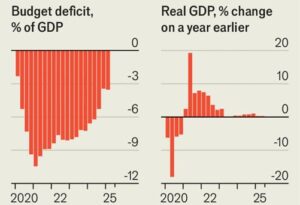
Source: Economist, April 2026
THE RESILIENCE OF EUROPEAN CREDIT SPREADS
However, despite the ongoing conflict and the continued accumulation of economic concerns, it is striking how European credit spreads remain resilient. The iTraxx Crossover index trades below 280 basis points, compared to the peak of 362 basis points recorded at the end of last month, when crude oil prices and German Bund yields were last at this level. During recession fears in 2022, spreads exceeded 600 basis points.
They remained above 400 basis points until the end of 2023. Current prices suggest substantial complacency, given intensifying headwinds. Retail flows into equities (especially in the US) are masking the deterioration of credit fundamentals, a disconnect unlikely to persist with earnings growth stalling and worsening energy shocks. From our perspective, this denotes an element of overconfidence, with risks for spreads in the region asymmetrically tilted upwards at this time.




