

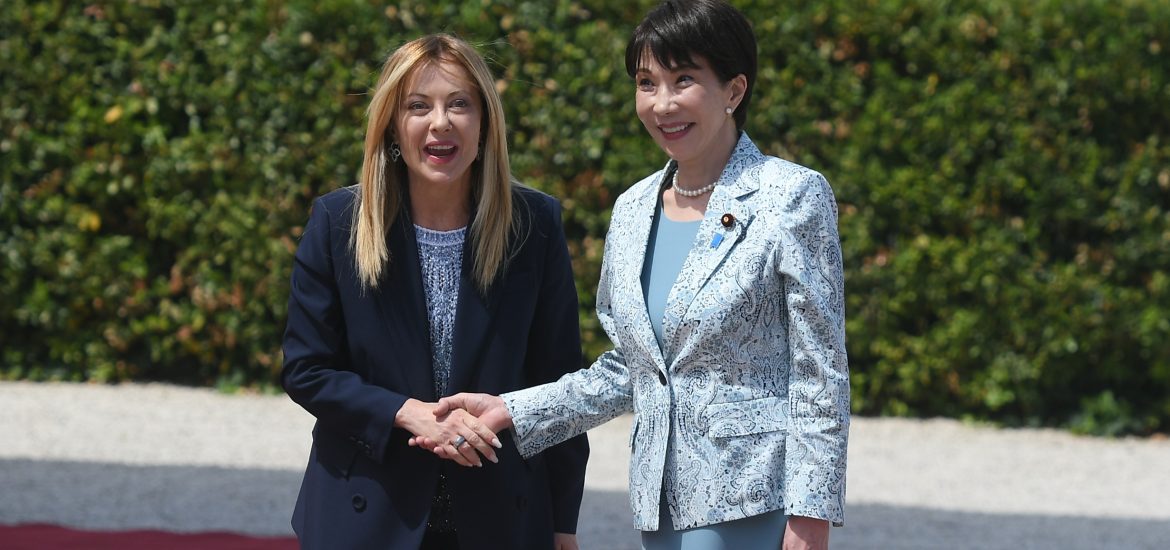

Italy and Japan are consolidating their special strategic partnership.
At the bilateral summit held at Villa Doria Pamphilj between Prime Minister Giorgia Meloni and Japanese Prime Minister Sanae Takaichi, the two leaders expressed their desire to intensify collaboration on multiple levels, from AI to biotechnology, from civil nuclear power to critical raw materials, also with an anti-China perspective.
The topics at the center of the meeting ranged from economic security to defense, from aerospace to semiconductors, to cooperation in Africa and advanced technologies.
The Prime Minister also stated that she is convinced that “Italy and Japan are naturally strategic allies destined to work together because they know that together they can impact the present and the future.” The meeting concluded with the signing of six cooperation documents and with Tokyo’s support for the Strait of Messina Bridge project.
All the details.
ECONOMIC SECURITY AND STRENGTHENING SUPPLY CHAINS AT THE CENTER OF THE DIALOGUE
One of the main topics on the table was economic security. Takaichi described the issue as a “fundamental problem for our countries,” recalling the agreement reached in January on mutual assistance in liquefied natural gas supplies in case of emergency.
“We discussed the actions the G7 should take to strengthen energy resilience,” Takaichi said during joint statements to the press at the end of the meeting. “Regarding economic security, including energy, a fundamental problem for our countries, I welcome today’s signing of an intergovernmental memorandum to strengthen resilience in supply chains,” Takaichi said. “We want to make strategic cooperation in the field of economic security even more comprehensive,” she reiterated. “In January, we talked about cooperation related to mutual assistance in the LNG sector in case of emergency,” she recalled. “Regarding semiconductors, concrete progress is being made in strengthening collaboration between institutions and companies from our countries.”
THE CHIP AGREEMENTS
Precisely on the semiconductor front, two new agreements were signed involving the Chips-It Foundation, the Italian center for integrated semiconductor circuit design. The first with the company Rapidus Corporation and the second with the National Institute of Advanced Industrial Science and Technology (Aist), one of Japan’s main public research institutions.
In particular, the agreement with the National Institute of Advanced Industrial Science and Technology will concern applied research activities on the study and design of so-called chiplets. These are systems composed of various microchips of different types, designed separately and then combined like ‘building blocks’ within the same package. This approach allows the construction of more complex, adaptable, and faster-to-develop components compared to other traditional systems designed as a single block. The goal of the collaboration is to develop these solutions and establish industrial standards in the coming years.
During the meeting, the Japanese Prime Minister also expressed concern about China’s restrictions on the export of critical minerals to Japan, highlighting the possible effects on global supply chains and urging European allies to send clear signals to Beijing also through concrete initiatives in the Indo-Pacific.
DEFENSE AND GCAP, TOKYO PUSHES THE ACCELERATOR
Cooperation in defense was one of the main dossiers of the summit. Takaichi announced the intention to accelerate work on the Global Combat Air Programme (Gcap), the joint program involving Italy, Japan, and the United Kingdom for the development of a sixth-generation air combat system.
As Breaking Defense recalled yesterday, the project had to face a period of uncertainty due to internal tensions between the UK Ministry of Defense and the Treasury, which, in collaboration with Prime Minister Keir Starmer, struggled to resolve a budget deficit. The signing of the contract for the program could therefore help alleviate the concerns of Gcap partners. Funding from London would indeed allow the three partners to sign a multi-year contract with industry covering design and development, after months of delays and diplomatic pressure from Tokyo. Last March, the Financial Times revealed that Japanese authorities were increasingly doubting London’s commitment to the project.
DEEPENING COOPERATION IN THE SPACE SECTOR
While the Gcap program is the core of collaboration between Italy and Japan in defense, the recent summit also produced new initiatives in the aerospace sector.
The Japanese Prime Minister emphasized that the two countries “are making progress regarding space cooperation.” “On this occasion, we published a joint declaration on space cooperation,” Takaichi highlighted. “Cooperation between aerospace companies is also advancing,” she said, referring “for example to measures against space debris and cooperation on satellite data.”
Italy and Japan also “recognize the need to promote stable and sustainable use of outer space and to protect space resources from natural and anthropogenic hazards, including orbital debris and solar particle events, as well as to strengthen planetary defense against potentially hazardous asteroids. Their respective competent authorities will collaborate, including in relevant multilateral forums, to develop coordination in the field of Space Situational Awareness (SSA). Recognizing the risks posed by the growing number of space debris in orbit, Italy and Japan will strengthen cooperation, including in international venues such as the G7, on debris mitigation and remediation. This will include their respective efforts to develop on-orbit servicing services, including Active Debris Removal (ADR), and enhancing collaboration on satellite collision avoidance systems.”
In this regard, a letter of intent was signed between Avio and a Japanese startup specialized in space debris removal, while a second agreement involves the Japanese company Synspective and the Italian e-Geos for cooperation in satellite data and related analysis activities, reports Agenzia Nova.
FOCUS ON LUNAR EXPLORATION
The joint declaration also includes a commitment to strengthen “collaboration in lunar exploration.” Italy and Japan “will intensify their collaboration in activities related to the realization of the multipurpose lunar habitation module and the pressurized rover, in coordination with NASA. Through their respective space agencies and industrial and research sectors, both countries will carry out joint activities” related to the International Space Station ISS (including the Calet cosmic ray telescope) and future space stations.”
Furthermore, “within the framework of cooperation on data exchange between Jaxa and Asi, Italy and Japan will strengthen their collaboration in Earth observation, to improve the mutual coverage of the two countries’ multiband images and contribute to disaster risk management.” In addition, collaboration in solar physics is planned to be deepened. To improve the acquisition of high-quality data, Rome and Japan “welcome the ongoing collaboration for the realization of the Solar-C mission aimed at studying the Sun and its mechanisms (plasma dynamics and solar wind).”
ENCOURAGING SCIENTIFIC COLLABORATION BETWEEN ROME AND TOKYO
The two parties also signed an intergovernmental document between the Japanese Ministry of Education and Research (Mext) and the Italian Ministry of University and Research (Mur) to promote scientific and technological collaboration. The agreement focuses particularly on artificial intelligence, robotics, and seismology.
FROM THE MATTEI PLAN TO COOPERATION IN AFRICA
During the talks, Meloni announced the intention to start “a structured bilateral dialogue” to create synergies between the Mattei Plan and the Tokyo International Conference on African Development (Ticad). The goal is to develop joint initiatives on the African continent, with particular attention to infrastructure and humanitarian interventions.
Moreover, the two leaders agreed to expand cooperation in areas such as the Arctic, artificial intelligence, biotechnology, natural disaster prevention, and next-generation civil nuclear power, leveraging the industrial and scientific expertise of the two countries.
JAPANESE SUPPORT FOR THE STRAIT OF MESSINA BRIDGE
Finally, the summit yesterday also revealed Tokyo’s support for the Strait of Messina Bridge project.
Takaichi hoped that the work “will be realized as soon as possible, leveraging Japan’s know-how and experience.” The Japanese Prime Minister recalled the involvement of Ihi Corporation, a leading company in the design of suspension bridges, within the Eurolink consortium led by Webuild and entrusted with the design and construction of the infrastructure.
“I hope it becomes a great flagship project of economic cooperation between our countries,” Takaichi declared. “Today,” the Prime Minister emphasized, “we decided to launch other initiatives with the promise to meet again by the end of the year, on the sidelines of the G20 with new announcements of concrete initiatives that we have carried forward.”




