

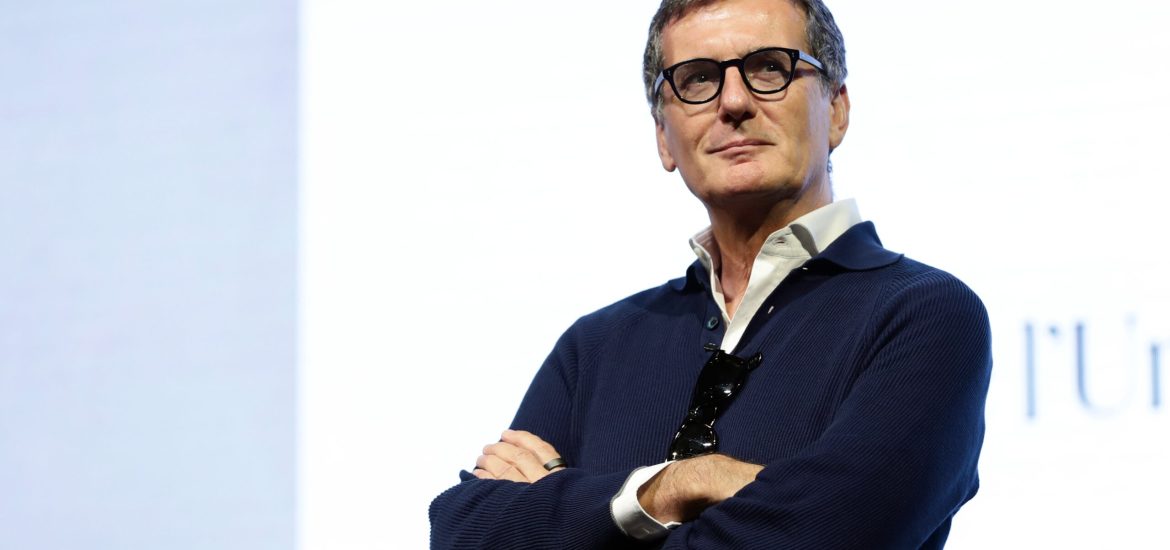

At the EssilorLuxottica meeting in Paris, Francesco Milleri does not raise his voice but sends very clear messages. Speaking on the sidelines of the event, the group’s top executive and Delfin chairman addresses the most delicate dossiers of the Del Vecchio empire, starting with the holding restructuring and the recent choices of Leonardo Maria Del Vecchio. The common thread is one: stability, to be rebuilt after years of precarious balance among the heirs.
SIMPLIFICATION ACCORDING TO MILLERI
It is precisely on the restructuring of Delfin that Milleri speaks most clearly. His judgment on the operation that will bring Leonardo Maria Del Vecchio – through Lmdv Fin – to 37.5% of the capital is clear, and the top manager entrusts it to a phrase that sounds almost like a call back to the founder’s orthodoxy: “Simplifying is always a good thing. Leonardo Del Vecchio taught us that.”
The acquisition of the shares of Luca and Paola Del Vecchio – each holding 12.5% – was approved by the assembly with six votes in favor out of eight, thus without a compact agreement among the heirs. But in Milleri’s reading, the point is not the conflict but the outcome: “It is a process that leads to simplification: if there remain six or five shareholders with their differences, it will be much easier to find good solutions for the company and for the country.”
The eight-shareholder structure slowed decisions; the reduction of shareholders therefore aims to make majorities faster, without changing governance.
THE VOTE ON MPS AND THE “RESULTS” LINE
The same approach is found in the banking game. Delfin is the largest shareholder of Monte dei Paschi di Siena with 17.5%, and the vote in favor of the Plt list for the renewal of the board caused a stir. Milleri, however, defends the choice, emphasizing that it was taken “unanimously by the board” based on the advice of banking and legal advisors. The Delfin chairman reiterates a principle destined to remain. “We are not interested in people or governance, we are interested in results,” he says, referring to the confirmation of Luigi Lovaglio at the helm of Mps, which marked the defeat of the Caltagirone line.
It is a stance that clarifies the holding’s scope of action. An approach that, in the context of the ongoing banking reshuffle, leaves many options open, especially regarding relations between Mps, Mediobanca, and Generali.
DEBT AND PORTFOLIO: THE LEVERAGE OF STAKES
A theme that runs through all these games is financial. The operation by which Leonardo Maria Del Vecchio will acquire the shares of his siblings is supported by financing of about 10 billion euros granted by a pool of international banks, including Unicredit, Bnp Paribas, and Crédit Agricole. It is a significant debt, which inevitably brings Delfin’s portfolio of stakes back to the center.
Milleri, on this point, maintains a cautious line but excludes nothing: “Anything can be done, but there is a board that has always decided unanimously.”
The asset structure represents one of the most important levers of the entire system. Besides the 32.4% in EssilorLuxottica, considered the industrial pivot and therefore not in question, Delfin holds significant stakes in the Italian and European financial system. The 17.5% in Mps is worth about 4.8 billion, the roughly 10% stake in Generali exceeds 6 billion at recent stock market values, while the 2.7% in Unicredit is around 2.6 billion. These are joined by other stakes such as that in Covivio (26%), which help bring the total portfolio value to levels close to 15 billion.
In this context, the possibility of selective disposals becomes a concrete tool, both to support debt service and for possible strategic operations. The issue is not only financial but also industrial and political, because it concerns assets that are at the center of the balances of Italian capitalism.
Unicredit, for example, is one of the most active players in the current scenario and watches closely the possible developments both on Mps and on Generali. The institution led by Andrea Orcel has already built a stake around 9% in the Lion, while Delfin holds about 10%, and could find precisely in the holding’s shares a lever for further developments. At the same time, Delfin is the largest shareholder of Monte dei Paschi with 17.5%, a stake that represents a crucial junction for any consolidation hypothesis, also because inside the Siena bank is held a further approximately 13% of Generali attributable to Mediobanca, destined to weigh in future system games.
However, timing does not appear immediate. Any sale of the stake in Generali would not be on the agenda before a possible broader restructuring that includes the relationship between Mps and Mediobanca.
MORE WEIGHT TO LEONARDO MARIA, BUT GOVERNANCE UNCHANGED
The strengthening of Leonardo Maria Del Vecchio to 37.5% nevertheless changes internal balances. Although remaining a minority shareholder, his weight becomes decisive in decisions requiring qualified majorities. In particular, he can influence crucial choices such as dividend distribution or extraordinary operations, without however having control of the holding.
The governance structure designed by the founder remains unchanged, assigning a central role to the board of directors and strongly limiting the direct intervention of shareholders. In this sense, Leonardo Maria’s strengthening does not alter the framework but helps make it more functional, reducing the risk of decision-making deadlocks.
There is also another relevant element, less visible but significant: the operation allows bringing back to Italy an important share of Delfin’s wealth, thanks to the use of an Italian law financial company.
ESSILUX BETWEEN DIVIDENDS, MEDTECH AND NEW MOVES
Meanwhile, Essilux continues to represent the empire’s fulcrum. The assembly approved all resolutions, including the distribution of a dividend of 4 euros per share, and confirmed confidence in the strategy outlined by management. The group closed 2025 with revenues around 28.5 billion euros, growing double digits, while net profit stood at just over 2.3 billion, slightly down compared to the previous year, with an operating margin around 16%.
Milleri insists on the group’s transformation, which is progressively shifting towards med-tech, aiming to build an integrated ecosystem around vision and wearable devices. The partnership with Meta is indicated as one of the pillars of this evolution, having created a new product category such as smart glasses.
At the same time, the acquisition front remains open. The group continues to monitor opportunities throughout its activity perimeter and does not hide interest in companies like Amplifon, although without concrete developments at the moment. Audio is indicated as one of the most promising areas, in line with a strategy that aims to integrate technologies and services rather than simply grow in size.
THE MILLERI PIVOT
In this intertwining of industrial setups and financial games, Francesco Milleri’s role remains that of guarantor of overall balance. He is the continuity point between the founder’s vision and the new phase marked by Leonardo Maria Del Vecchio’s rise.
His position, strengthened over the years also by Leonardo Del Vecchio’s testamentary indications, continues to be central both in the operational management of EssilorLuxottica and in Delfin’s functioning.
From his words emerges a clear line: to accompany Delfin’s restructuring, keep any hypothesis about the EssilorLuxottica stake outside the perimeter, and at the same time, not exclude interventions on financial stakes, from Mps to Generali, if functional to the holding’s balance.




