

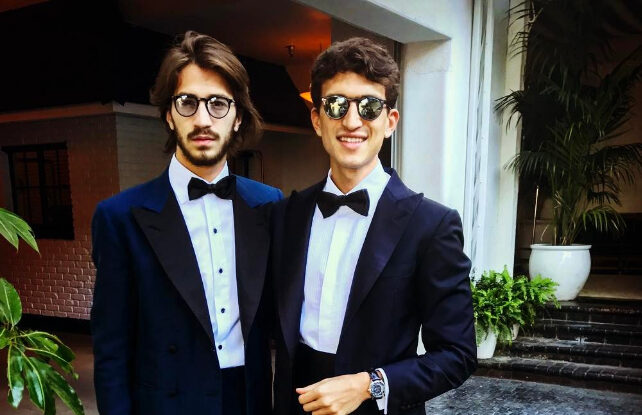

The truce in the Del Vecchio family is over. The tension in the galaxy built by the Luxottica founder had been brewing for months, but now the clash has moved out of family living rooms and landed in the courts of Luxembourg. The one who brought it before the judges was Rocco Basilico (on the right in the 2022 photo), son of Nicoletta Zampillo – Leonardo Del Vecchio’s second wife – who challenged the green light to the operation destined to bring Leonardo Maria Del Vecchio (on the left in the photo), the patron’s youngest son from the marriage with the same Zampillo, to the helm of Delfin, the family’s safe. The news was first reported on May 8 by Bloomberg.
At the heart of the dispute is the transfer of 25% of Delfin from Luca and Paola Del Vecchio to Leonardo Maria Del Vecchio, an operation approved by the holding’s assembly on April 27 and destined to bring the patron’s youngest son from 12.5% to 37.5% of the family safe. But, according to Rocco Basilico, that resolution was approved with a majority insufficient compared to what is required by the Luxembourg company’s statute.
The affair is bringing back all the fragilities of a succession that Leonardo Del Vecchio had tried to lock down by distributing equal shares among the heirs (12.5%) and imposing almost unanimous quorums to avoid internal wars. Almost four years after the Luxottica founder’s death, however, the truce seems definitively broken.
LEONARDO MARIA’S TAKEOVER OF THE DELFIN SAFE
The protagonist of the new phase is Leonardo Maria Del Vecchio, born in 1995, known as Leonardino. He is the youngest son of the Luxottica founder, born from Leonardo Del Vecchio’s second marriage to Nicoletta Zampillo. In recent months, he has built an operation destined to change the family holding’s structure.
The agreement provides for the purchase of the 12.5% shares held by half-brother Luca Del Vecchio and half-sister Paola Del Vecchio. Luca is the son of Leonardo Del Vecchio and former Luxottica manager Sabina Grossi; Paola is instead the daughter of the first marriage with Luciana Nervo. Through the vehicle Lmdv Fin, Leonardo Maria aims to rise from 12.5% to 37.5% of Delfin, becoming the holding’s largest shareholder.
The operation is financed by a pool composed of Unicredit, and the French Crédit Agricole and Bnp Paribas, with a total exposure of around 10 billion euros and with Delfin shares pledged to the lending banks.
The closing is scheduled by June 27, the fourth anniversary of Leonardo Del Vecchio’s death. But Basilico’s appeal now risks complicating the timing and even questioning the validity of the assembly that approved the restructuring.
WHAT BASILICO CHALLENGES
Rocco Basilico claims that the April 27 assembly applied the wrong quorum. According to the appeal, the transfer of shares to Leonardo Maria would have required the consent of over 88% of the capital, as provided by Delfin’s statute for transfers to third parties. In the assembly, however, a 75% majority was considered sufficient.
The difference is not technical but decisive. Basilico actually owns 12.5% of the holding, and if the reinforced quorum had been applied, his opposing vote would have been enough to block the operation. Hence the request submitted to the Luxembourg judges to declare null the resolutions approved on April 27.
That’s not all. Basilico also challenges the change in dividend policy approved at the same assembly. According to Bloomberg, the holding would have resolved a minimum distribution equal to 80% of net profits for the 2025-2027 three-year period, a measure that – according to the appellant – would facilitate Leonardo Maria in repaying the debt contracted to finance the acquisition of the siblings’ shares. Basilico also claims that the topic was not included in the original agenda of the assembly.
DELFÍN’S REPLY
Delfin immediately reacted by fully contesting the appeal. In a note released on May 8, the holding stated that “the resolutions were adopted in full compliance with applicable regulations, the company’s statute, and the required majorities.”
According to the company, Basilico’s appeal is “unfounded” and “not suitable to affect either the transfer of shares or the resolutions regularly adopted.” Delfin also announced that it will defend before the Luxembourg courts the full legitimacy of the decisions approved by the shareholders’ meeting on April 27.
Sources close to Leonardo Maria Del Vecchio, cited by the Giornale (of which the entrepreneur owns 30%), also assured that “the operation will go ahead anyway,” emphasizing that the restructuring was approved by the majority of the heirs, six shareholders out of eight.
LEONARDO MARIA’S COUNTEROFFENSIVE
The dispute, however, is not one-sided. Leonardino contests the transfer of 12.5% of Delfin from Nicoletta Zampillo to his son Rocco. Originally, Basilico had the usufruct of the package, but subsequently, the mother allegedly transferred full ownership of the shares to him. Leonardo Maria Del Vecchio’s challenge focuses on this transfer, questioning the full ownership of the share transferred from Zampillo to Basilico.
At the same time, according to MF, Nicoletta Zampillo and Leonardo Maria are reportedly defining an agreement that could lead to the transfer to the son of the remaining 12.5% held by the founder’s widow.
If the operation goes through, Leonardo Maria would come to directly or indirectly control 50% of Delfin: 37.5% deriving from the purchase of Luca and Paola’s shares plus 12.5% attributable to his mother.
THE SUCCESSION BUILT BY LEONARDO DEL VECCHIO
To understand the scope of the clash, one must return to the succession plan built by Leonardo Del Vecchio together with trusted lawyer Sergio Erede. As reported today in the long feature by Foglio, in 2017 the Luxembourg safe Delfin was divided into equal shares to avoid power concentration and guarantee balance among the heirs.
Nicoletta Zampillo received 25% of the holding, while each of the founder’s six children obtained 12.5%: Claudio, Paola, and Marisa – born from the first marriage with Luciana Nervo – Leonardo Maria, born from the marriage with Nicoletta Zampillo, and finally Luca and Clemente, children of the relationship with Sabina Grossi.
The structure was designed to prevent unilateral moves. The statute indeed provided for very high quorums, over 88%, on strategic decisions. A clause of almost unanimity that should have forced all heirs to find compromises. It is precisely on this clause that today’s judicial battle is fought.
THE DELFIN EMPIRE
The stakes are enormous. Delfin is not only the Del Vecchio family holding but one of the nerve centers of Italian and European capitalism.
The company controls about 38.4% of EssilorLuxottica, the global eyewear giant born from the merger between Luxottica and the French Essilor. It also owns about 10% of Generali, 17.5% of Monte dei Paschi di Siena, and 2.7% of Unicredit. Added to these holdings is 28% of the French real estate company Convivio.
Through EssilorLuxottica, the family controls brands like Ray-Ban, Oakley, and Persol and retail chains like Sunglass Hut and LensCrafters. In recent years, the group has become one of the main players in the development of smart glasses thanks to the partnership with Meta, from which the Ray-Ban Meta and new lines of AI glasses were born.
The overall value of the empire is estimated at around 40 billion euros, most of which is linked to the stake in EssilorLuxottica, which recorded revenues of 28.5 billion euros in 2025. And it is precisely the management of this wealth, together with the governance of the holding, that is the real battleground.
THE ROLE OF FRANCESCO MILLERI
In this family-industrial-financial framework, the figure of Francesco Milleri, president of Delfin and CEO of EssilorLuxottica, is also central. A trusted manager of Leonardo Del Vecchio, Milleri was the great architect of the merger with Essilor and the transformation of the group into a global giant.
Milleri would look favorably on Leonardo Maria’s operation, convinced that a more defined leadership could reduce the decision-making paralysis that has characterized Delfin after the founder’s death.
It is also true that the strengthening of Leonardo Maria risks changing the balances that have so far held the system built by the patron.
FROM THE EXTENDED FAMILY TO THE LEGAL WAR
The affair also has a strong personal dimension, as emerges from Foglio. Leonardo Del Vecchio had built over the years a complex extended family, marked by relationships, separations, and reconciliations.
Nicoletta Zampillo, a key figure in the group’s recent history, had been married twice to the Luxottica founder. From the first marriage, she had Rocco Basilico with financier Paolo Basilico. After the rekindling with Del Vecchio, Leonardo Maria was born.
For years, Rocco and Leonardo Maria grew up together, and Rocco himself had worked at EssilorLuxottica, dealing with the wearable division and relations with Meta for smart glasses. But in recent years, relations have deteriorated, leading to the current conflict explosion.
THE REAL GAME BEHIND THE APPEAL
Behind the Luxembourg appeal, there is not only a procedural issue. The real game concerns who will lead Delfin in the coming years and what role the holding will have in the major Italian financial balances.
In recent years, Delfin has been one of the protagonists of the Italian banking risiko. The Del Vecchio family holding has increased its stake in Generali, Mediobanca, Monte dei Paschi di Siena, and Unicredit, becoming one of the most influential shareholders in the Italian financial system. Around these holdings, some of the most delicate games in Italian finance have developed: Mps’s offer on Mediobanca, the future setup of Generali – where CEO Philippe Donnet’s mandate will expire in 2028 – and Unicredit’s moves, progressively increasing its stake in the Leone di Trieste. In this scenario, Delfin has often shared the positions of Francesco Gaetano Caltagirone, supporting the critical front against the governance of Generali and Mediobanca and more recently backing Montepaschi’s offer on Piazzetta Cuccia. In recent weeks, however, the holding voted in favor of the list led by Luigi Lovaglio for the renewal of Mps’s board, a choice that marked a divergence from the Roman builder’s position.
In the background, however, remains the most delicate issue: the financing obtained by Leonardo Maria Del Vecchio to purchase the siblings’ shares. The approximately 10 billion granted by Unicredit, Crédit Agricole, and Bnp Paribas have as collateral precisely the Delfin holdings, a “Damocles sword” over the holding since the lending banks have obtained the pledged shares at the center of the restructuring desired by the patron’s youngest son.




