

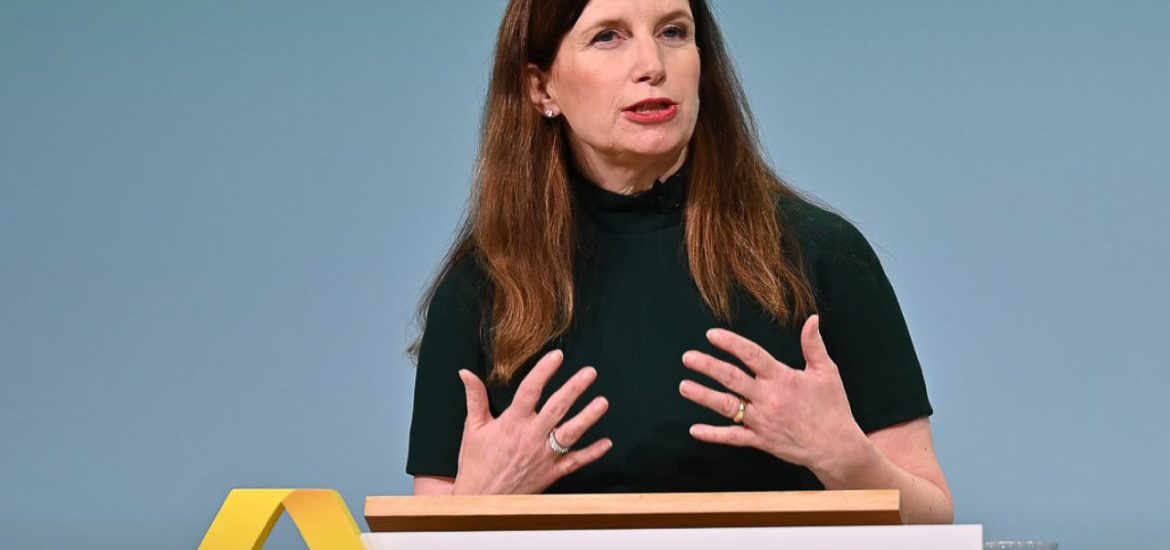

In front of the RheinMain Congress Center in Wiesbaden, even before the start of the proceedings, there were Commerzbank yellow hoodies and “UniCredit go away” signs. The assembly of the second largest German bank opened like this: with a united mobilization of shareholders and employees against the takeover bid launched by Andrea Orcel. The political, industrial, and identity message emerging from the long German day was very clear: Commerzbank wants to remain independent. At least under the current conditions: CEO Bettina Orlopp, in fact, left a window open for dialogue.
THE ASSEMBLY OF GERMAN PRIDE
In Wiesbaden, the atmosphere was clear even before the speeches by Bettina Orlopp (in the photo) and Jens Weidmann. Over a thousand shareholders physically present in the congress center, 41.8% of the capital represented at the assembly, continuous applause for the management, and a very strong mobilization of employees against Unicredit’s takeover bid.
Many shareholders wore hoodies with the inscription “We own yellow,” while outside the congress center employees waved signs against Orcel and the merger. In front of the entrances, hundreds of binders appeared with the inscription “Personnel file – closed. Thanks for nothing Andrea Orcel,” symbolizing fears of possible job cuts. The atmosphere was that of barricades.
For its part, Unicredit, although now the largest shareholder of the German bank, once again chose not to participate in the assembly, not depositing the shares within the deadline. But even without being in the room, Orcel remained the true protagonist of the day. Especially because, meanwhile, Unicredit continued to strengthen its position in Commerzbank’s capital.
THE 42% THAT CHANGES THE BALANCE
Indeed, during the hours of the assembly, it emerged that Unicredit further strengthened its exposure to Commerzbank. According to Mediobanca’s calculations, the bank led by Orcel holds 26.77% of the capital and voting rights of the German institution, plus 3.22% through derivatives with physical delivery and a further 10.7% through cash-settled derivatives. Overall, therefore, the potential total exposure rises to 40.7% of the capital, equal to about 42% net of treasury shares.
The threshold of absolute control, that is 50% plus one share, “is getting closer and closer,” note the analysts from piazzetta Cuccia.
Numbers that explain the atmosphere that pervaded Wiesbaden. Because formally UniCredit does not yet control Commerzbank. But in fact, the market is beginning to think as if the fate of the German bank were already hanging on Orcel’s decisions. This is why the assembly turned into a redde rationem between the German management and the Italian advance.
WEIDMANN STRIKES BACK
The counteroffensive was led especially by Jens Weidmann. “Our recommendation is clear: do not accept Unicredit’s offer,” he declared before the shareholders, amid applause from the audience.
According to Weidmann, becoming shareholders of Unicredit would mean finding themselves “in a significantly worse economic position” than that guaranteed by an independent Commerzbank. And to reinforce the concept, the chairman relied on some sensitive issues: from the high exposure to Italian government bonds to the greater incidence of non-performing loans, up to the still significant presence of the bank in Russia.
But the harshest moment came when Weidmann directly accused Orcel of having compromised the trust necessary for any integration. “Unicredit’s actions, constantly uncoordinated, and its repeated misleading communication,” he said, “have significantly undermined the foundations for constructive and trust-based cooperation.”
ORLOPP BETWEEN WALLS AND OPENINGS
Bettina Orlopp maintained equally strong tones, but with a more negotiative approach.
The CEO of Commerzbank alternated very explicit attacks on the Italian takeover bid with cautious, almost diplomatic openings towards a possible future dialogue.
On one hand, the strike. “From the beginning, Unicredit’s approach has been characterized by public pressure and an increasingly aggressive way of proceeding,” Orlopp accused.
The manager spoke of a “vague and constantly changing framework,” of “fundamental questions left unanswered,” and above all of an offer that “does not include any premium.” Even sharper was the criticism of the industrial plan: according to Orlopp, the cost reduction proposed by Unicredit would not be achievable within the indicated timeframes, and the compression of the international network would end up weakening the very heart of the Commerzbank model, namely the relationship with small and medium-sized exporting enterprises.
The CEO then quantified the possible damage: “The negative impact on revenues would far exceed one billion euros.” And again: profitability losses would have been underestimated, synergies overestimated, and restructuring charges much higher than indicated by Unicredit.
Yet, Orlopp left a window open.
“We remain open to dialogue,” she said, provided that Piazza Gae Aulenti shows “a real willingness to discuss the points we raised,” offers “an interesting premium” to shareholders, and presents “a plan that takes into account the success factors of our business model.”
An opening that marks a difference compared to the much firmer tones used by Weidmann.
THE UNIONS AND THE FEAR OF CUTS
On the union front, the main fear remains employment. Workers’ representatives speak of 23,000 jobs at risk in case of integration and recall the heavy cuts following the acquisition of HypoVereinsbank by UniCredit in 2005.
Frederik Werning, a Verdi union official and member of the supervisory board, directly attacked Orcel: “We cannot trust this man.” Even harsher was Dirk Mumot, chairman of the works council of the Ruhr area, who in Italian invited Unicredit to “go away” and let Commerzbank grow “without you.”
BUT SOME CALL FOR DIALOGUE
But not everyone pushes for confrontation. While the official front continues to reject the takeover bid, part of the market begins to consider a confrontation with Orcel inevitable.
At the assembly, for example, the Dws fund openly invited Commerzbank management to engage in dialogue with UniCredit “in the interest of the company and shareholders.”
For Flavio Notari, Head of Tax for Technology Companies Italy, many of Commerzbank’s objections have sound technical bases but also fall within the normal negotiating dynamics of a hostile operation. Meanwhile, Orcel continues to strengthen his position in the German bank’s capital, further increasing pressure on Frankfurt.




