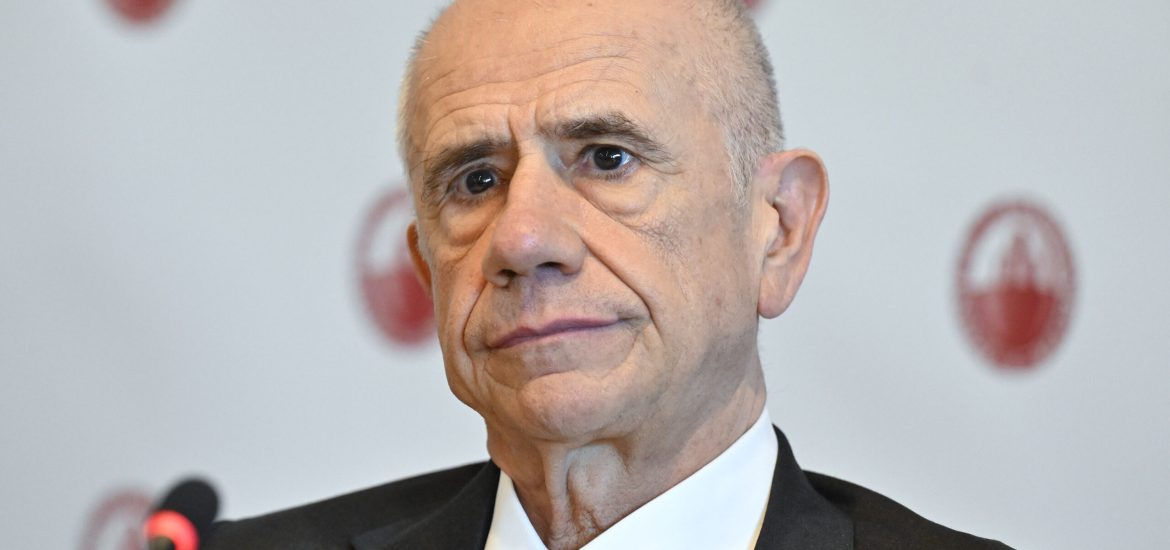

It happens that David wins against Goliath. This is what happened to the “small” Plt Holding of Pierluigi Tortora, whose board list, with Luigi Lovaglio as CEO, prevailed over that of the outgoing board supported by Goliath represented by the Caltagirone group. The Tortora family owns, through its shareholders and subsidiaries, about 1.2% of the capital of Monte dei Paschi di Siena.
Small, so to speak. Because behind that stake there is a group that over the years has built a complex industrial and financial presence, with an overall estimated value of around 1.3 billion – according to estimates by Mf/Milano Finanza – and activities ranging from energy to real estate operations, to finance and artificial intelligence. This explains how an entrepreneur relatively low-profile compared to the big financial circles managed to have such a strong impact on the governance of a systemic bank like Mps.
FROM MUNICIPAL UTILITIES TO RENEWABLES
Pierluigi Tortora is a civil engineer, graduated in Bologna in 1981, with a long first part of his career in the world of local utilities. After initial experiences in gas and district heating, the turning point came in 1997 with the appointment as general manager of Acam, now merged into Iren, where he became CEO from 2001 to 2007. It was during this phase that he built his managerial profile, before moving into entrepreneurship.
The real rise happened in the following years, when together with his family he entered the renewable energy business. Tortora began acquiring and developing wind and photovoltaic parks in Italy, Spain, and the United States, particularly in Texas, progressively building a significant portfolio in a sector characterized by long authorization times and high capital intensity.
THE LEAP WITH PLT ENERGIA AND THE AGREEMENT WITH PLENITUDE
The moment of greatest expansion came with Plt Energia, the group’s operational arm, which in 2024 carried out the operation that consecrated its growth: the sale of assets to Eni Plenitude for a figure close to one billion euros and an installed capacity exceeding 400 megawatts. After the sale, the group quickly rebuilt a pipeline of new projects, continuing to expand in the renewable sector both in Italy and abroad.
Plt Energia remains today the industrial heart, with development of wind, photovoltaic plants and storage systems (Bess) and a pipeline aiming to exceed 1 gigawatt of installed capacity by 2031.
THE FAMILY HOLDING (WITH THE SECOND GENERATION IN COMMAND)
Around this platform, Tortora has built a holding company – Plt Holding – which coordinates the shareholdings and manages financial and strategic activities, with a composition that remains firmly family-based and sees an increasingly important role for the second generation: one of the daughters, Eleonora, is indeed actively involved in the group, where she holds operational roles between finance and investor relations.
The governance develops along an extended family axis, which also includes husband Stefano Marulli. Eleonora holds the majority stake in the holding, with about 51% of the capital, while Pierluigi Tortora and his wife Elisabetta have stakes of about 26% and 17% respectively, and Carlo Corradini a stake of about 1.5% (the same Corradini who now sits on the Mps board). In the company’s governance, Pierluigi Tortora himself appears as chairman of the board of directors, while Eleonora Tortora and Corradini sit on the board as directors.
FROM REAL ESTATE TO ARTIFICIAL INTELLIGENCE
The perimeter has progressively expanded. Beyond energy, the group has entered real estate with Plt Tower, engaged in the development of a residential tower in Dubai, and has launched a new business line in artificial intelligence with Plt AI, also developed through a partnership with the German company Backwell Tech. Alongside these activities also moves a financial component typical of a family office, with capital allocation and targeted investments.
THE ENTRY INTO THE MPS GAME
It is this set of activities that explains why the “small” Plt Holding is actually an entity with an influence capacity far greater than the shareholding weight expressed in Mps. And it is on this basis that Tortora decided to enter the game for the renewal of the board of the Sienese bank. “I have never sought confrontation, because it is not a victory of one against the other. We presented a list open to the market in the exclusive interest of the bank, because the institution is above the shareholders,” Tortora himself explained in an interview with Radiocor .
THE NUMBERS AND THE WINNERS
The Mps assembly result is known: the Plt list obtains 49.95% of the votes, against 38.79% of the outgoing board list supported by the Caltagirone area, winning the relative majority and 8 seats on the board. Decisive is the support of Delfin and Banco Bpm, which helped overturn the balance, while the Mef stayed out of the vote.
It is on this basis that the new board of directors takes shape, in which – alongside Luigi Lovaglio and the designated chairman Cesare Bisoni – sit, for the component expressing the Plt list, Flavia Mazzarella, Livia Amidani Alberti, Massimo Di Carlo, Patrizia Albano, Carlo Corradini and Paola Leoni Borali.
A team that presents several links with Cassa Depositi e Prestiti: Mazzarella was president of the related parties committee of Cdp, Amidani Alberti is in Cdp Venture Capital, Di Carlo has held positions in the Cassa, while Corradini was chairman of the Cdp board of auditors.
Among the most significant profiles is, indeed, Corradini, who besides sitting on the board is also a shareholder of the Plt holding with a stake of about 1.5%.
DENIALS ABOUT GRILLI, DELFIN AND BPM
There were no shortages, in the days before the assembly, of reconstructions and behind-the-scenes stories. In particular, the Giornale wrote that the “activation” of Tortora’s entry into the field was by the former Minister of Economy, and current chairman of Mediobanca, Vittorio Grilli. A version that the entrepreneur explicitly denied: “I am not aware of that. We met with Grilli at the beginning of the year, because I felt the duty to greet him after he took office at Mediobanca. It was a courtesy gesture, I certainly did not have in mind to present a list for Mps, it was premature.”
Likewise, Tortora rejected the hypotheses of prior contacts with other major shareholders who later supported his list. “I did not speak with any investor. I am convinced that Delfin made a decision internally for reasons… Banco Bpm, for me it was a pleasant surprise.”
MEDIOBANCA, THE REAL TARGET
But Tortora’s position also fits into the broader framework of Mps’s industrial project, particularly on the Mediobanca dossier. “I bet on the mega bank that will be born from the marriage between Mps and Mediobanca,” he had already said a few weeks ago, adding that it would be “an international bank model, like Jp Morgan.”
A GAME THAT CONTINUES
In the end, the result goes beyond the single assembly. With limited participation but an effective strategy, Tortora managed to enter as a protagonist in one of the most relevant games in recent Italian finance. The playing field now moves to Mediobanca and, perhaps, to Banco Bpm.