


Pope Leo XIV has decided to intervene directly in one of the most delicate dossiers of Italian Catholic healthcare: the financial crisis of the Casa Sollievo della Sofferenza, the large hospital founded by Padre Pio in San Giovanni Rotondo. With a chirograph published by the Holy See, the pontiff has established a Steering and Supervisory Commission with extraordinary powers which, in fact, amounts to an administration of the foundation managing the Apulian polyclinic. The Vatican speaks of the need to “analyze the current situation of the Foundation” and to identify “the best solutions for ever greater efficiency, effectiveness and sustainability over time of its work and mission.”
THE GAP BETWEEN 220 AND 290 MILLION
The decision comes after months of intense internal tensions, union protests, liquidity alarms, and an economic framework that the Holy See no longer considers manageable with stopgap measures. The central issue is the financial hole accumulated by the hospital: estimates range between 220 and 290 million euros. The Messaggero speaks of a chasm exceeding 220 million, citing sources inside the structure and focusing especially on debt exposure and the cash crisis that has worsened in recent years. La Repubblica pushes the estimate up to a range between 250 and 300 million, indicating that the deficit includes not only debts to suppliers and bank exposures, but also arrears related to personnel, ongoing disputes, contract renegotiations, and a liquidity situation so delicate that it pressures even the continuity of healthcare supplies.
Further complicating the picture is the fact that the Foundation’s financial statements are not published, as the structure is under Vatican sovereignty. This is precisely one of the points contested by the unions, which in recent weeks have demanded transparency on the accounts and clarification on the real extent of the deficit.
“DON’T CALL IT ADMINISTRATION”
Meanwhile, however, the hospital management rejects the term “administration.” General Director Gino Gumirato, in a note released after the pontifical chirograph, states that “obviously it is not an administration, it is a Steering and Supervisory Commission, just as happens in many governments when they deal with public companies.” According to Gumirato, the new body “will guarantee the continuity of a center of excellence in the medical, surgical, and scientific research fields.”
The Venetian manager also explained that by June the Foundation will approve the 2025 budget and that, with the natural expiration of appointments, it will be necessary to renew the board of directors and the general management. A step that, according to the current governance’s intentions, should better clarify the operational role of the new commission.
WHO WILL MANAGE THE HOSPITAL NOW
The new structure desired by Leo XIV will in any case have powers far beyond simple supervision. It will be able to amend the statutes, approve acts of ordinary and extraordinary administration, sign contracts, interact with Italian public administrations, and acquire all necessary documentation regarding the Foundation’s management. Not just a coordinating body, therefore, but an operational organism destined to enter directly into the hospital’s governance.
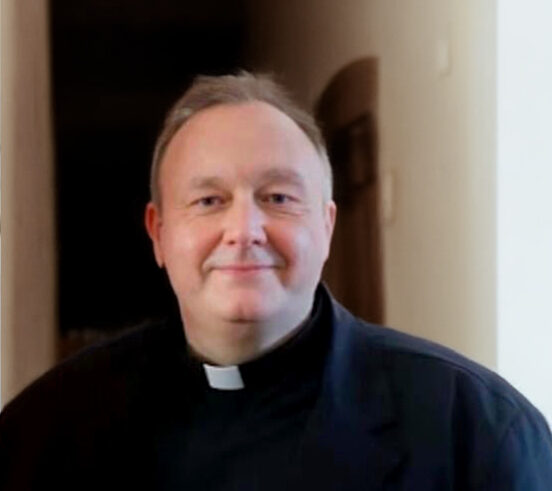
The commission will be led by Maximino Caballero Ledo, prefect of the Secretariat for the Economy and one of the main architects of the Vatican accounts restructuring desired by Francis. Coordinator will be Fabio Gasperini, secretary of the Apsa, the Administration of the Patrimony of the Apostolic See. Members also include Monsignor Paolo Rudelli, new substitute of the Secretariat of State, Monsignor Giordano Piccinotti (in the photo), president of Apsa, and Monsignor Giorgio Ferretti, bishop of Foggia-Bovino. The technical committee includes Benjamín Estévez de Cominges, Alessandro Ela Oyana, and Gumirato himself, called in 2022 to attempt the hospital’s financial recovery.
However, one absence does not go unnoticed: that of Cardinal Pietro Parolin. In recent years the Secretary of State had been the main political referent for the Vatican healthcare dossier and had personally followed the Casa Sollievo case. Only on May 5th did he visit San Giovanni Rotondo for the hospital’s seventieth anniversary, also meeting union representatives in an attempt to cool a now explosive dispute. But his name does not appear in the new commission.
Also Monsignor Franco Moscone, archbishop of Manfredonia-Vieste-San Giovanni Rotondo and president of the Foundation, remains outside the new body. A choice that weighs heavily, because Moscone had publicly expressed strong concern about the hospital’s economic management in recent months, even threatening to resign if a structural solution to the crisis was not found.
VATICAN HEALTHCARE AND FRANCIS’ LINE
Casa Sollievo della Sofferenza represents a particular case in Italian Catholic healthcare. Unlike other religious structures, in fact, the hospital belongs directly to the Holy See. It is therefore the Vatican that is responsible, also patrimonially, for its management. The same applies to the Bambino Gesù in Rome, while the Fatebenefratelli on the Tiber Island has a mixed ownership structure. This means that the economic problems of the San Giovanni Rotondo polyclinic inevitably fall within the Vatican’s financial perimeter.
Over the years, the Holy See’s interventions have not been lacking. Repeatedly the Vatican has intervened to cover deficits or indirectly support the structure. Already during Benedict XVI’s pontificate, then Secretary of State Tarcisio Bertone had envisioned the creation of a large Catholic healthcare hub coordinated from Rome, which would have brought together Casa Sollievo, Bambino Gesù, Gemelli, and even San Raffaele of Milan. That project never took off, but the issue of economic sustainability of Catholic healthcare remained open.
Pope Francis then initiated a profound revision of Vatican accounts, relying especially on the Spanish Jesuit Juan Antonio Guerrero. It was in those years that the Vatican decided to expand the consolidated budget to include hospitals as well, precisely to have more direct control over financial exposures. In 2022 Francis also created a Vatican Foundation dedicated to coordinating Catholic healthcare, attempting to rationalize a sector increasingly fragile under the weight of contemporary healthcare costs.
Leo XIV now seems to want to push that line even further. The administration of Casa Sollievo della Sofferenza is indeed interpreted as a choice of centralization and direct control by the Holy See. Not only a financial recovery operation, but also a change in the management method of major Catholic works.
THE CLASH WITH THE UNIONS
The problem, after all, does not concern only the numbers. Around the hospital, a very tough union dispute has developed in recent months. Employees contest the lack of contractual adjustment, unpaid arrears, and economic sacrifices required of staff while, the unions claim, personal bonuses and career advancements were distributed to a small circle of managers and officials. In a letter sent on May 22 directly to the Pope and reported by the press, CGIL, CISL, and FIALS denounce “a strong asymmetry in the distribution of internal resources” and demand “total transparency of the budgets.”
Tensions rose further when the unions initiated legal actions to recover arrears. The first injunctions have already been issued and could exceed 1,400, further worsening the hospital’s financial position.
Union complaints have also focused on Gumirato’s management, who arrived in 2022 with the mandate to restore order in the accounts through a policy of cost reduction and revision of internal agreements. In the background, a clash with the Apulia Region has also opened: the hospital management complained about the failure to meet certain financial commitments, while the ASL responded sharply, claiming that the financial relations actually favor the Region.
THE NUMBERS OF CASA SOLLIEVO
However, the crisis of Casa Sollievo does not arise only from union clashes. In recent years the polyclinic has progressively lost part of the healthcare centrality it had built in the South. For decades the structure founded by Padre Pio attracted very high-profile doctors and patients from all over the South thanks to advanced technologies and highly specialized departments. But the strengthening of other Apulian hospital hubs, starting with the Riuniti of Foggia, has eroded that dominant position. Moreover, salaries are no longer as competitive as in the past.
Yet the structure’s numbers remain enormous. In 2025 Casa Sollievo della Sofferenza recorded over 35,000 hospitalizations, more than one million outpatient services, and about 30,000 surgical interventions. Employees number over 2,500.
It is also for this reason that within the Vatican the conviction has grown that allowing the situation to deteriorate further would entail too high risks, both on the healthcare and reputational levels. At the top of the Holy See, the belief has matured that periodically covering losses without addressing management was no longer sufficient. “The deficit is structural,” sources close to the dossier have long observed.
Leo XIV’s choice thus comes at the end of a long phase marked by tensions, mediation attempts, and emergency measures. Now the Vatican aims for a profound restructuring, entrusted to a team chosen directly by Leo XIV.




