

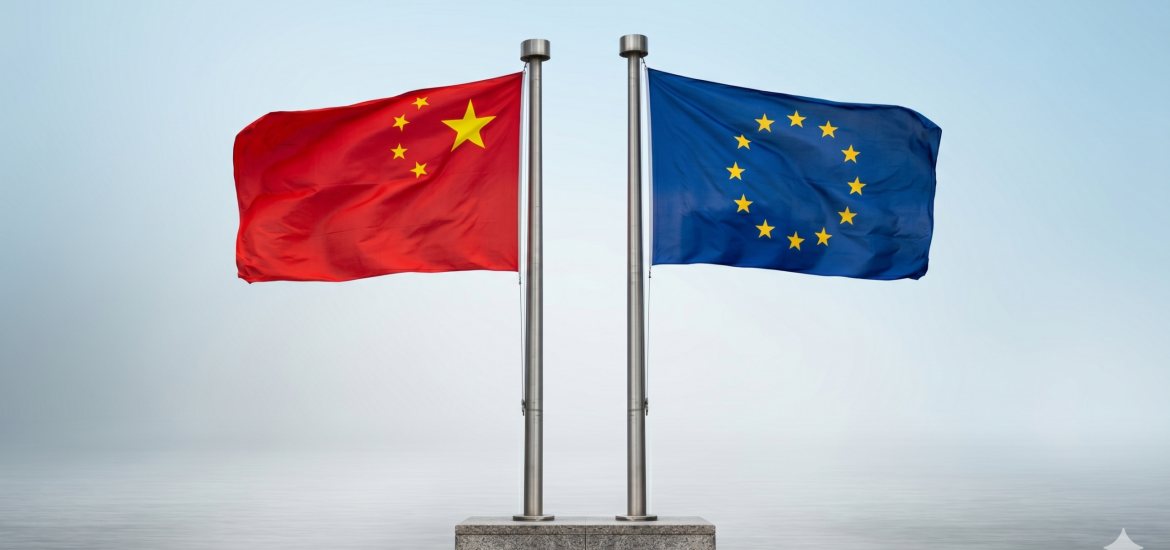

China strikes at European defense companies.
On April 24, Beijing announced the imposition of restrictions on seven European companies and entities active in the arms and defense sectors, specifically for arms sales or for “collusion” with Taiwan. Specifically, Chinese exporters are prohibited from supplying their goods that may have dual use, civilian or military, the ministry specified.
Dual-use goods are goods, software, or technologies that have both civilian and military applications, including some rare earth elements essential for the production of drones and chips, explains Reuters.
This is a rare case of sanctions directly targeting Europe and related to Taiwan. The country, which China considers an integral part of its territory, sources most of its weapons from the United States. Over the years, China has repeatedly imposed sanctions against major U.S. defense companies for military supplies to Taiwan; the most recent episode dates back to December, after Washington announced an $11 billion arms sales package to the island.
But this is the first time Beijing has acted against European manufacturers: Reuters also recalls that Europe has not sold high-value items, such as fighter jets, to Taipei for about thirty years, for fear of provoking the Dragon’s ire.
Among the companies included on the list are Belgian firearms manufacturers Herstal and FN Browning, the German Hensoldt, and Czech defense and aerospace companies Omnipol, SpaceKnow, Excalibur Armory along with the Czech Aeronautical Research and Testing Institute.
All the details
ANNOUNCEMENT FROM THE CHINESE MINISTRY OF COMMERCE
On Friday, the Chinese Ministry of Commerce announced the ban on the export of dual-use items to seven European entities due to arms sales to Taiwan, immediately placing them on the export control list.
Specifically, the department stated that foreign organizations and individuals are prohibited from transferring or supplying dual-use goods originating from China to the seven entities and that any related activities must be stopped immediately.
Furthermore, the ministry indicated that China reserves the right to approve shipments on a case-by-case basis under exceptional circumstances, stating that exporters of dual-use goods may apply to the ministry when an export is deemed “actually necessary” for the entities.
SEVEN EUROPEAN COMPANIES AFFECTED BY THE CHINESE MEASURE
The seven companies in question participated in arms sales to Taiwan or “colluded with Taiwan,” a spokesperson for the Ministry of Commerce said in a statement. Among these are Belgian firearms manufacturers Herstal and FN Browning and the German defense electronics company Hensoldt. The company active in Germany in sensors for defense and security applications, with a portfolio in sensing, data management, and robotics, is owned by the German government and Leonardo, each holding an equal 25.1% stake.
FOUR OF WHICH ARE FROM THE CZECH REPUBLIC
Four of the seven entities on the list are Czech. The Czech company Excalibur Army, a division of the Czechoslovak group CSG, stated that it does not source dual-use technologies directly from China and does not anticipate a significant impact on its business, notes Reuters.
“The Chinese authorities need to clarify the situation for us. I have already given instructions to our embassy in Beijing,” wrote Czech Foreign Minister Petr Macinka on Facebook.
THE SCOPE OF THE CHINESE MOVE
According to the Beijing ministry, China informed the European Union of the situation through the bilateral export control dialogue mechanism before the announcement.
The measure was adopted to “safeguard national security and interests and fulfill international obligations, such as non-proliferation,” the ministry explained.
Not only that, “The measures apply only to dual-use goods and do not affect normal economic and trade exchanges between China and Europe,” the spokesperson clarified. “EU entities that comply with the law and act with integrity have absolutely no reason to worry.”
IN RESPONSE TO EU SANCTIONS AGAINST MOSCOW?
As Euractiv observes, Beijing’s move comes in response to the EU’s adoption of its twentieth sanctions package against Russia, which targeted 27 Chinese companies accused of helping Russia and Belarus evade Western sanctions or directly supplying items such as components for drones for their war production.
For EPP MEP Tomáš Zdechovský, it is no coincidence that Czech companies are among the most affected. “Our defense industry has actively mobilized in support of Ukraine,” he told Euractiv.
The Czech parliamentarian said he does not foresee a drastic disruption of supply chains. “The defense sector in the EU, and particularly in the Czech Republic, is already moving away from dependence on China for sensitive or dual-use components,” he said, adding however that smaller or highly specialized companies risk delays, higher costs, or the need to recertify alternative suppliers.




