



SpaceX is preparing to take off on Nasdaq next month, with what could become the largest IPO in financial market history.
Yesterday, Elon Musk’s aerospace company filed documentation with the Securities and Exchange Commission (SEC), the US equivalent of Consob, choosing Nasdaq as its listing venue with ticker SPCX. In the S-1 form filed with the SEC, SpaceX describes itself as “the only company building the integrated hardware and software infrastructure of the future in the fields of space, connectivity, and artificial intelligence.”
Until now, the space economy leader founded by Musk in 2002 has remained private but rests on a diversified and profitable business model: Falcon 9 rocket launches, crewed missions to the International Space Station via Crew Dragon, and above all, the development of Starlink, which has become the main revenue engine through satellite internet. Moreover, Musk’s ambitions already look beyond, such as colonizing the Moon and Mars and orbital data centers.
For some time now, the SpaceX IPO has been talked about as a record launch, one of the most significant financially in history, but now it could be even more explosive. A June stock market debut would make SpaceX the first of a potential trio of mega-IPOs, ahead of OpenAI and Anthropic.
The company had submitted the documentation confidentially to the SEC in April and, according to last week’s report by CNBC, aims to start a roadshow to promote the IPO on June 8.
Not to mention that, thanks to the shares he holds in SpaceX, the IPO could make billionaire Musk, already the richest man in the world, a trillionaire, notes the BBC.
All the details.
WALL STREET’S MOST ANTICIPATED IPO
As already reported in recent months, Musk’s company aims to impress with a valuation exceeding $1.75 trillion. This ambition aligns with the group’s recent trajectory, valued around $1.25 trillion after the integration of xAI in February. Musk’s majority stake could be worth over $600 billion.
SpaceX aims to raise up to $75 billion with the launch, nearly triple the record set by Saudi Aramco in 2019. Other estimates suggest a figure above $50 billion, still enough to surpass this historic precedent.
The submitted documentation offers an awaited overview of SpaceX’s financial situation.
Recent documents filed with the SEC reveal the numbers of the group active in space launches, satellite connectivity, and artificial intelligence:
SPACEX’S LATEST FIGURES
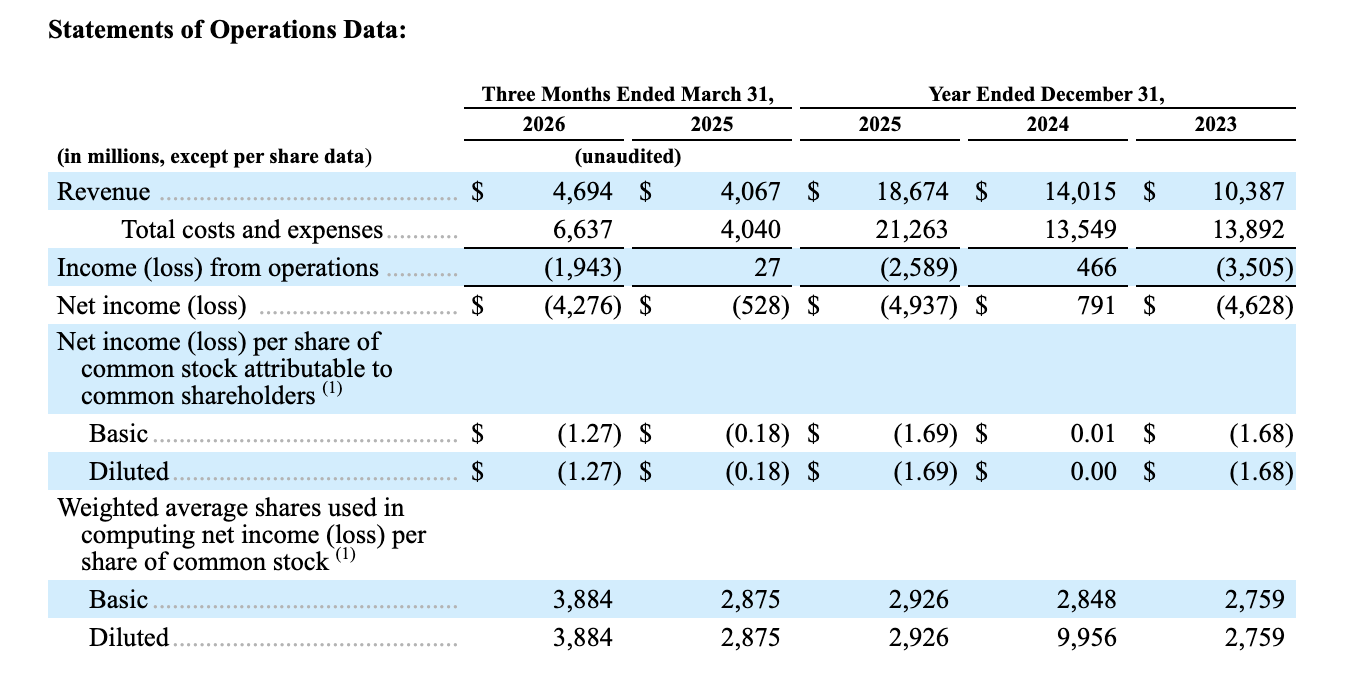
Last year, it recorded revenues of $18.6 billion, but a net loss of $4.9 billion and an adjusted EBITDA of $6.584 billion. The balance sheet shows assets of $102 billion, such as rockets and other equipment, but also a debt of $60.5 billion.
In the document filed with the SEC, the company warns that “We may not achieve or, if achieved, maintain profitability in the future.” As of March 31, 2026, the accumulated deficit stood at $41.311 billion.
FIRST QUARTER 2026 FINANCES IN THE RED
In the three months ended March 31, 2026, SpaceX recorded consolidated revenues of $4.694 billion. In the same period, the group booked an operating loss of $1.943 billion and an adjusted EBITDA of $1.127 billion. The net loss amounts to $4.276 billion.
The results fit into a context of strong expansion of the group’s industrial and technological activities, accompanied by very high investments.
INTEGRATION WITH XAI
Also in the prospectus filed with the SEC, SpaceX highlights the growing role of artificial intelligence within the group. xAI, founded in 2023 and acquired by SpaceX at the beginning of 2026, is described as a fundamental pillar of the company’s strategy. Thanks to the integration with xAI, SpaceX is developing a computing infrastructure for artificial intelligence with the goal of extending it from terrestrial space to orbital space. This infrastructure supports the training of Grok, the chatbot created by xAI, indicated by the company as one of the world’s most advanced frontier models.
STARSHIP PROGRESS AND SPACE INVESTMENTS
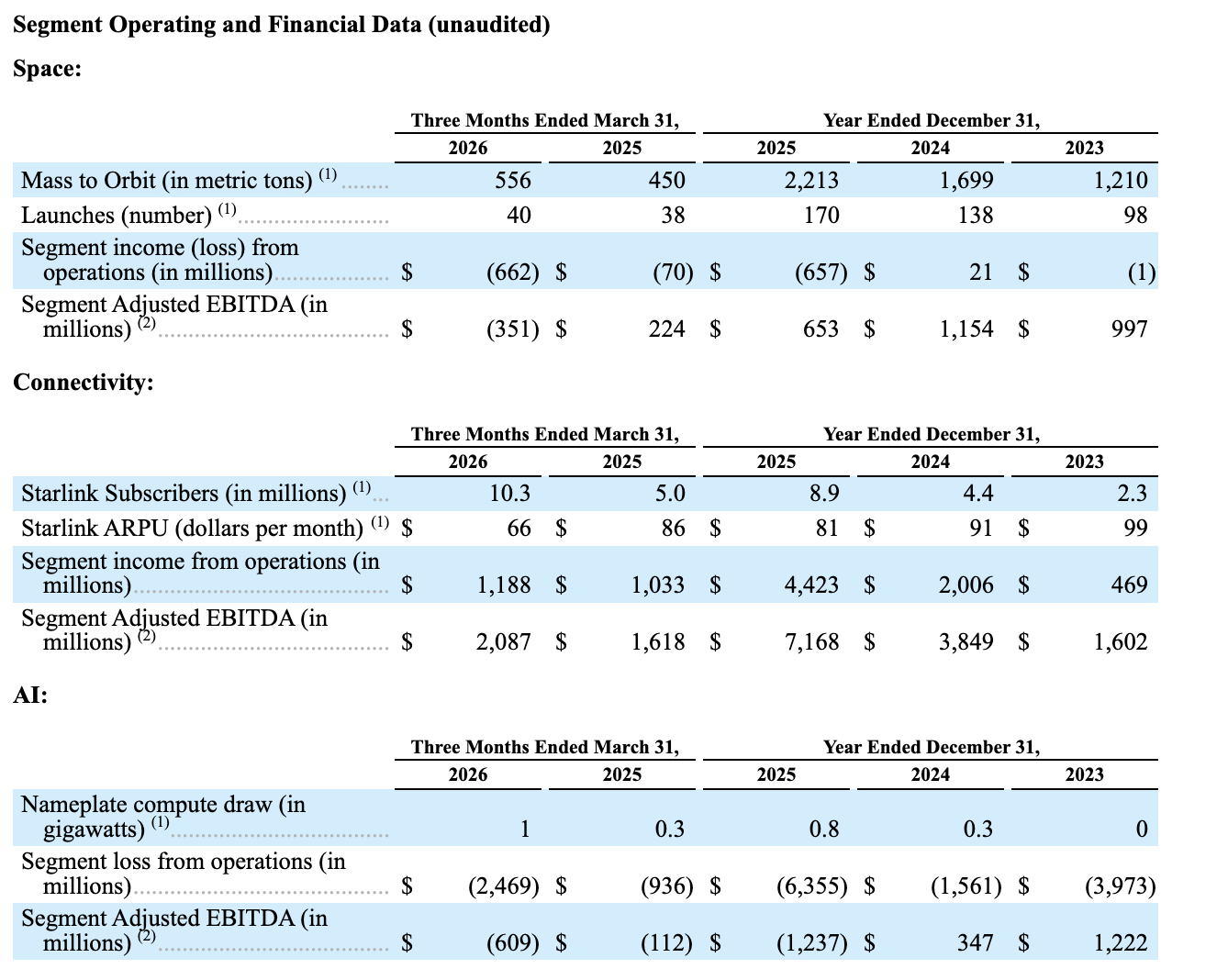
In 2025, the Space segment recorded revenues of $4.086 billion, an operating loss of $657 million, and an adjusted segment EBITDA of $653 million.
The division also sustained significant investments in the Starship program, the next-generation launch system designed to increase reusability, payload capacity, and launch frequency. This week the company is expected to conduct the twelfth uncrewed test flight of Starship, the first of the new V3 version, which features several updates compared to previous models, and aims to qualify the vehicle as a lunar landing module for NASA’s Artemis program and for operational launches of SpaceX’s Starlink satellites and future vehicles for orbital data centers according to the company.
Research and development expenses for Starship were $930 million in the three months ended March 31, 2026, and $3 billion for the entire 2025.
STARLINK DRIVES GROWTH
Moving to the Connectivity segment, mainly led by Starlink, it remains SpaceX’s main source of revenues and profits.
In 2025, it generated revenues of $11.387 billion, an operating profit of $4.423 billion, and an adjusted EBITDA of $7.168 billion. Annual growth was 49.8% for revenues, 120.4% for operating profit, and 86.2% for adjusted EBITDA.
According to SpaceX, the results were supported by subscriber growth, increasing adoption of services by businesses, and continuous improvement in network efficiency.
HOW THE AI SEGMENT IS FARING
In 2025, the AI segment recorded revenues of $3.201 billion, but also an operating loss of $6.355 billion and a negative adjusted EBITDA of $1.237 billion. The company attributes these results to the early development phase of the division and high investments aimed at supporting long-term growth opportunities in the artificial intelligence sector.
HOW MUSK’S WEALTH WILL EXPAND
Finally, thanks to the stake held in SpaceX, the IPO could turn billionaire Musk, already the richest man in the world, into the first trillionaire in history. Last year, the American entrepreneur became the first person to reach a net worth exceeding $500 billion. This means that SpaceX’s listing could bring his total net worth to over $1 trillion.




