

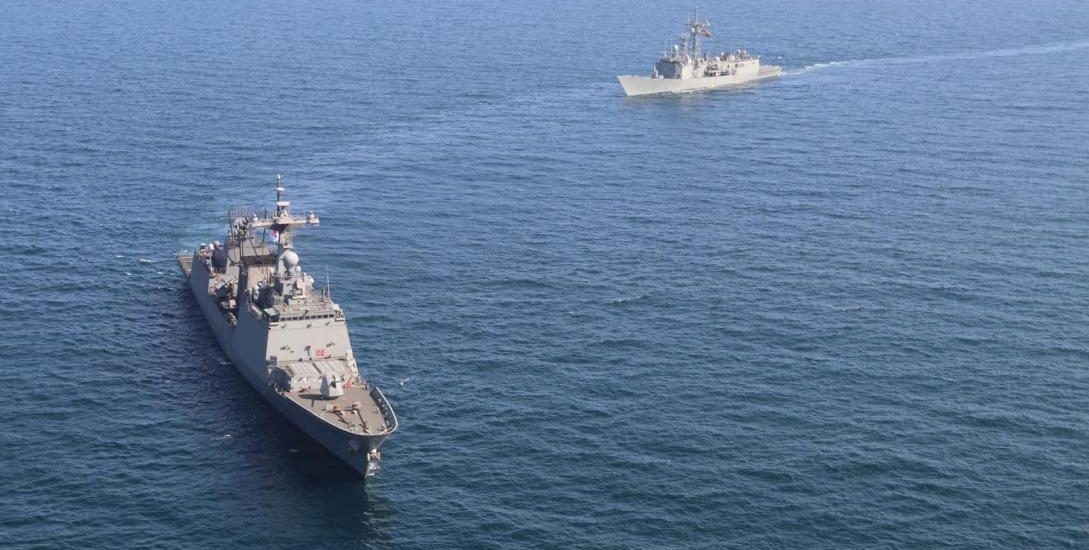

The EU expands the Atalanta mission to counter the so-called Russian shadow fleet.
This was announced by Kaja Kallas, EU High Representative for Foreign Affairs and Security Policy, stating that this week the European Union member states authorized Operation Atalanta to initiate boardings to verify the flag of ships suspected of belonging to the Russian shadow fleet, similar to Operation Irini.
The announcement came along with the communication regarding the boarding, which took place on July 20, of the sanctioned tanker MV South Star, suspected of sailing under a false flag “in violation of international maritime law, by the forces of Operation Irini for flag verification.” Kallas explained that the EU is “intensifying pressure on the Russian shadow fleet” and highlighted that “every illicit voyage helps sustain the Russian war machine.” For this reason, “we are accompanying our sanctions with activities at sea,” the High Representative explained, specifying that “This decision tightens the net further.”
Atalanta is the EU’s first naval operation, launched in 2008. Its mandate, initially focused on combating piracy, was expanded in 2022 to include combating illicit trafficking of arms and narcotics at sea. The mandate is set to last at least until February 28, 2027.
All the details.
A WIDER SCOPE OF ACTION IN THE INDIAN OCEAN
The mandate extension broadens the geographical scope of European activities against the Russian shadow fleet, a network of tankers characterized by opaque ownership structures that Moscow uses to export oil at prices above the cap imposed by Western countries, explains Defense News.
While Irini operates in the Mediterranean, Atalanta is deployed in the Somali Basin, the Gulf of Aden, the Red Sea, the Gulf of Suez, the Gulf of Aqaba, and waters around Oman. The operational area includes one of the main routes used by tankers transporting Russian crude to Asian markets.
Operation Atalanta is distinct from the European mission Aspides. Regarding the latter, an operation launched in February 2024 in response to repeated Houthi attacks against international navigation, it has a defensive character and a mandate set to last at least until March 2027. To launch it, Brussels allocated 42 million euros, complementing it with other naval operations already present in the region: Atalanta, active since 2008 against piracy off Somalia, and Emasoh/Agenor, launched in 2020 at Paris’s initiative for navigation security in the Strait of Hormuz and now with limited surveillance tasks.
CHANGES TO THE ATALANTA MISSION DECIDED BY THE EU COUNCIL LAST MARCH
For the Atalanta mission, following the 2025 strategic assessment, the EU Council last March decided to suspend monitoring of illicit coal trafficking, while maintaining secondary surveillance tasks on arms trafficking, narcotics, and illegal fishing. Coordination with the EU Crimario (Critical Maritime Routes Indo-Pacific) initiative is also strengthened, and a new task related to the collection and sharing of information on suspicious activities concerning critical underwater infrastructure is added, within the limits of available means and capabilities.
THE LEGAL FRAMEWORK FOR BOARDINGS
The American outlet also reports that on the high seas ships generally cannot be stopped and inspected by third states. However, Article 110 of the United Nations Convention on the Law of the Sea allows warships to conduct inspections when there is reasonable suspicion that a vessel is stateless or sailing under an unauthorized flag.
The new mandate therefore does not grant a generalized power to stop any sanctioned ship or one linked to Russia, but concerns cases where there are suspicions about the vessel’s actual flag, a practice frequently associated with the Russian shadow fleet.
The decision of the Council of the European Union, the operational plan, and the rules of engagement that will detail the application of Atalanta’s new powers have not yet been made public, specifies Defense News.
Finally, as reminds Kyiv Independent, some EU countries have already boarded ships suspected of being part of the Russian shadow fleet when they entered their territorial waters. Among the most recent cases are France, Sweden, Belgium, and the United Kingdom.




