

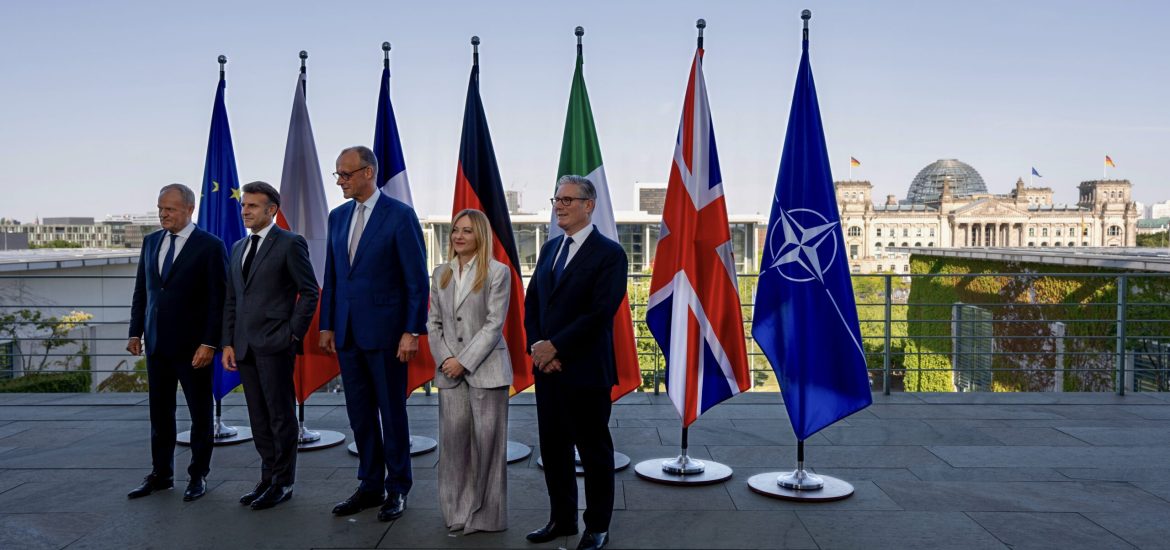

The leaders of the five major European countries met yesterday in Berlin at an E5 summit that aimed to send two clear messages: Europe remains determined to support Ukraine against Russian aggression and intends to take on greater responsibilities in Euro-Atlantic security.
Hosted by German Chancellor Friedrich Merz, the meeting brought together French President Emmanuel Macron, outgoing British Prime Minister Keir Starmer, Italian Prime Minister Giorgia Meloni, and Polish Prime Minister Donald Tusk, with NATO Secretary General Mark Rutte joining via video link.
On the eve of the Atlantic Alliance summit scheduled for July 7 and 8 in Ankara, the European “Big Five” reaffirmed their concrete commitment alongside Kyiv, discussed increasing defense spending, and worked to strengthen the European pillar within NATO, at a delicate moment in transatlantic relations.
The E5 Format
At the Berlin table sat representatives of the continent’s major military powers and defense contributors.
As Euractiv writes, the E5 format, established in 2024, has now become the privileged forum to coordinate European support for Ukraine and to respond to the gradual American disengagement from the Old Continent, as explained by Euronews.
The expansion from the old E3 to the E5 was not accidental. Poland and Italy strongly pushed to be included after Warsaw and Rome were excluded from a recent E3 meeting in London with Zelenskyy, an event that sparked protests from Donald Tusk.
“Without Poland, without the Scandinavian, Baltic countries and Romania, it will be difficult to achieve concrete results,” warned the Polish Prime Minister, according to Politico.
Summit Agenda
The leaders stressed the need to continue supplying air defense systems to Kyiv, increase economic pressure on Moscow through new sanctions, and support the resilience of Ukraine’s energy sector.
In a joint statement, the five committed to “further and substantially support Ukraine in its defense against Russian aggression,” as reported by Al Jazeera.
At the same time, great attention was given to strengthening the European pillar within NATO. Merz outlined some key steps, including closer cooperation on air defense, long-range weapons, and AI.
Germany, announced the Chancellor, aims to reach the target of 3.5% of GDP in military spending by 2029. All participants confirmed their intention to significantly increase their defense investments, thus laying the groundwork for a more balanced transatlantic relationship.
Convergences and Clear Messages
During the closing press conference, the tone was unified. Merz emphasized that “the message to Russia is: Ukraine remains strong” and announced he would personally inform both Trump and Turkish President Erdogan about the summit’s outcomes.
As Al Jazeera observes, the German Chancellor wanted to send a signal both to Washington and Moscow about European determination.
Macron spoke of growing convergence between Europe and the United States, placing the Berlin meeting in the positive wake of the “Évian moment” that emerged from the recent G7.
Keir Starmer instead insisted on the need to further increase economic pressure on Russia, defining support for Ukraine as “the defining element” of the upcoming NATO summit, as highlighted by Politico.
Tusk emphasized the indispensable role of Eastern European countries, while Giorgia Meloni stressed that “Europe must take responsibility in terms of defense and security.
There were also acknowledgments for the outgoing British Prime Minister: colleagues praised his strategic choices and his contribution to renewed European unity, enough to “make us forget Brexit for a while,” as Tusk joked.
The International Context
The Berlin meeting comes at a delicate moment. After the G7 in Évian-les-Bains and last week’s European Council, European leaders seek to maintain momentum on the Ukrainian front while in the United States Trump seems to have reprioritized the issue.
The five also discussed possible ways to manage future peace negotiations with Russia and who should speak on behalf of Europe in that case.
As noted by Euronews, the summit also had strong symbolic value: to show unity and determination in Washington, but also to demonstrate that Europe is ready to do more, both militarily and in terms of Ukrainian reconstruction.
Tusk will already host the Ukraine Recovery Conference today in Gdańsk, another important event on the calendar.




