

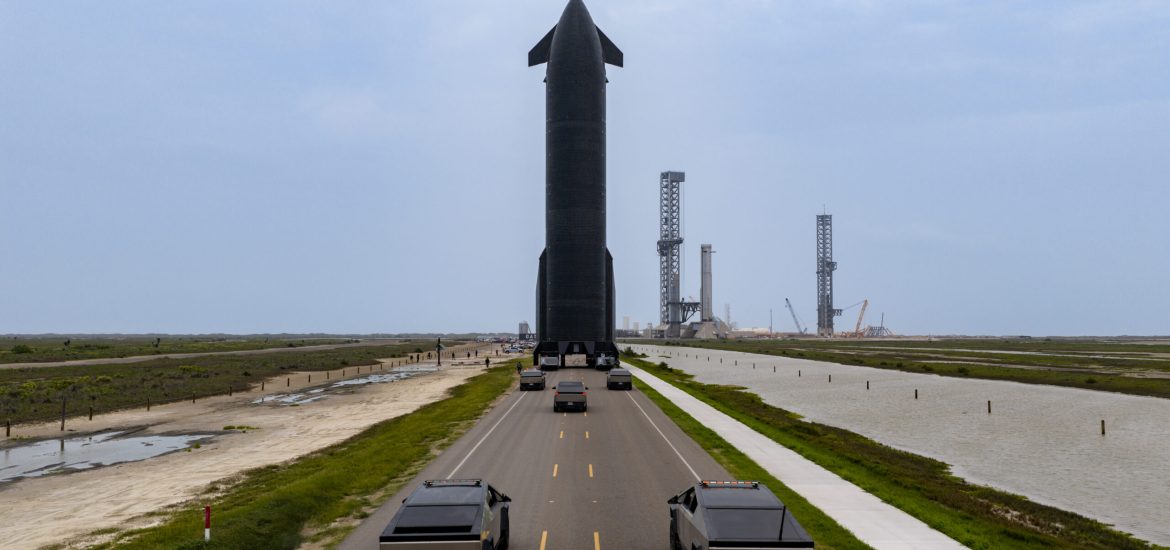

SpaceX is revving up in anticipation of the next Starship test, a fully reusable launch system, as well as the IPO.
This week, Elon Musk’s aerospace company is expected to conduct the twelfth uncrewed test flight of the Starship rocket, the first of the new V3 version of the largest launch system ever built. The launch was initially scheduled for May 19 but was postponed to May 22, from the Starbase facility in Texas.
Meanwhile, investors are closely watching the company’s technological progress – engaged in a race against time to make the spacecraft ready for NASA’s upcoming Artemis missions – ahead of the IPO expected next month.
According to sources close to the matter, SpaceX has chosen Goldman Sachs as the lead underwriter for its anticipated stock market debut. Following are Morgan Stanley, Bank of America, Citigroup, and JPMorgan Chase. The rocket, satellite, and artificial intelligence company of the American billionaire is expected to publicly file the IPO documentation today, according to Bloomberg News, after having submitted it confidentially to the Securities and Exchange Commission (SEC) last month.
The SpaceX IPO could raise up to $75 billion, far surpassing the current record held by Saudi Aramco with $29 billion from its 2019 debut.
All the details.
THE DEBUT OF STARSHIP V3
Flight 12 will be the twelfth test flight of the Starship vehicle since 2023, but the first this year and the first Starship test flight after 7 months.
It will be the inaugural launch of Starship Version 3 (V3), which features several updates compared to previous models, and aims to qualify the vehicle as a lunar landing module for NASA’s Artemis program and for operational launch missions of SpaceX’s Starlink satellites and future vehicles for orbital data centers, according to the company.
TECHNICAL INNOVATIONS OF THE LAUNCH SYSTEM
Among the main changes introduced is the redesign of the 33 Raptor engines of the Super Heavy booster, developed to provide greater thrust with reduced weight. The propulsion system of Starship’s upper stage has also been upgraded for long-duration missions, with mechanisms allowing vehicle docking, in-orbit refueling, and greater maneuverability, explains Reuters.
THE TEST AND REENTRY MANEUVERS
For this twelfth test flight, SpaceX will not attempt to recover either the Starship or the Super Heavy booster. However, the mission objectives include performing several controlled reentry maneuvers, including engine ignitions before splashdown at sea.
According to the flight plan, the Super Heavy booster should splash down in the Gulf of Mexico about seven minutes after liftoff, while the “exciting landing” of Starship, as SpaceX calls it, is expected about an hour later in the Indian Ocean. Before reentry, Starship’s payload will release 20 Starlink simulators and two modified satellites to collect data on the vehicle’s heat shield behavior during atmospheric reentry and transmit it to ground operators.
THE STELLAR IPO CHALLENGE
The Starship V3 test takes on particular significance also from a financial perspective. SpaceX is equally ready to impress with a valuation exceeding $1.75 trillion. This ambition aligns with the group’s recent trajectory, valued around $1.25 trillion after the integration of xAI, Musk’s artificial intelligence company, in February. From a financial standpoint, market estimates suggest the group generated about $8 billion in profits on revenues between $15 and $16 billion last year.
The company aims to raise up to $75 billion with the launch, nearly triple the record set by Saudi Aramco in 2019. Other estimates suggest a figure above $50 billion, still sufficient to surpass this historic precedent.
PROCEEDS AS A BOOSTER FOR STARSHIP AND XAI
The funds will be necessary to further develop its mega-rocket Starship, as well as to fuel Musk’s other favored project. One of the ideas behind the merger between SpaceX and xAI is to put data centers for artificial intelligence into orbit, where solar-powered satellites could, in theory, avoid some of the space and energy limitations that exist on Earth. But the technology is far from proven and the entire operation would be incredibly costly.
But the American billionaire is showing full commitment: at the end of March he presented the Terafab project, a joint venture among his companies Tesla, SpaceX, and xAI, for the production of chips for artificial intelligence, robotics, and data centers in space. The project aims to produce chips capable of supporting computing power between 100 and 200 gigawatts on Earth and one terawatt in space. One terawatt equals 1,000 billion watts. For comparison, Musk stated that the energy demand of the United States is 0.5 terawatts.
Finally, as Reuters points out, it remains to be seen how investors evaluating SpaceX’s upcoming IPO will reconcile Musk’s propensity for short-term risks with his long-term aspirations for lunar and interplanetary space travel.




