
Anthropic and OpenAi, as is known, share the spotlight in the sector – now considered a strategic asset by superpowers like the USA and China – of artificial intelligences. But Google also wants to reaffirm its centrality with a series of announcements presented to journalists and the general public.
Build your first game with Gemini 3.5 Flash.
Translate everyday objects directly into interactive, digital experiences without complex 3D modeling. Start with a Nano Banana prompt, turn your image into a game in Canvas, and refine your vision for optimal gameplay.
— Google Gemini (@GeminiApp) May 19, 2026
GOOGLE’S AI UPDATES
The core of the initiative is Gemini 3.5 Flash, whose name suggests a certain speed of execution. It will be the default model powering both apps on smartphones and tablets as well as searches on the well-known engine, a true epicenter of the web.
The CEO of the American multinational, Sundar Pichai, personally committed to assuring his audience that the Mountain View company has worked diligently also to prevent the smart algorithm from generating harmful content, while at the same time avoiding the AI refusing to answer safe queries, since excessive caution could also trigger the opposite mechanism.
THE SPARK OF GEMINI
The advertising campaign meanwhile has already started and involves big names but, above all, large companies. Mountain View is also moving along the agentive AI front, with Gemini Spark, which according to promises is capable of analyzing information coming from connected apps.
In short, it will be an evolved version of the digital assistant tested so far, capable of comparing, cross-referencing and coordinating multiple pieces of information recorded in different software in order to organize our day, responding to emails, reminding us of appointments and more: the beta version will initially be available for qualified testers and subscribers to Google AI Ultra starting next week. Most likely it will also interface with smart home devices in the US Group’s lineup.
THE RETURN OF GOOGLE GLASSES
But the real novelty of Google’s conference is the official announcement of Mountain View’s decision to challenge Meta with its smart glasses, a field that the Facebook & Co. Group has been occupying for quite some time (according to the latest data, Menlo Park would have already placed 7 million units worldwide).
A “telegraphed” novelty since news in this regard had been awaited for some time news in this regard, however it remains significant as both Google and Mark Zuckerberg’s company, while chasing OpenAi and Anthropic on the software side, are at least anticipating them on the hardware front, giving physical form to their algorithms.
THE COLLABORATION WITH SAMSUNG
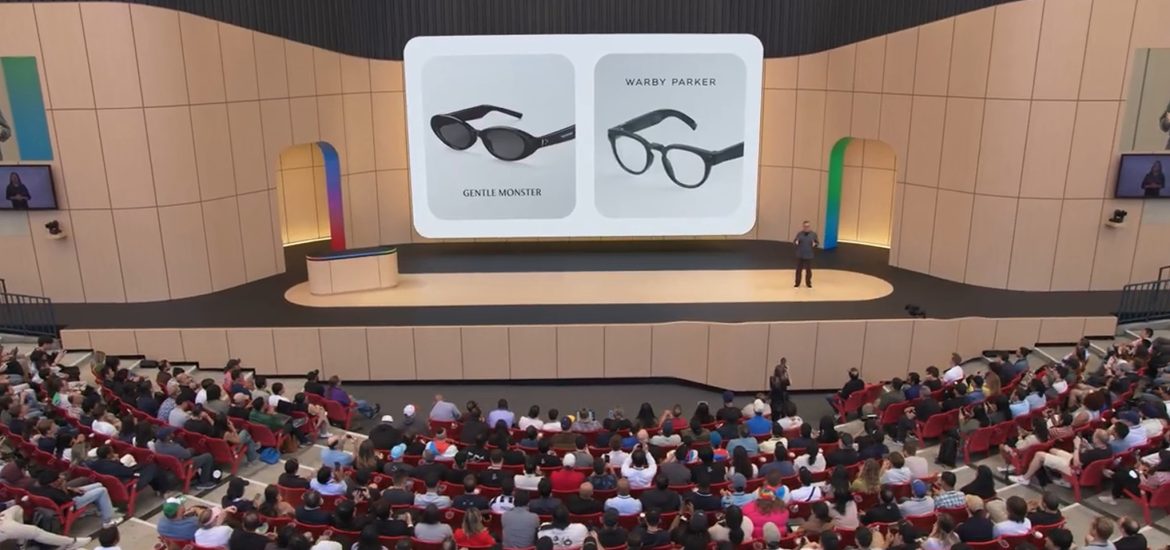
Just as from the rumors we anticipated back in 2024, these new wearable devices will be made in partnership with South Korean Samsung. The wearable devices, available in two variants (the first the result of design with Gentle Monster, the second with Warby Parker) seem to follow Meta’s offer which has focused heavily on style, relying as is well known on the Italo-French EssilorLuxottica, of which Menlo Park also holds shares.
But above all, focusing on appearance, it seems that Mountain View has learned from past mistakes: those with good memory will recall that this is a return and not a debut for Google in the smart glasses sector after the heavy blow suffered over a decade ago, both because the technology was not yet mature enough and did not allow integration into devices with an appealing look, and for privacy-related reasons. The latter uncertainty could still remain even ten years later, as some recent Meta vicissitudes remind us.