Italy’s major banks continue to generate record profits, but while profitability is rising, employment is declining and the weight of labor in the banks’ accounts is shrinking ever more. This is, in brief, the snapshot taken by the Fiba Foundation of First Cisl in its analysis of the first quarter 2026 financial statements of the five main Italian banking groups: Intesa Sanpaolo, Unicredit, Banco Bpm, Bper with Banca Popolare di Sondrio and Mps with Mediobanca. A study that tells of a sector healthy in terms of margins, efficiency and capital solidity, but which at the same time highlights growing imbalances between capital remuneration and labor valuation.
RECORD PROFITS AND COMMISSIONS INCREASINGLY CENTRAL
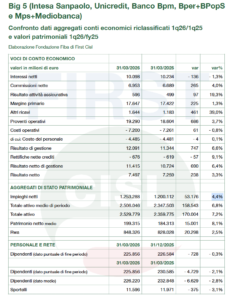
The first striking figure is that of profits: the Big 5 closed the quarter with an aggregate net result exceeding 7.4 billion euros, up 3.3% compared to the same period in 2025. A performance that confirms the extraordinary earning capacity achieved by the Italian banking system in recent years, even in a phase where the interest rate boost is beginning to slowly fade.
Indeed, net interest income, which in recent quarters had been the main driver of banking profitability, recorded a slight decrease of 1.3%, falling from 10.2 to 10.1 billion. However, the slowdown is offset by the growth of net commissions, which rose 4% to nearly 7 billion euros. This is a key development because it signals how banks’ business is becoming increasingly linked to asset management, financial products and customer services rather than traditional lending.
Not surprisingly, the share of commissions on the primary margin continues to increase and reaches 39.4%. The result of insurance activities also grows (+19.3%), while other revenues even show a leap of 39%. Overall, operating income rises by 3.7% to 19.3 billion.
Comparison of aggregated reclassified income statement data
Source: Fiba Foundation of First Cisl
The emerging picture is of banks increasingly less dependent on interest margin and more oriented towards commission activities. A model that offers greater revenue diversification but which, the study implicitly notes, also increases the weight of commercial distribution and pressure on sales targets.
EFFICIENCY AT HISTORIC HIGHS
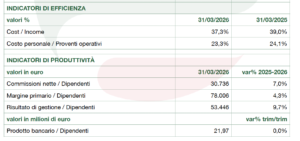
While revenues grow, costs remain essentially flat. Operating costs fall by 0.8% and personnel costs remain almost unchanged (+0.1%). The result is that the cost/income ratio — the indicator measuring banks’ efficiency — plummets to 37.3%, a “record” level significantly lower than the estimated average of major European competitors, indicated around 51%.
In other words: Italy’s major banks today generate many more revenues compared to the costs incurred to produce them. A leap in efficiency that in recent years has been favored by restructurings, digitalization, branch closures and staff reductions.
The ratio of personnel costs to operating income falls to 23.3%, a further sign of the progressive reduction of labor’s weight in banking accounts. And this is precisely one of the most critical points highlighted by the union.
For Riccardo Colombani, national general secretary of First Cisl, “the contribution of workers has been decisive in achieving record profits.” Hence the request to “redistribute the value created to those who produced it.”
Efficiency, moreover, also grows on the individual productivity level. Net commissions per employee increase by 7%, primary margin per employee by 4.3%, and operating result per capita by 9.7%. Numbers that tell of ever greater productive pressure on commercial networks and operational structures.
Efficiency and productivity indicators
Source: Fiba Foundation of First Cisl
FEWER BRANCHES, FEWER EMPLOYEES
The flip side of great banking efficiency is, however, the continuous reduction of physical presence on the territory and employment. Compared to the first quarter of 2025, the five groups lost 4,729 employees, equal to a decrease of 2.1%, while branches decreased by 375 units (-3.1%).
The contraction concerns a sector that for years has been following a constant rationalization path. Digitalization has reduced the use of traditional branches and pushed banks to compress their distribution network. But for the union, the risk is that technological transformation is mainly used as a lever to cut labor costs.
“It is unacceptable that while revenues and profits increase, the weight of labor costs on operating income continues to decrease and employment cuts persist,” Colombani argues. An imbalance that also forms the backdrop to the negotiations for the renewal of the national contract, in which unions are demanding a broader redistribution of the sector’s record results.
Among the demands is also the reduction of working hours with no salary reduction, considered “a necessary response to increased productivity.”
The issue is particularly delicate as it comes at a time when the banking sector, after years of crisis and restructuring, has returned to producing very high profits.
STABLE CREDIT, COLLECTION SLOWED BY VOLATILITY
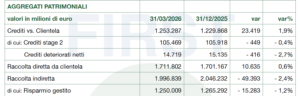
On the credit quality front, the picture remains reassuring. Loans grow by 4.4%, although less than total assets, which increased by 7.2%. This brings the ratio of loans to customers to total assets below 50%, confirming once again the progressive transformation of banks into groups more oriented towards financial services than classic lending activities.
Net non-performing loans continue to decrease and the net NPL ratio remains stable at 1.2%, one of the lowest levels in recent decades for the Italian banking system. Stage 2 loans, i.e., loans showing signs of deterioration but not yet classified as problematic, also register a slight decrease (-0.4%), falling by about 449 million compared to the end of 2025.
The dynamics of deposits are weaker. Direct deposits rise by 0.6%, from 1,701 to 1,712 billion euros, while indirect deposits retreat by 2.4%, falling from 2,046 to 1,997 billion and affected by financial market volatility in the early months of the year. Managed savings also decline, down 1.2% with a reduction of over 15 billion euros.
Capital aggregates
Source: Fiba Foundation of First Cisl
Overall, the capital solidity of the system remains high. The aggregated CET1 ratio of the Big 5 stands at 13.94%, albeit slightly down compared to the end of 2025.
THE ISSUE OF REDISTRIBUTION
But the most delicate issue concerns the growing gap between shareholder remuneration and the weight of labor in banking accounts. According to the study, over the past four years the Italian banking system has progressively shifted the balance in favor of shareholders.
In 2022, labor costs were more than 150% higher than capital remuneration through dividends and buybacks. In 2025, the ratio shrank to 75%, due to the strong growth in distributions to shareholders and share buybacks.
Dividends and buybacks

Source: Fiba Foundation of First Cisl
The phenomenon has accompanied a powerful stock market revaluation of the sector: between 2022 and 2025 the FTSE Italia Banks index grew by 230%.
For First Cisl, the numbers clearly show where the wealth produced by the sector is shifting. Italian banks are solid, profitable and capital-strong. They have improved credit quality, increased efficiency and strengthened their ability to generate profits. But this growth does not seem to be translating into a corresponding strengthening of labor.
Hence the call to banks not to use technological transformation exclusively as a lever to further reduce the weight of labor in their accounts.