

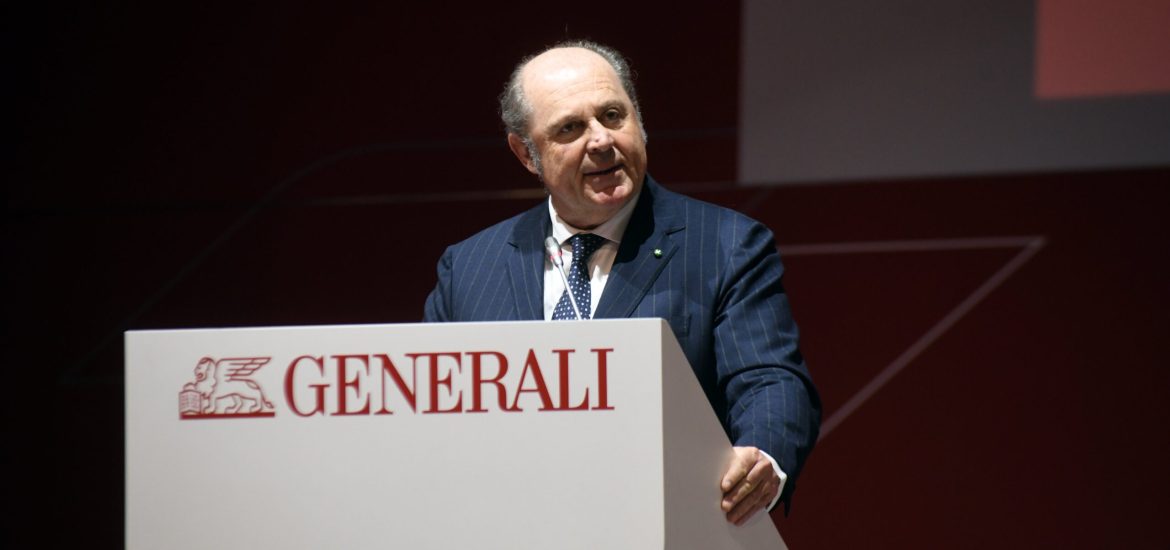

What will happen at Generali? The question has been circulating for weeks in financial circles and yesterday it gained even more momentum. At the Lion’s shareholders’ meeting, Unicredit appeared with a stake increased to 8.7%, becoming the third largest shareholder and surpassing Francesco Gaetano Caltagirone. A move that, officially, remains “financial,” but suggests that Andrea Orcel wants to stay in the game.
ORCEL RISES AND POSITIONS HIMSELF IN THE NEW BALANCE
The move is not spontaneous. As noted by La Stampa, Unicredit built the position over time, also through derivatives, then consolidated it into shares, bringing the investment to about 1.2 billion. Not only that: the stake was strengthened precisely while the balance between Siena and Milan was being redefined, with Mps, after Lovaglio’s victory, strengthening its influence over Mediobanca and thus over 13.2% of Generali.
The result is twofold. On one hand, Unicredit becomes a shareholder who truly counts in the governance of the Lion. On the other, it sends a signal to other shareholders: no decision on Generali’s future can ignore Orcel.
This move comes while Unicredit is engaged on multiple fronts, from the German Commerzbank deal to the domestic takeover game, and precisely for this reason it assumes a strategic, not tactical, value.
THE LINK WITH DELFIN: NOT JUST A CONVERGENCE
Here the picture becomes clearer. The relationship between Unicredit and Delfin is a concrete link played on multiple levels.
The first is financial. Unicredit is among the banks involved in the massive financing of about 10 billion needed for Delfin’s internal restructuring. A crucial operation, as it serves to redesign the balance among Leonardo Del Vecchio’s heirs and to strengthen Leonardo Maria Del Vecchio’s position.
The second level is industrial. Delfin today is one of the main hubs of the system: about 10% of Generali and a stake around 17.5% in Mps, where it played a decisive role in supporting the Lovaglio list. This means that the holding’s restructuring is not neutral: it has direct effects on Siena and indirect ones on Trieste.
The third level is strategic. Delfin holds Siena, Unicredit enters Trieste. Two different but complementary positions, which may intersect when the key Generali stakes move.
THE DELFIN VARIABLE: IS LIQUIDITY NEEDED?
And it is precisely here that the most delicate scenarios open up. Delfin’s restructuring is not only a matter of internal governance. It is also a matter of resources.
A 10 billion operation is not neutral. And according to some market readings, it could push the holding to raise cash. How? By divesting, at least partially, from its most liquid and significant holdings.
The options on the table are two. The first is Generali, where Delfin holds about 10%. The second is Mps, where it holds the relative majority. Two central assets, but also two potential levers to raise liquidity.
If this scenario were to materialize, the link with Unicredit would immediately become operational. Because Orcel is not only a shareholder of the Lion: he is also a financier of Delfin’s restructuring. And could therefore find himself in a position to accompany – or intercept – any disposals.
THE MEDIOBANCA PACKAGE: THE BALANCE PENDULUM
Making everything even more delicate is the Mediobanca game. The 13.2% of Generali held by Piazzetta Cuccia, today under Mps’s influence, is the real balance pendulum. After Lovaglio’s victory, that stake has become even more central. And all attention focuses on that participation.
According to the Financial Times, Lovaglio is considering the possibility of selling the Generali stake held by Mediobanca – and thus today under Mps’s influence – to finance the integration with Banco Bpm. A move that would have a precise industrial logic: creating the third national banking hub using the Lion as a financial lever.
Mps has officially denied this. But the issue remains. Also because Lovaglio himself defined the participation in the Lion as a “nice to have.” A definition that, in market jargon, means one thing only: it is not untouchable.
UNICREDIT IN THE FRONT ROW
If the market really opened on that 13.2%, Unicredit could be among the natural candidates. By size, positioning, and strategy. The growth to 8.7% is already a first step. But it might not be the last.
Orcel aims to enhance the stake also from an industrial perspective, exploiting synergies in asset management and bancassurance, two areas where Unicredit is less structured compared to the major Italian players. In particular, as La Stampa highlights, the operation could strengthen presence in wealth management and open expansion opportunities in Eastern Europe, an option also favored by Generali CEO Philippe Donnet.
INTESA, THE OTHER VARIABLE
But Unicredit is not alone. Intesa Sanpaolo remains in the background. The hypothesis of its involvement returns cyclically, especially after the stalemate on the joint venture with the French Natixis. The government has already shown it does not favor solutions that could bring strategic assets under foreign influence. And this automatically reopens space for an Italian alliance.
Intesa has the size to build a savings hub with Generali. And if antitrust constraints remain a brake, as Il Foglio observes, a possible reshuffle of stakes – starting with Delfin – could reopen the dossier.
The balances remain intertwined: Unicredit grows, Delfin reorganizes, Mps controls the Mediobanca lever while Intesa watches and the government supervises. The link between Orcel and Delfin adds a possible weld between finance and key holdings, with potentially disruptive effects on the arrangements.




