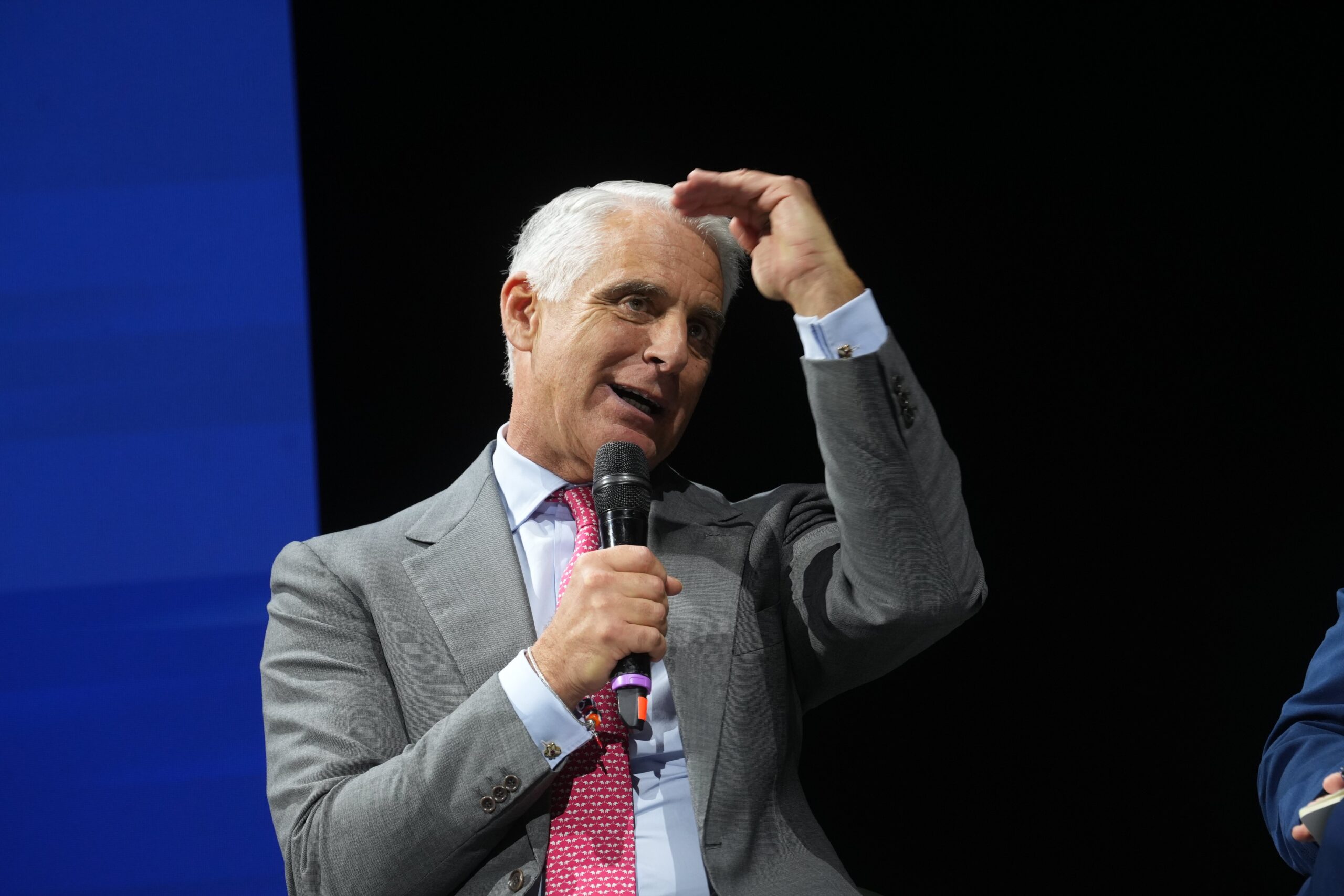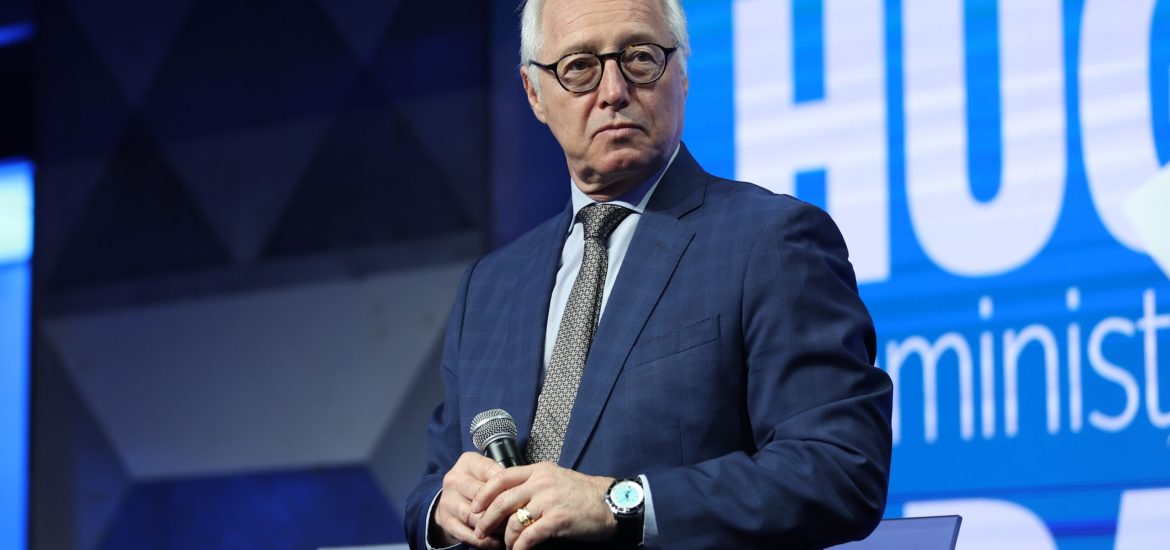

Crédit Agricole reveals its cards on the future of Banco Bpm and does so with words that leave no room for doubt: full support for the current leadership led by CEO Giuseppe Castagna and Chairman Massimo Tononi. The indication comes directly from the CEO of Crédit Agricole Italy, Hugues Brasseur (in the photo), who yesterday explained how the Milanese group “has done an excellent job on development” and how the French “believe strongly in the future of this bank.”
The message is clear: the Green Bank, while preparing its own minority list for the renewal of the board of directors, does not intend to challenge the bank’s leadership. On the contrary, the list that Paris is expected to submit by March 23 will effectively be a list supporting the current management. In short, the French are ready to back the confirmation of the ticket formed by Castagna and Tononi in the new board. Certainly, it is reasonable to think that Crédit Agricole’s real goal is to exercise decisive influence over Piazza Meda, as already noted in recent days by Startmag.
Not by chance, Brasseur recalled the recent words of Castagna himself, who, speaking at the Teatro alla Scala, talked about “dialogue with all shareholders” and “excellent relations with everyone.”
This position comes on the eve of a delicate shareholders’ meeting: on April 16, Banco Bpm will renew the board for the first time applying the new rules introduced by the Capitali law. In this context, Crédit Agricole’s weight – now the largest relative shareholder of the institution – could prove decisive.
THE GROWING WEIGHT OF CRÉDIT AGRICOLE IN BANCO BPM’S CAPITAL
The strengthening of the French role is the result of a strategy launched several years ago. Crédit Agricole entered Banco Bpm’s capital in 2022 and in recent months has progressively increased its stake to exceed 20% of the capital, with ECB authorization to rise up to 30%.
The investment has progressively transformed Crédit Agricole into the reference shareholder of Piazza Meda. The declared objective is to qualify the participation as a stable, long-term investment, strengthening an already existing industrial partnership between the two banking groups.
The French group, on the other hand, has built a very significant presence in the Italian market over the last two decades. As reported, among others, by Startmag, Italy is the only country besides France where Crédit Agricole is present with all business lines: commercial banking, consumer credit, corporate and investment banking, asset management, and insurance. The group counts over 2.8 million customers in the country, about 1,200 branches, and more than 12,500 employees, with total deposits exceeding 150 billion euros.
In this context, Banco Bpm represents a strategic partner for the French group and at the same time a significant piece in its presence in Italian credit.
THE NEW RULES OF THE CAPITALI LAW AND THE PUZZLE OF THE LISTS
The renewal of Banco Bpm’s board will be an important test for the innovations introduced by the Capitali law regarding the election methods of boards of listed companies.
The new mechanism allows the list presented by the outgoing board to obtain up to twelve seats out of fifteen, provided it is the most voted. At the same time, minority representation increases, which can obtain up to six seats, compared to the three provided by the previous system.
But the real novelty concerns the individual vote on each candidate: if the board’s list is the most voted, each candidate must still be subjected to a separate vote by the assembly. A system that introduces a sort of “approval vote” on individual directors and that could make the final board balances more uncertain and open the door to possible shareholder ambushes.
In this scenario, Crédit Agricole’s strategy becomes decisive. With its own list, the French could aim for broader representation on the board and strengthen their role in the bank’s governance.
THE BANKING RISIKO AND UNICREDIT’S STEP BACK
What is happening at Piazza Meda is an integral part of the great reshuffle that is redesigning the Italian banking system. In recent years, the sector has been crossed by numerous consolidation hypotheses and more or less successful operations among the country’s main institutions.
Among these stands out UniCredit’s attempt to launch a public exchange offer on Banco Bpm. However, the operation was withdrawn last summer after resistance from the Italian government and uncertainty linked to the application of the State’s special powers, the so-called golden power.
GOLDEN POWER AND THE BRUSSELS BEACON
According to European sources cited by Reuters, the European Commission is pressing Italy to introduce further changes to the golden power legislation, judging the corrections made so far insufficient to limit government intervention in banking operations. In the background is also the case of the attempted UniCredit OPS on Banco Bpm, later withdrawn amid tensions with the executive. As noted by the Messaggero, that case reignited the debate in Brussels on the scope of Italian special powers and their possible impact on the competencies of European authorities within the banking union architecture. A close technical dialogue is reportedly underway between the European Commission and the Ministry of Economy on amendments to the legislation.
UniCredit’s step back had a direct effect on shareholder balances: with the exit of the potential Italian buyer, Crédit Agricole emerged as the strong shareholder of the Milanese institution, progressively consolidating its role in the game.
THE POLITICAL KNOT AND THE BALANCE BETWEEN ROME AND PARIS
Behind the Banco Bpm game there are also political balances that cross the entire Italian banking system. The government’s intervention with the golden power to block UniCredit’s offer opened a debate on the State’s role in market operations and on the balance between national capital and foreign investors.
As observed by the Corriere della Sera, Crédit Agricole’s growth in the Milanese bank’s capital was effectively tolerated by Italian institutions precisely while UniCredit’s operation was blocked.
The result is a complex balance between Rome, Paris, and Brussels, in which the French group has so far moved with great caution, avoiding presenting itself as a subject interested in controlling the bank but progressively consolidating its presence.
THE CROSSING WITH MONTE DEI PASCHI
The Monte dei Paschi di Siena dossier also enters the mosaic of Italian credit. The Treasury still holds a stake in the Sienese bank of about 4.8% and is considering a possible exit from the capital after the bank’s relaunch, also through market operations such as an accelerated bookbuilding on the residual stake.
Banco Bpm, for its part, holds a stake below 4% in Mps’s capital.
This cross-shareholding fuels speculation about possible future aggregation scenarios between institutions, although at the moment these are mainly hypotheses circulated among analysts and advisors.
As Corriere della Sera wrote, some observers have hypothesized that after the season of board renewals, a new phase of reflection on possible integrations between Banco Bpm and Monte dei Paschi could open. An operation that would create a group with over 40 billion in capitalization, redesigning the balances of the Italian banking system.
THE BOARD GAME AS A KEY POINT OF THE RISIKO
In the end, the renewal of Banco Bpm’s board appears as one of the central nodes of the new Italian banking reshuffle. On one side is the goal of confirming the autonomous growth strategy of the bank led by Castagna. On the other side is the presence of a strong shareholder like Crédit Agricole, determined to strengthen its influence.
Brasseur’s words, and the explicit support for the current leadership, mark a line of continuity: long-term investment, industrial collaboration, and a more structured presence on the board.