
China’s rise in the electric vehicle (EV) market, from batteries to motors to mass production, demonstrates the country’s success in transforming an innovative initiative into a full-fledged industry. This milestone has paved the way for China’s ambitions in the humanoid robotics sector, fueling a debate on the opportunity to apply the same formula to the entire industry.
Humanoids are machines designed to move and act like humans. Intended for a range of uses, they are currently being tested in factories and warehouses to perform repetitive and labor-intensive tasks, such as moving materials, sorting goods, or conducting inspections. In the long term, humanoids could even be employed in healthcare and elder care, assisting humans with household chores and addressing labor shortages linked to a declining active population.
Although estimates may vary, it is clear that investments in humanoids are growing rapidly. Global funding for startups in the sector was almost negligible at the beginning of the decade but has since grown to reach USD 1.2 billion in 2024. DroidUp, Robot Era, and X Square Robot are just a few of the many humanoid companies born in China since 2020. In particular, many of these startups originated within universities or maintain close ties with academic institutions, and several have received funding from large multinationals such as Alibaba Cloud, Tencent, and Huawei.
- Main technological obstacles
Despite advances in AI accelerating progress, some key obstacles remain in the widespread adoption of humanoids.
- Training data and robotic intelligence: humanoids must rely on vast amounts of real data to learn through trial, error, or imitation.
- Software and control limitations: most existing humanoids are partially autonomous, with preset activities under human or system supervision.
- Power supply and battery life: humanoids typically weigh between 50 and 70 kg and operate only 1-2 hours per charge. Batteries remain heavy and expensive, affecting the practical use of robots.
- Mechanical reliability and design trade-offs: walking and manipulating objects require motors and joints capable of withstanding various operational demands. Early models are prone to overheating and mechanical wear.
- High prices: an advanced unit like Boston Dynamics’ Atlas can cost up to USD 150,000. Even humanoids designed for specific tasks generally cost several tens of thousands of dollars each.
A crucial question thus emerges: what must happen for humanoid robots to become economically sustainable, initiating a cycle where lower costs and better performance encourage wider adoption?
The key message is simple: scale is decisive. For the humanoid robot sector to break even economically, it will likely need to achieve annual sales of at least 100,000 units, a threshold similar to that which recently brought collaborative robots close to profitability. To go beyond break-even and benefit from the strong profitability observed in the industrial robot market, which exceeds 500,000 units annually, humanoids would need to reach comparable production levels.
Considering that current humanoid robot deliveries are well below these levels, it will take at least five years before the sector even approaches break-even, while real profitability will remain a longer-term goal. That said, this should be seen more as a strength than a weakness, reflecting the early stages of major technological transformations of the past, when progress depended on constant innovation, the development of concrete use cases (and data), demand growth, and ultimately profitability.
HUMANOIDS: EV 2.0?
Although the sector is still in its early stages, the Chinese government sees humanoids as a strategic priority. China’s dominance in the electric vehicle sector could potentially extend to humanoid robots, thanks to the significant overlap in the supply chains of the two products. Both rely on electric motors, power electronics, batteries, and sensors—areas in which China has developed considerable capabilities and know-how; for example, the lightweight electric actuators that move a robot’s limbs are close relatives of the motors in EV drive systems, while high-density battery packs for robots are directly based on advances made in the electric vehicle sector.
As a result, many Chinese automotive suppliers are converting their products for humanoids. Companies such as Zhejiang Sanhua Intelligent Control and Ningbo Tuopu Group, originally manufacturing thermal and chassis components for electric vehicles, have reportedly begun assembling joint modules intended for Tesla’s Optimus humanoid1. China’s extensive electronics and automotive ecosystem (motors, reducers, lithium batteries, camera modules, etc.) enables sourcing much of the “body” hardware of humanoid robots locally and on an industrial scale.
INDUSTRIAL: FRAGMENTATION VS INTEGRATION
The Chinese humanoid robot sector is highly fragmented, with specialists distributed among components such as servomotors, reducers, sensors, and actuators. This structure supports rapid expansion at competitive costs, thanks to well-developed local supply chains, while leaving room for possible consolidations as common standards emerge.
Chinese developers leverage local component availability to iterate quickly and cost-effectively, focusing on humanoid robots oriented toward specific tasks rather than expensive generalist models. State support encourages “test in production,” with early units deployed in factories and logistics sites to collect operational data and refine hardware and control software. This generates rapid learning cycles, pragmatic engineering, and cost structures that enable large-scale deployment in the short term.
A CHANGING GLOBAL LANDSCAPE
In summary, China’s dynamism in the humanoid robot sector is based on its remarkable innovation and execution capabilities, as demonstrated by its success in the electric vehicle market: a large and skilled manufacturing workforce, cost-efficiency focus, strong government support, increasing emphasis on technological innovation, and rapid prototyping and continuous iteration capabilities.
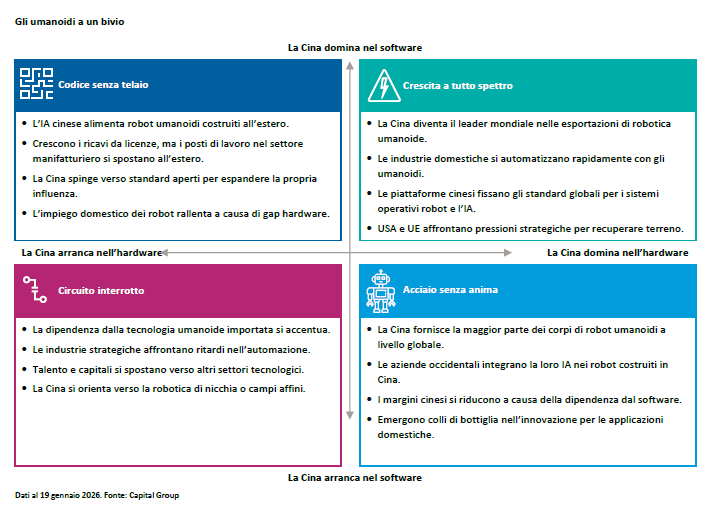
More than mere rivalry, the future could move toward a complex and globally interconnected value chain. It is plausible that one day Chinese factories will produce hundreds of thousands of humanoid units, each supported by a US-licensed AI operating system and equipped with a mix of Chinese actuators and American-designed chips. However, this dynamic could change drastically depending on China’s evolution in both software leadership and hardware leadership. On the software front, China has made rapid progress in generative AI; on the hardware front, proven execution capability in the electric vehicle sector and a maturing robotics supply chain suggest strong potential in terms of scalability, cost advantages, and rapid iteration.
Overall, these two dimensions—whether China maintains or loses its advantage in software and whether it retains or loses primacy in hardware—represent the main uncertainties that will define the future of humanoid robotics. These uncertainties outline the four quadrants of the scenario framework below: from a future where China leads in both hardware and software, to one where it falls behind in both, with two possible intermediate scenarios.
The resulting scenario analysis maps these possibilities into four plausible industrial trajectories, helping investors and industry leaders anticipate how different combinations of hardware and software leadership could reshape global competition, supply chains, and value distribution in humanoid robotics.