

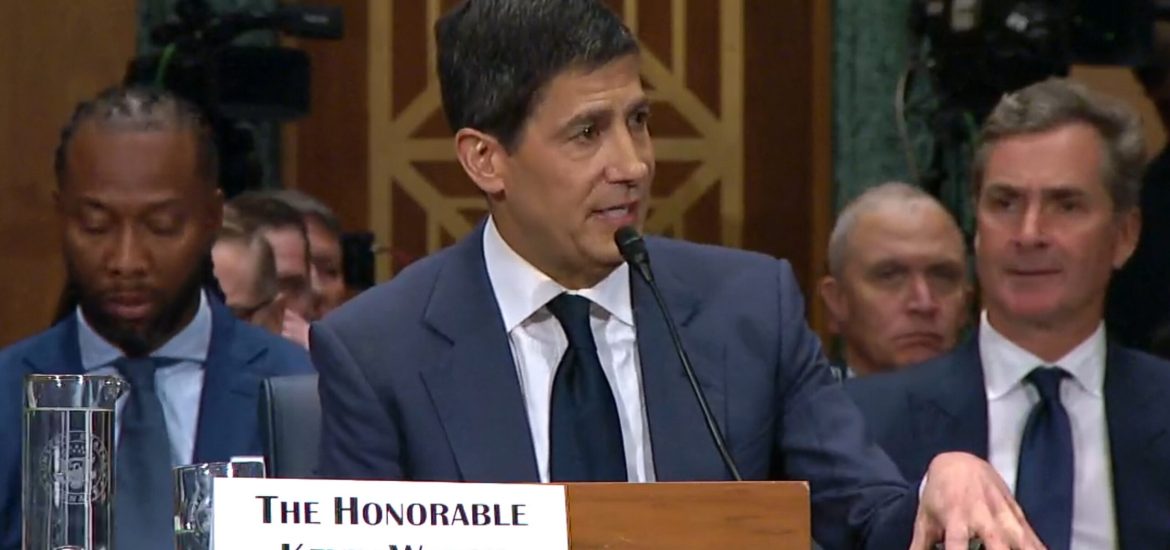

This week Kevin Warsh assumes the role of Chairman of the Board of Governors of the United States Federal Reserve. We expect him to adopt a measured but distinctive approach to monetary policy and to seek over time to modify the Fed’s strategy in several areas. However, any change will be evolutionary, not revolutionary.
Meanwhile, Warsh takes office during a period of macroeconomic turbulence. Inflation in the US remains above the Fed’s stated target, under pressure from geopolitical conflicts and energy prices. Labor markets have shown resilience but also face uncertainties on several fronts, including transformative technology, AI, with the potential to reshape the workforce.
The conflicting currents in the US outlook pose risks to both sides of the Fed’s dual mandate – price stability and maximum employment – and suggest it may remain in a wait-and-see mode for some time, possibly even beyond 2026. Warsh is confident and persuasive and, as chairman, will be able to steer Fed discussions in the direction he deems appropriate, but monetary policy will remain a committee decision.
EVOLUTIONS IN MONETARY POLICY RULES, COMMUNICATION, AND THE BALANCE SHEET
Warsh has long advocated rule-based monetary policy, stating that central banks should rely less on discretion and follow a clear framework for monetary policy. He believes leadership has been too ad hoc and insufficiently anchored to a guiding framework, such as a Taylor rule that pushes for policy adjustments based on data, trends, and mathematical formulas. He may seek to steer policy toward a more disciplined approach.
Warsh has also expressed skepticism regarding Fed communication: in simple terms, he believes Fed officials talk too much, especially through detailed guidance on future policies. He fears that excessive guidance could confuse markets and limit policymakers’ flexibility. During his Senate hearing, Warsh even indicated willingness to reduce regular post-meeting press conferences, something we doubt he will ultimately choose to do. A recalibration of Fed communication under Warsh’s leadership is certainly possible and could be welcomed in some circles as a way to improve clarity and agility in monetary policy. That said, markets have grown accustomed to a couple of decades of “open-mouth operations,” and other Fed officials may continue to voice their views in numerous public settings.
The Fed’s balance sheet could be another focal point. Warsh has criticized the size and composition of the Fed’s massive bond portfolio, built through several quantitative easing cycles. We expect him to closely examine the balance sheet strategy. He has proposed ideas to reduce it gradually, holding shorter-term assets and establishing a clearer framework for its long-term size. However, as with decisions to cut or raise interest rates, any changes to balance sheet policy will require a majority vote of the Federal Open Market Committee (FOMC).
WHAT TO EXPECT FROM A WARSH-LED FED
Under Chairman Warsh’s leadership, we can expect the Fed to maintain its historic independence and credibility. He has the power to act independently and not be swayed by politics; clearly, he has his own ideas and will make decisions based on economic data. I expect him to preserve the Fed’s institutional credibility and the tradition of a decision-making process founded on the committee’s collegial work. The Fed’s independence remains well entrenched in Congress and markets, which strengthens Warsh’s ability to lead it effectively.
A Warsh-led Fed will likely recalibrate monetary policy strategy rather than make abrupt changes. This could include a gradual normalization of the balance sheet, shifting to shorter-duration securities, and simplifying communications to avoid over-committing to future moves. These adjustments will likely be introduced cautiously and thoughtfully, and we expect core principles such as independence, data-dependence, and committee consensus to remain intact even as Warsh gradually imprints his own mark on monetary policy.
In fact, a Fed chairman’s power lies in persuasion, not unilateral action. Warsh will need to secure the support of the majority (i.e., at least six other voting members) of the FOMC to implement any significant change. Although we often characterize the Fed by its chairman’s name – the “Warsh Fed,” the “Powell Fed,” the “Greenspan Fed” – it is and always has been a group, a committee. The chairman’s influence derives from the ability to lead colleagues toward consensus, and Warsh can be a persuasive leader – a trait he will need in this role.
BROAD EXPERIENCE IN POLICY AND MARKETS
As I discussed in January when Warsh was appointed, his broad experience makes him well qualified to lead the Fed. During his previous term as governor from 2006 to 2011, he stood out during the global financial crisis as a key liaison figure between the Fed and financial markets. He is well known and respected in both political and market circles, and the combination of Fed experience gained during a crisis period and private sector knowledge gives him a valuable perspective on future monetary policy challenges.
Warsh’s Fed may be more open to adapting its framework. This could introduce uncertainty in the short term but over time could foster greater clarity. It is a significant transition that will shape not only the policy path but also how that policy is understood.


