

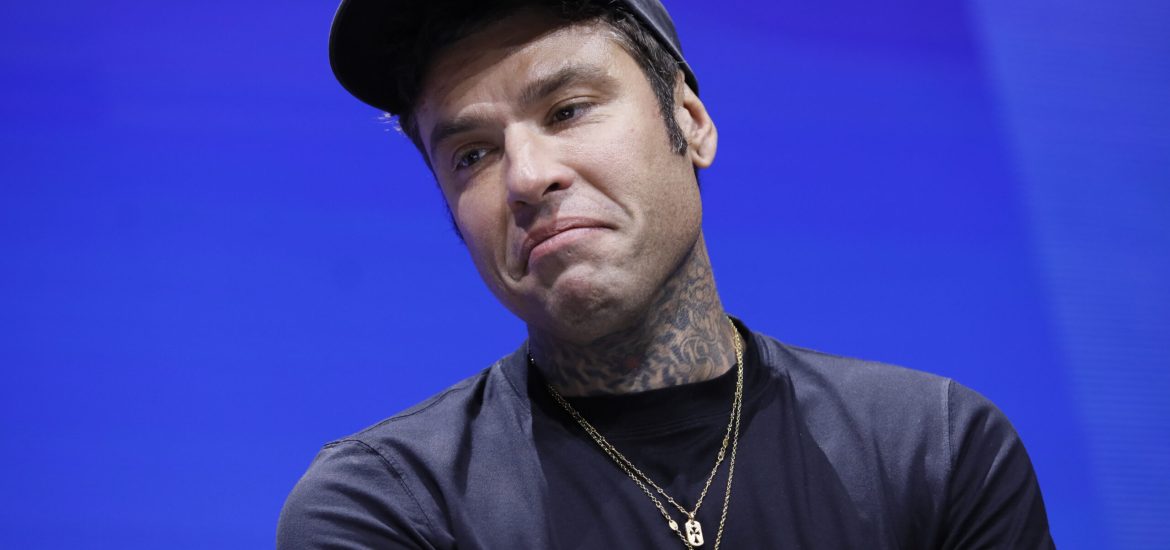

Last Friday, Doom Entertainment, Fedez’s talent management agency, triumphantly announced that the podcast is no longer just an editorial format, but “one of the central spaces of political debate,” and that this revolution in Italy would be driven by Pulp Podcast, the project by Fedez and Mr. Marra, produced by Doom Entertainment.
The announcement follows one from a few days earlier, by Pulp Podcast itself, which on its Instagram page indulged in a long gush about how much Pulp is followed and influential.
The carousel is a cornucopia of charts and numbers; all positive, all overflowing.
Four million, no wait, five million interactions!
Pulp dominates, a success across the board. Fedez and Marra’s show is such a revolutionary format that it marks a turning point: the “podcastization of politics.” This is an important milestone, a fundamental stage of magnificent and progressive fortunes; if only we were able to realize it.
Yes, because the so-called podcastization of politics has a problem of elusiveness. Paraphrasing Saint Augustine, I would say I know perfectly well what podcastization is until someone asks me; but if I have to explain it, I no longer know.
Pulp, however, seems to really know what it is, and above all seems to know that the podcastization of politics is a good thing, something worth investing energy in.
On the other hand, why doubt it?
There in the carousel are, laid out plainly, the numbers from a communication agency proving it. Fedez and Marra’s podcast is watched, and a lot. That’s enough after all.
The data cannot be ignored, they are bothersome. To prove that Pulp is wrong, one would have to deny reality, and only madmen or dogmatists deny reality. Their carousel puts you in an uncomfortable position: if you don’t like the podcastization of politics, you just have to challenge the numbers, which by definition cannot be challenged.
But this is precisely the great mistake of Pulp Podcast: thinking that the goodness of an editorial project – and not its effectiveness, which is different – is measured only in quantitative terms.
If that were the case, we would have to say that even the famous Bestia of the Lega, the imposing social propaganda machine set up years ago by Luca Morisi, is a good thing, because in some way it was successful, it produced results. Not everything boils down to numbers, especially if the goal of an editorial project is something as vague as the “podcastization of politics.”
Again: what is meant by this expression? It is likely that Fedez and Marra think of something different from its tautological meaning, that is, the simple transfer of political debates from television to podcasts.
In that case, Pulp Podcast’s format would be a few years late compared to the same trend launched in the United States. The migration from one communication medium to another has already happened. No, the podcastization of politics must be something different.
It could be a matter of format, but beyond the somewhat goofy and accommodating style – very accommodating, extremely accommodating – what would be Pulp’s big novelty? Certainly, you don’t watch Fedez and Marra’s show to witness a sharp debate that challenges the guests. The reason is that, except for some noble efforts by Marra, the two hosts simply do not have the skills to moderate a debate on major political issues.
Basically, they are not prepared on the dossiers, and if they prepare, they are not very incisive dialectically, leaving a lot of room for the guests – have we already said it’s an accommodating podcast? The podcastization of politics, therefore, hardly marks the birth of a revolutionary format. So what is it?
Indirectly, the producers of Pulp themselves suggest the correct interpretation. In their carousel, at one point they write that “when format, informal language, and strong guests combine, the effect is evident: audiences that other content does not intercept are reached in a short time. This is where the podcastization of politics is born.”
And it continues: “for leaders [politicians] aiming to reach broad and cross-sectional audiences, increasingly young and active online, [the podcast] becomes a space that is hard to avoid.” It is the vision of the podcast as a tool in the hands of politics to reach new audience segments. Pulp Podcast’s greatest ambition is to become indispensable, to be the monopolist through which all communication teams of major parties must pass to pay their toll.
It is an idea of the podcast as a form of reversed gatekeeping: you have to go through me not because I act as a filter that improves content (classic gatekeeping), but because I am the only one who allows you to reach a certain audience. Grant me the toll of views and the gates to new audience segments will open wide before you.
BEHIND THE NUMBERS
The podcastization of politics, as conceived by Pulp Podcast, is simply about generating many numbers. Behind it, there is no great editorial project, no vision. The podcast’s goal is… to generate many interactions, beat other competitors, and become number one in that market segment. Period, nothing else.
There is no intention to improve public debate in any way; because while it is true that the extended times of podcasts are preferable to the frenzy of television shows – as they allow for in-depth development of a topic – it is also true that when dealing with politics one cannot give up any form of resistance.
Moderators cannot just introduce the topics on the agenda; for that, timestamps and navigable thematic sections of YouTube videos suffice.
When guests are politicians and party leaders, the moderator, if they want to do their job well, must use their expertise (if they have it) to generate some friction: clarify, occasionally interrupt, ask for evidence, try to dismantle slogans.
Otherwise, the long podcast time is not an advantage but a multiplier of rhetoric. Without contradiction, the conversation slowly slips into a rally; and the format, instead of correcting television’s limits, amplifies them.
Pulp Podcast, instead, often gives the impression of trading competent moderation for simple confrontation between parties: the idea is that just opposing two guests with opposite positions is enough for some form of mutual correction to emerge.
General Roberto Vannacci says that the Italian Constitution is not antifascist? Well, let him say it, at most Matteo Renzi will correct him, if he wants to earn a social media clip with an empty-net goal. How this should benefit the audience? Unknown.
Let us at least hope that in the long run, when talking about politics, we do not arrive at the “pulpization” of podcasts.
(Excerpt from Stefano Feltri’s Notes)


