

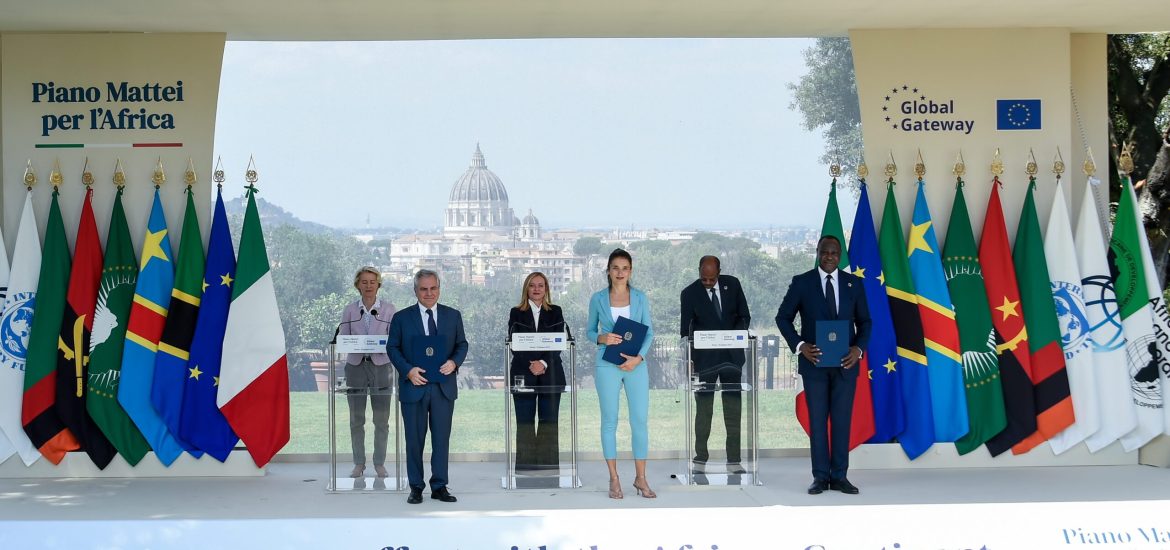

The European Union, with the launch of the Global Gateway program in 2021, has marked a significant turning point in its cooperation policy with the African continent.
As highlighted by ISPI in a report dedicated to the program, the Union’s goal is clear: no longer just providing traditional aid, but promoting the development of large strategic infrastructure corridors, especially in West Africa.
Global Gateway projects represent a dual tool: for African countries, they serve to strengthen regional integration and seize the opportunities of the African Continental Free Trade Area (AfCFTA), while for Brussels they constitute a concrete way to consolidate trade, political, and economic ties with an increasingly important region.
Global Gateway and strategic corridors in West Africa
Through Global Gateway, the EU has shifted focus from implementing isolated projects to creating fully integrated corridors capable of connecting ports, roads, railways, and regional value chains.
In West Africa, four priority corridors have been identified in an area already of considerable importance to Europe: as ISPI recalls, in 2025 bilateral trade exceeded 68 billion euros, representing over 15% of total EU-Africa trade, while European direct investments stand at around 54 billion.
These interventions are designed to integrate with the objectives of the AfCFTA and with the Programme for Infrastructure Development, the African Union’s main continental infrastructure development program.
Despite the interest shown during the EU-Regional Business Forum in Abidjan in March 2026, the path remains challenging. Private capital participation is still very limited, hindered by political risks, instability, and governance shortcomings.
The coastal corridors
Since 80% of extra-African trade passes through ports, effectively connecting land infrastructure to the port system is essential.
The most ambitious project is undoubtedly the Abidjan-Lagos corridor: a modern six-lane highway of 1,080 kilometers crossing Ivory Coast, Ghana, Togo, Benin, and Nigeria.
With an estimated cost of 15 billion dollars, this infrastructure is set to become the backbone of one of the region’s most dynamic areas. Nigeria, Ivory Coast, and Ghana, which alone generate 60% of European trade in the area, represent the economic heart of the corridor.
Born in 2013 and formalized by a treaty the following year, the project has had a very long gestation. Only in February this year was the board of directors of the Abidjan-Lagos Corridor Management Authority (ALCoMA), the supranational body responsible for building and managing the work, established.
Technical studies are completed and there is interest from private investors and multilateral banks, but construction is scheduled to start by the end of 2026.
Alongside this, the Praia-Dakar-Abidjan corridor is progressing, which will extend over 3,000 km and will feature a strong maritime component between Cape Verde and Dakar. The project involves eight countries of the Economic Community of West African States (ECOWAS) and is still in its early stages.
A first concrete step was taken with European funding of 38.1 million euros, of which 17 million is a grant, for the expansion of the port of Praia.
Both corridors, conceived as complementary, aim to reduce transport times and costs, promote industrial integration, and strengthen trade ties with Europe.
The inland corridors
On the north-south front, the goal is to connect coastal ports to landlocked countries, particularly Burkina Faso, Mali, and Niger. Here the EU has identified two main corridors: Abidjan-Ouagadougou and Cotonou-Niamey.
Both, however, face a complicated geopolitical context. After leaving ECOWAS in January 2025 and the creation of the Sahel States Alliance (AES), the three Sahelian countries have taken an openly anti-Western stance.
The Cotonou-Niamey corridor is the most compromised: funding was frozen after the 2023 coup in Niger and currently no operational technical channels exist.
The case of Abidjan-Ouagadougou is more complex, involving road upgrades and railway renewal. Despite Burkina Faso’s exit from ECOWAS, some technical channels remain open in this case.
Both coastal and Sahelian countries are aware of their strong economic interdependence, and the EU seems to rely precisely on this pragmatism to keep dialogue alive even in the absence of political convergence.
However, the overall risk remains high. The expanding jihadist threat, frequent checkpoints, non-tariff barriers, and recent protectionist measures by the AES, such as tariffs introduced in April 2025, make these projects unattractive to private investors.
The financing model
Global Gateway is based on the logic of blended finance: European public funds and concessional loans should serve to reduce risks and attract private capital.
In practice, however, private involvement struggles to take off. Political and security risks, especially in the Sahel, discourage investors. Most projects therefore advance thanks to public resources and multilateral development banks.
Complicating the picture, ISPI points out, are also the region’s structural weaknesses, including the gap between ECOWAS’s advanced regulations and their actual implementation, and the growing competition among ports. Abidjan, in particular, recorded a record traffic of 46.6 million tons in 2025, consolidating its position as a hub for Sahelian countries.
This success, while positive on one hand, risks creating tensions with other ports in the region.


