

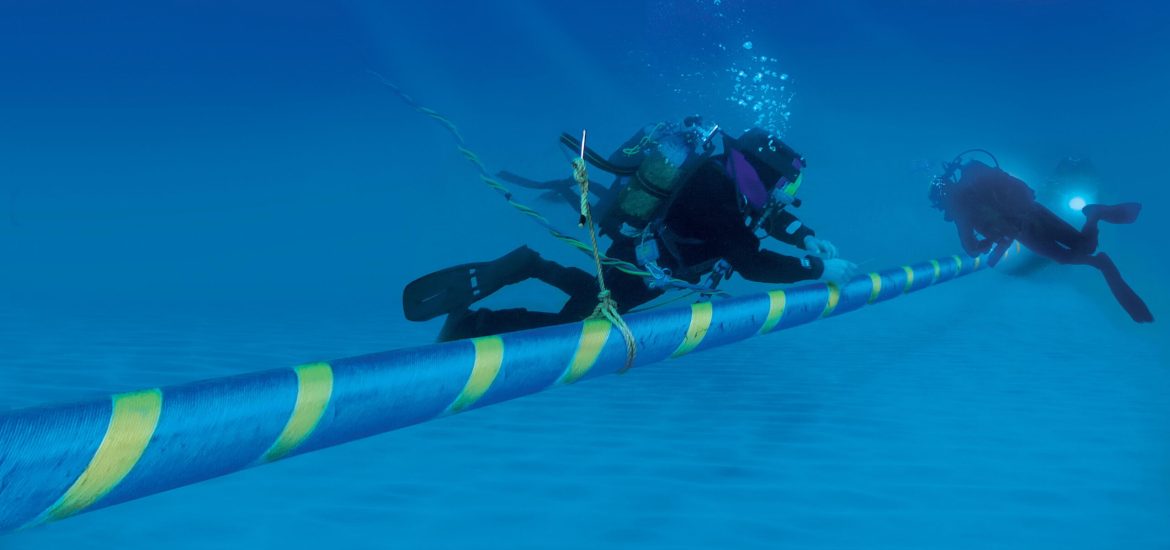

The suspension of submarine cable projects in the Persian Gulf, the Strait of Hormuz, and the Red Sea represents a serious setback to the region’s aspirations to become a global hub for AI, cloud computing, and the digital economy.
As highlighted by the Financial Times, which dedicates a specific report to the topic, despite the end of hostilities between the United States and Iran, industry operators have decided to keep the work on hold indefinitely due to security risks that have not yet dissipated.
This situation not only calls into question the substantial investments already made by Gulf countries in data centers and digital infrastructure but also risks eroding international investor confidence and complicating the post-oil economic transition of these states.
The problem, the City newspaper points out, goes far beyond a simple technical delay: it touches the core of the diversification strategies that have driven the UAE, Saudi Arabia, Qatar, and other Gulf Cooperation Council (GCC) members for years.
An indefinite suspension
According to Alan Mauldin, research director at TeleGeography, all submarine cable projects in the Strait of Hormuz and the Gulf have been “delayed indefinitely.”
A position shared by Ryan Sher, chief operating officer of West Indian Ocean Cable Company (WIOCC), a partner in the Meta-led 2Africa project: until there are concrete security guarantees, laying work will remain “on pause.”
This collective choice by operators reflects a cautious assessment of the geopolitical context, developed after months of tensions that have made the region’s waters too risky for delicate operations like cable laying.
Even after the reopening of the Strait of Hormuz, the perception of vulnerability remains high among investors. Mostafa Ahmed of the Emirati think tank Al Habtoor Research Centre emphasizes that the area has gained the reputation of a precarious digital bottleneck that will not easily lose this stigma.
In practice, it will take a long time before investors consider these routes reliable again.
Consequences
GCC countries have invested billions of dollars in state-of-the-art data centers, cloud services, and AI projects, aiming to drastically reduce dependence on oil and position themselves as modern, competitive global economies.
However, as noted by Masha Kotkin, an energy and geopolitical analyst, the stalled cables “call into question the ambitions of these countries.”
Connectivity infrastructure is as crucial as capital, available energy, and access to the most advanced chips. Without reliable, high-capacity submarine links, even the most powerful data centers risk remaining isolated or underutilized.
The suspension of projects could also discourage new foreign investments, especially those still in the planning stages, while companies are unlikely to abandon those already underway but will proceed with much more caution.
Obstacles to restarting
Resuming laying work will require more than just an improvement in the political situation. Analysts indicate that it will be necessary to remap the seabed with sophisticated tools and carry out clearance of any mines or war remnants, complex, costly operations that require long times.
Specialized cable-laying ships, diverted to other projects during the peak tension period, will need to be redirected to the region, with timelines that could extend for many months and create further bottlenecks in the global infrastructure schedule.
Another critical issue is insurance policies. Force majeure clauses that forced operators to stop work will likely remain in effect until a prolonged period of peace and stability is recorded.
This strongly limits companies’ ability to restart sites quickly, even in the face of a decrease in military tensions.
Ripple effects
Several important international cables pass through the Strait of Hormuz, providing essential connectivity to the Middle East and acting as a bridge between Africa, Asia, and Europe.
Although the share of global traffic passing through this route is relatively modest, it is a “critical digital artery,” as Ahmed defines it.
Any disruption would have cascading effects on vast geographic areas, with India particularly exposed due to its growing dependence on these links for the digital economy.
Among the affected projects are Meta’s 2Africa Gulf segment, for which force majeure notices were reportedly issued by Alcatel Submarine Networks, the $700 million WorldLink project intended to connect various Gulf states, Ooredoo’s Fibre in Gulf, and Sea-Me-We 6, which connects Southeast Asia to Europe. The paralysis of these projects risks slowing down the entire regional digital ecosystem.
Geopolitical vulnerability
The current situation fits into a context of accumulated tensions over time. In 2024, three cables in the Red Sea were damaged by the anchor of a cargo ship sunk by the Houthis, forcing operators to reroute traffic and effectively rendering a significant section of 2Africa unusable for WIOCC. Sher spoke of a “massive investment” temporarily lost on that route.
Added to these episodes are acts of sabotage and the Iranian threat to impose tolls on cables in the strait, an intention that, although difficult to enforce practically, signals how Tehran considers these infrastructures as real strategic assets to be used in case of crisis.
Prysmian, a major Italian cable manufacturer active in the region, has noted growing customer concerns not only about quality and price but especially about the security of submarine infrastructures.
The search for alternatives
Faced with these risks, operators are accelerating route diversification. WIOCC is evaluating alternative routes through continental Africa and terrestrial solutions to reduce dependence on the Middle East.
However, Ryan Sher describes a climate of “resignation” in the sector: “There is no light at the end of the tunnel either on traditional routes or in the areas everyone was planning on.”
The search for alternative corridors has become more urgent, but finding routes that are equally efficient, capable, and secure is not simple. Meanwhile, the region risks losing momentum just as it seeks to position itself as a global digital hub of reference.


