



Artificial intelligence continues to evolve at a rapid pace. Models are improving, computing costs are decreasing, and companies are beginning to report tangible efficiency gains. At the same time, the AI investment cycle is taking on an increasingly structural character. Hyperscalers’ capital expenditures (capex), data center expansion, and financing of high-energy consumption projects are increasingly relying on debt markets. The increase in capex, rise in emissions, and drop in the cost of computing power (the hardware resources needed to run AI) indicate the start of a capital deepening cycle, not a temporary rebound.
Politics is shaping the transition. Fiscal easing in parts of Europe, accommodative policies in Japan, and expected interest rate adjustments in the United States should promote ongoing investments. Regulation is tightening, but the overall political context, especially against the backdrop of national strategic competition, still aims to encourage adoption rather than hinder it.
Productivity gains are beginning to emerge
The result is strong momentum, albeit accompanied by some uncertainty. Adoption is spreading, but frictions remain in the real world. Investments are substantial, although returns will depend on how quickly these tools spread throughout the economy. The following scenarios are useful to outline how the transition to AI might unfold.
A framework to reflect on the future of AI:
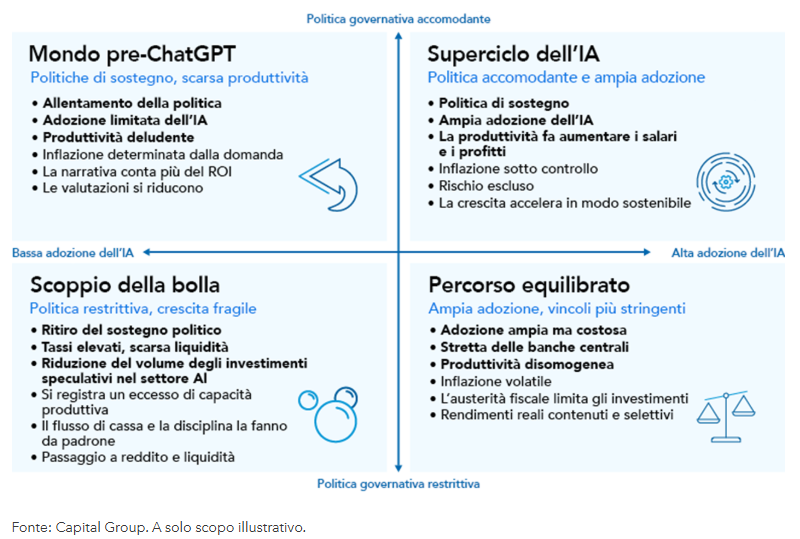
SCENARIO 1: AI SUPER CYCLE
In this scenario, AI becomes an integral part of all sectors. Companies reorganize workflows, automate routine tasks, and use AI tools for operational, analytical, and creative work. Early signs of productivity improvement and reduced computing capacity costs lower the barrier to wider adoption.
Supportive policies play a reinforcing role. Governments prioritize competitiveness, national productivity, and the strategic importance of AI-based sectors, creating an environment that encourages continuous investment.
A sustained investment cycle also emerges. Expansion of data center capacity and related infrastructure fuels persistent demand for high-energy-consuming equipment and materials, while lower unit computing costs make it easier for companies to increase AI usage. With accommodative policies and accessible financing alongside widespread adoption, the interaction between the two axes strengthens each other: productivity increases support earnings, which in turn support investments, stimulating further use. The result is a prolonged period of high growth and improving margins.
SCENARIO 2: BALANCED PATH
In this scenario, AI continues to advance, but the pace varies significantly among companies and sectors. Some firms rapidly expand adoption, while others proceed cautiously due to costs, power constraints, data availability issues, or regulatory uncertainty. Progress is real but uneven. The trajectory resembles a staircase rather than an escalator.
Several practical constraints contribute to this uneven progression. In some sectors, financing costs remain high or budget priorities limit how quickly companies can reorganize. Elsewhere, companies work with legacy systems or adapt to evolving regulatory standards that slow full integration. Political signals can also be mixed: favorable in some jurisdictions, more cautious in others. These frictions do not stop momentum but produce a pattern where some sectors move quickly while others wait for clearer economic conditions or a more favorable political environment.
SCENARIO 3: BUBBLE BURST
In this scenario, investments precede realized returns, while political or financial conditions become less favorable. Higher financing costs, tighter credit standards, or a shift in risk appetite make it harder to fund new projects. Fiscal positions may also become more constrained, pushing governments to curb support or prioritize other areas. Regulatory oversight could increase, particularly in sectors facing data security issues, competitive dynamics, or labor replacement concerns. The combined effect is a tightening of the overall political environment that amplifies existing concerns about returns.
Meanwhile, some data center projects experience delays, and parts of the energy and semiconductor supply chains may prove oversized in the short term. Companies reassess the pace of implementation, and investors shift toward stability. The main risk is not that AI disappears, but that investments outpace the underlying economy.
SCENARIO 4: RETURN TO THE PRE-CHATGPT WORLD
In this scenario, AI never becomes the catalyst many expected. Adoption remains marginal: tools are tested, dashboards improved, some workflows partially automated, but radical change never materializes. Companies experiment without fully committing, held back by fragmented systems, heterogeneous databases, and limited capacity to absorb change. AI proves useful in some cases but fails to change how companies operate on a large scale, leaving productivity gains modest and limited to isolated functions rather than the economy at large.
Even with supportive policies and low-cost capital, momentum slows. Funding flows remain available, but investments gravitate toward proven technologies with clearer returns. Liquidity supports markets but fuels narratives more than production, and valuations become increasingly disconnected from real efficiency improvements. Growth continues to rely on traditional drivers while AI plays a marginal role, shaping expectations more than outcomes. The result is a cycle defined by optimism without transformation: a world where AI matters, but not enough to move the macroeconomic needle.
IMPLICATIONS FOR INVESTORS
Early signals currently suggest that AI-driven expansion has already begun. Productivity increases are becoming evident in data, investments in AI-related infrastructure remain high, and the political context in major economies is broadly favorable to continued innovation.
In this context, the body of evidence leans toward a constructive path, where adoption spreads, productivity rises, and capital continues to be allocated to AI development. But the picture is not unambiguous. A world characterized by steady but uneven progress remains entirely plausible, and there is always the possibility that expectations outpace returns or that adoption settles at a more stable level. Each scenario reflects a different alignment of the two critical axes: how widely AI spreads in the economy and whether political and financial conditions remain favorable or begin to tighten.
For investors, the practical task is not to choose a single outcome but to monitor signals indicating which direction we are moving along these axes: the pace of integration in companies, evidence of lasting productivity increases, the pace of capital spending, and how policymakers respond to the evolving cycle. AI is advancing rapidly; the economy will adjust more gradually. Staying attuned to changes that bring us closer to one scenario rather than another will be essential as this transition unfolds.


