



Donald Trump won the election backed by Elon Musk and has never hidden his intention to give free rein to companies developing new technologies; in fact, he made it one of the pillars of his government.
Excelling in artificial intelligence is a goal the American president set not only to dominate the market but also to have a geopolitical role of some significance. And citizens seemed to have believed in his vision.
In recent months, however, the mood is changing, and the surprising thing is that the spreading unease is transversal, both in the sense that it involves people with opposing political views and in that it brings together individuals from very different social backgrounds, classes, and ages.
In rural areas, people take to the streets to protest against the construction sites of new data centers necessary for the development of artificial intelligence, while at universities students protest against those who praise AI’s potential.
For decades, data centers have enjoyed extraordinary political invisibility. Considered as neutral infrastructure, like a power line or an aqueduct, they were treated by local administrations with little attention or, rather, attracted with tax exemptions and accelerated approvals.
Since 2021, spending on data center construction in the United States has grown exponentially due to AI, and in Virginia, the state with the highest number of data centers, the energy demand of these facilities is skyrocketing.
In Texas, a considerable increase in water consumption is expected, with the peculiarity that server cooling occurs through evaporation, so the water is no longer treatable but dissipates into the air.
Technology has thus rapidly entered citizens’ homes in the form of higher electricity bills, drained dams, and pollution, hence the increasingly widespread and organized protests in rural areas.
In a very different context, on May 8, 2026, at the University of Central Florida, Gloria Caulfield began her speech by calling artificial intelligence “the next industrial revolution” and was unexpectedly booed by the student audience. When, astonished, she asked to continue and stated that a few years ago AI did not exist, she was overwhelmed with applause, only to receive all the boos and “boos” again as soon as she tried to praise AI as the engine of the future.
Students perhaps do not think so much about bills and green fields occupied by machines, although they have a strong sensitivity to environmental respect. Their concern is for the jobs that will be lost, what will become of all they have studied, and having to bend to activities ancillary to AI development.
As protests spread, an NBC News poll from March 2026 produced an almost surreal result.
On one hand, it confirms the climate of hostility, with artificial intelligence registering a net approval rating of minus 20 points, lower than that of ICE, the federal immigration agency, a protagonist of one of the most contested policies in recent years, and lower than that of the Democratic Party and Donald Trump.
On the other hand, however, it highlights that the number of people who declare using artificial intelligence tools every day has risen to 56 percent, twelve points higher than in December 2025.
The same data is also found in another Quinnipiac poll from April 2026, which notes that 76 percent of Americans say they do not trust AI, but only 27 percent have never used it.
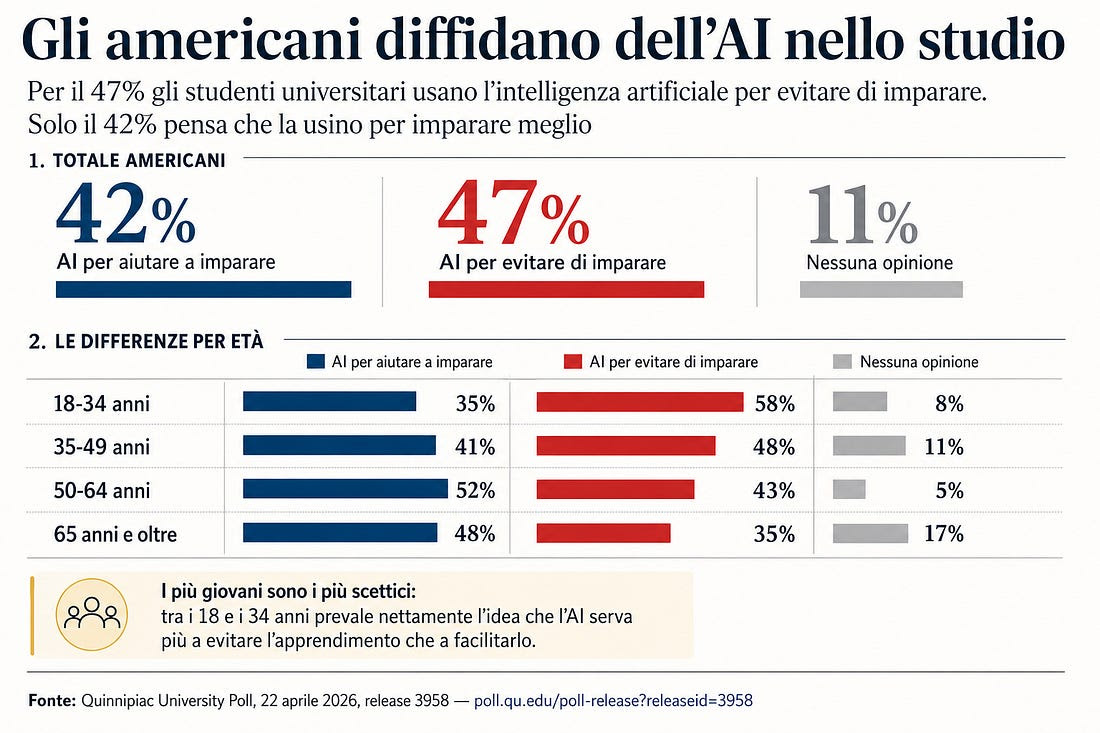
In short, Americans seem to use ChatGPT to write work emails and do research in the morning, then in the evening sign petitions against data centers or boo professors who praise the technology they themselves use.
It seems contradictory, but perhaps it is not entirely so.
It is as if citizens were rationally trapped in a reality they cannot escape. They use AI because the market forces them to and they cannot help it, but they contest it because they understand what it is doing to their lives.
We are not facing a form of Luddism, but a new phenomenon.
The Luddites were workers who rejected a future in which they did not recognize themselves and refused to use new machines so as not to lose the skills of their trades.
Americans in 2026 protest against something that is fully within their grasp, that they know well and that in some ways they have even fueled, and this is the breaking point with all previous waves of technological skepticism.
There is no dichotomy between those who understand technology and those who fear it, between those who use it and those who do not, but a population that cannot do without it and understands its capabilities but does not approve of the future being built on its basis.
You cannot give up AI without giving up competing in the labor market, you cannot stop using digital services that integrate it without isolating yourself from a significant part of social and economic life, and even less can you build a career in finance, law, technology, or communication pretending the tool does not exist.
The boos at graduation ceremonies are a protest against a sort of hypocrisy and express a crisis of trust.
For years, the American tech industry has enjoyed the benefits of a sort of implicit social pact, in which in exchange for many sacrifices the illusion of participation in democratic life and freedom of thought was waved. The internet would give everyone a voice, social media would connect the world, the cloud would lower costs, and AI would free humans from repetitive jobs to allow them to dedicate themselves to creative ones.
These were the commitments, unspoken but clear, that justified the concentration of power in the hands of an ever smaller number of companies and founders.
Today that balance has broken.
Chatbots confirm falsehoods with a confident tone, deepfakes destroy reputations, algorithmic decisions on mortgages and hiring are opaque and unappealable, while data collection to train models happens without compensating those who produced that data. Above all, the promise of work freed from repetitive tasks has turned into the elimination of “entry-level” jobs, which are precisely those the new generation is seeking.
All this is the result of absent governance and unkept promises.
The problem is not the technology itself but who decides how it is developed and used and who bears the costs.
For those with the power to decide, the time has come to listen carefully to these voices of dissent before rushing into the whirlwind of enthusiasm for artificial intelligence that is supposed to solve all the problems of a country and a system.
The regulatory flow, instead, more than the result of careful economic and social analysis, seems like a desperate race dictated by the urgency to take action.
Reflection and listening would be a duty in everyone’s interest, or even selfishly, a necessity for the very survival of an increasingly useless political system.
(Excerpt from the blog Notes by Stefano Feltri)


