



Another reason why economic activity is holding up better than many feared is that today the world is more resilient to energy shocks. Our base scenario is that maritime traffic through the Strait of Hormuz begins to recover between the end of the second quarter and the beginning of the third quarter. If this happens, the global economy should suffer limited lasting damage.
In our view, we are not in the seventies, nor even more so in 2022. Firstly, crude oil prices would have to exceed $200 per barrel to reflect the price increases observed in 1973-1974. Secondly, oil accounted for 44% of the global primary energy supply in 1971, compared to 30% in 2025, based on data from the International Energy Agency. Finally, the oil intensity of global GDP is about half of what it was in 1990 and, in our opinion, much lower than in 1970.1 The Strait of Hormuz is a critical maritime bottleneck for energy flows. According to some estimates, about 20-25% of oil and liquefied natural gas (LNG) trade passes through the Strait.
Many of these flows of oil and gas, as well as other goods such as sulfur, helium, and others, have suffered severe disruptions. However, countries and companies seem to have adapted more quickly than we might have expected in the past. Although the IEA estimates that Gulf countries’ production dropped by 14.4 million barrels per day compared to pre-war levels (during April), global supply decreased by a lesser amount, 12.8 million barrels per day, as production increased in other parts of the world. The production decline in countries affected by the closure of the Strait of Hormuz is perhaps less than initially feared thanks to more intensive use of east-west pipelines in Saudi Arabia and the United Arab Emirates (UAE), which allow bypassing the Strait. Further mitigating the shock is the fact that most IEA member countries held stocks exceeding 90 days of net imports, with an average of 140 days among net importers.
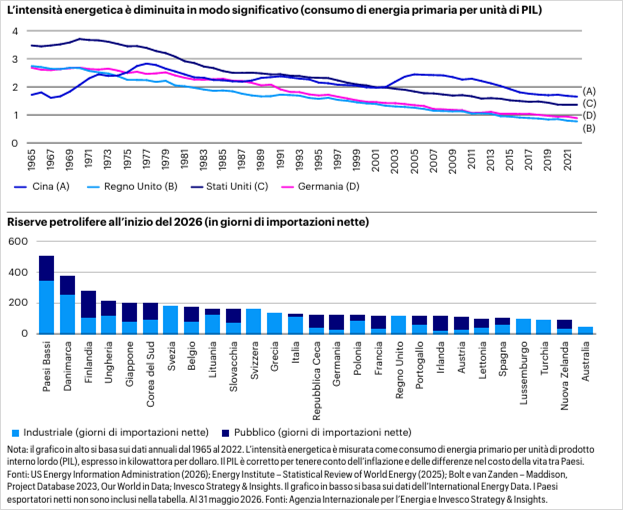
This suggests that, at the current rate of import reduction, the average country has enough stocks for over a year. According to some sources, China has some of the largest reserves. Moreover, it has shown willingness to release refined product reserves to neighboring countries, which we consider a positive signal for its relative energy security. We also believe it unlikely that all countries are experiencing the same import decline. For example, Asian countries were particularly dependent on imports from the Middle East, especially Japan, South Korea, and India. We doubt that governments want to see their reserves depleted, especially since this could damage some storage facilities. Finally, bottlenecks could still occur in some products for which Middle Eastern refining capacity cannot be replaced, such as shortages of jet fuel. Nevertheless, we believe there could be sufficient stocks to allow most countries to get through the third quarter of 2026 without a significant demand shock.


