

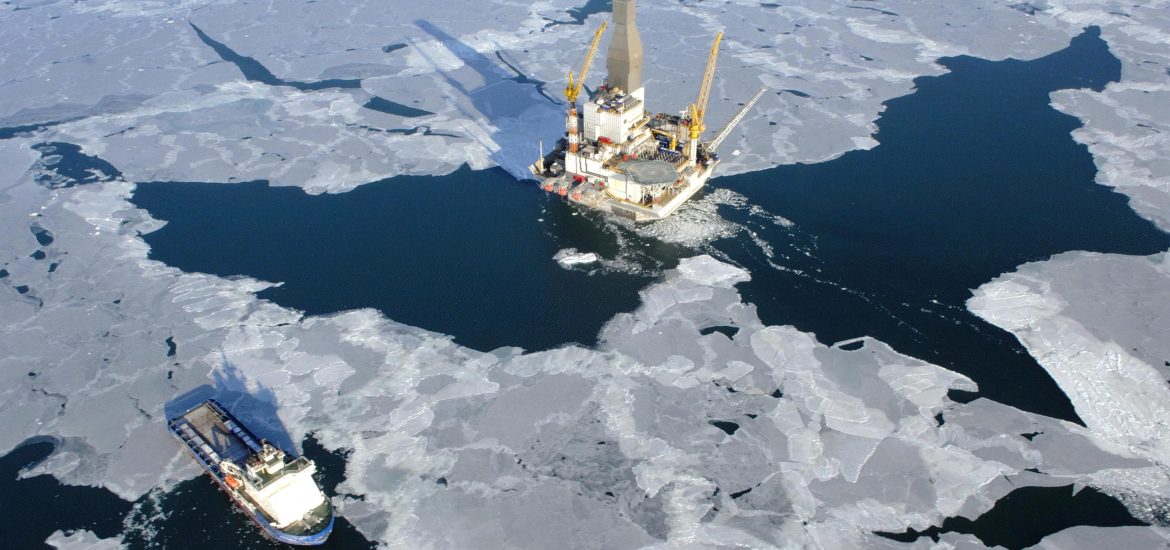

After years of seemingly irreversible decline, Alaska’s oil sector is experiencing a surprising revival.
As highlighted by Bloomberg, which devotes a lengthy article to the Alaska case, new significant geological discoveries, a more favorable regulatory framework under the Trump administration, and the strong return of major international companies are revitalizing a region that just fifteen years ago seemed destined for a slow abandonment.
The Decline of the North Slope and the TAPS Crisis
At the beginning of 2009, the situation on Alaska’s North Slope appeared dramatic.
Crude oil production had plummeted to 567,000 barrels per day, just a quarter of the two million barrels per day peak reached twenty years earlier.
John Kurz, then senior operations manager for BP at Greater Prudhoe Bay, described an industry that seemed headed for the end. There was serious concern that the Trans Alaska Pipeline System (TAPS) might shut down permanently: with such a reduced flow, the oil risked moving too slowly, cooling and solidifying inside the pipeline, creating paraffin build-ups.
Many professionals, including Kurz, decided to leave Alaska in search of more stable opportunities abroad, convinced that Alaska’s oil golden era was behind them.
Kurz’s Return and the Shift in Political Climate
In 2023, Kurz was called back to Alaska to take the helm of Alyeska Pipeline Service Co., the company responsible for TAPS. His return symbolically represents the profound change underway in the region.
Two decisive factors contributed to this recovery: significant new geological discoveries and, above all, an administration strongly oriented towards energy development.
Hours after taking office, Trump signed executive orders to unlock oil, gas, and mineral resources, removing numerous previously introduced restrictions and simplifying permitting procedures.
These measures quickly restored investor confidence, transforming Alaska into one of the pillars of the American “energy dominance” agenda.
The Alaska National Petroleum Reserve
The sector’s focus is particularly on the Alaska National Petroleum Reserve (NPRA), a vast federal area of about 23 million acres in the northwest of the state, which remained relatively unexplored for a long time.
In March, a record federal auction took place: ConocoPhillips, Shell, ExxonMobil, Santos, and seven other companies collectively bid nearly $164 million for new oil lease contracts.
Particularly significant was the return of major operators who had previously abandoned or reduced their presence in Alaska. ExxonMobil, which had not drilled in the state since the 1990s, won 23 leases. Shell, which exited in 2015 declaring it was leaving the state “for the foreseeable future,” re-entered the market in partnership with Repsol.
This influx of capital and companies has been interpreted as a clear vote of confidence both in the quality of the subsurface and in the durability of the new regulatory policies.
The Nanushuk Formation and Recent Major Discoveries
The true catalyst for this renewed interest has been the Nanushuk formation.
A 2013 discovery by independent driller Bill Armstrong, made together with Repsol, revealed a potential vastly exceeding previous estimates. Additional confirmation wells between 2015 and 2017 confirmed the formation’s vastness.
Today, the first commercial project, the Santos-Repsol Pikka project, has started producing initial barrels, with a projected capacity of about 80,000 barrels per day. About thirty miles away, ConocoPhillips is advancing the large Willow project, with recoverable reserves around 600 million barrels and commercial production expected to begin in early 2029.
Other positive discoveries, such as Quokka and Sockeye, are further fueling overall enthusiasm.
Potential of the Alaska Basin
According to estimates by the US Geological Survey, the NPRA alone contains about 8.7 billion barrels of recoverable oil.
Compared to many fields in the 48 continental states, Alaska’s conventional fields are larger and characterized by a slower production decline, ensuring a longer useful life and potentially greater profitability.
Despite operational challenges – temperatures that can drop to -30°F, limited seasonal windows for operations, and the need to build ice roads and artificial platforms – Wood Mackenzie analysts emphasize that few areas in the world offer such an attractive combination of known resources and still unexplored potential.
As Ryan Lance, CEO of ConocoPhillips, stated, this is a true “Alaska renaissance,” with companies returning to look at the region to meet global demand for conventional oil.
Environmentalists’ Opposition
However, development is not without controversy.
Many Alaskan residents, especially in remote communities, consider the oil industry the only concrete source of revenue to fund infrastructure, schools, and essential services. Conversely, environmentalists and numerous indigenous communities express strong concerns about the impact on fragile ecosystems.
The Natural Resources Defense Council speaks of a “gold rush mentality” that risks compromising one of the planet’s last great intact ecosystems, a crucial habitat for caribou, migratory birds from every continent, and whales along the Arctic coasts.
However, Alaskan Republicans in Congress have pushed legislative measures to make pro-development policies more stable and lasting, increasing investor confidence in the continuity of the regulatory framework.


