



At the end of last year, the Federal Reserve concluded its latest quantitative tightening (QT) program: the process through which it reduces its balance sheet by selling securities or letting them mature without reinvesting. From a peak of nearly $9 trillion, about 35% of the US GDP, the Fed had reduced the balance sheet by over $2 trillion. Unlike in 2019, when a spike in money market volatility caused the Fed to abruptly halt QT, this time the markets seemed almost unaware.
The absence of reactions is significant. As former Fed Chair Janet Yellen stated in 2017, QT is designed to proceed quietly in the background, “like watching paint dry.” In this respect, the smooth conclusion of this latest QT cycle appears to be a success.
So why do some Fed officials – Governor Stephen Miran and other staff members – along with Fed Chair candidate Kevin Warsh and several academics and former Fed staff (including Bill Nelson of the Bank Policy Institute) all advocate for further reduction? Many argue that the interaction between post-crisis banking regulations and the normal growth of bank deposits could lead to an ever-larger Fed balance sheet unless policies are adopted to mitigate banks’ demand for reserves.
In our view, there are several ways to achieve this goal, and foundations are already being laid to potentially restart a gradual QT process as early as the second half of next year. If implemented gradually and predictably, similar to previous programs, with ongoing monitoring of demand by large banks, we believe the overall market impact will be similar to recent experience: negligible.
FED LIABILITY DEMAND DETERMINES BALANCE SHEET SIZE
The size of the Fed’s balance sheet ultimately reflects the demand for its liabilities. Like any institution, the Fed’s balance sheet consists of assets and liabilities. The asset side is mainly composed of Treasuries and agency MBS securities. The liability side includes currency in circulation, bank reserves held at the Fed, and the Treasury’s general account.
Since the global financial crisis, the Fed has expanded its balance sheet to overcome the constraints of the effective lower bound on interest rates and provide additional monetary easing. It financed these asset purchases by issuing liabilities in the form of reserves to banks. The extent to which the Fed can normalize its balance sheet during more favorable economic periods will depend on banks’ demand for reserves and also on the public’s demand for currency.
Post-crisis regulations have increased reserve demand by requiring banks to hold certain levels of liquid and high-quality assets (e.g., reserves) to cover part of their funding – largely composed of deposits. Since banking activity involves lending and issuing lines of credit, which generate deposits, banks’ demand for reserves has gradually grown over time alongside the increase in bank deposits. This has led to a larger Fed balance sheet, while the ratio of central bank liquidity to bank deposits has fluctuated within a stable range, as the Fed expanded and contracted its assets for monetary policy reasons (see Figure 1).
Figure 1: The ratio of bank reserves to deposits has fluctuated but remained within range
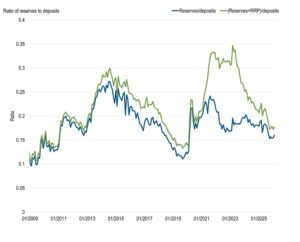
Source: Haver Analytics, Federal Reserve, PIMCO calculations as of February 28, 2026. RRP = reverse repurchase agreements.
FED BALANCE SHEET REDUCTION
Given the link between bank reserves and deposits, the Fed’s balance sheet is likely to continue expanding gradually over time, even without asset purchase programs (quantitative easing, or QE). Some observers fear that if no action is taken to reduce banks’ demand for reserves, the growing Treasury portfolio held by the Fed to meet that demand could distort market prices – including those in the Treasury repo markets – and reduce Treasury market liquidity. Beyond the Fed’s traditional responsibilities as lender of last resort, its increasingly large presence in the Treasury market could increase the need for the Fed to act as a market maker of last resort during stress periods, raising moral hazard concerns. Several officials and academics have also expressed worry that a continuously expanding Fed balance sheet could blur the line between monetary and fiscal policy, threatening central bank independence.
These concerns underpin recent research1, authored by Miran and other Fed economists, aimed at reducing banks’ demand for reserves despite rising deposits. The research quantifies a range of possible strategies that, if implemented, could reduce reserve demand by an additional $1,000–2,000 billion over time. These aggregate figures overstate what is likely and feasible within the next year or two; however, in our view, there is a subset of strategies that could be implemented more quickly, freeing about $500 billion in reserves.
Effective implementation of structural changes to how banks settle daily payments through the Fedwire Funds Service, aimed at reducing banks’ liquidity reserve needs, would likely take several years: the 24-hour Fedwire service has been available for just under three years and its usage remains limited.2 Other proposals would require reforms in managing the Treasury general account (which is outside the Fed’s control). Still others require changes in how the Fed conducts monetary policy and would involve market trade-offs, such as slightly higher money market volatility, and would require active daily reserve management.
Other strategies requiring changes in how the Fed applies liquidity requirements to large banks could have tangible impacts more quickly. Specifically, the Fed could modify liquidity, resolution, and stress test requirements for large banks to allow them to access the Fed’s discount window in severe stress scenarios. The Fed could also encourage banks to shift current reserves held toward other high-quality liquid assets (e.g., T-bills and short-term agency securities), which could be pledged as collateral at the Fed to obtain additional liquidity during market stress periods. If the Fed encouraged banks to use such instruments, it could also have the added benefit of reducing the stigma associated with their use.
Under current rules, the Fed requires banks to hold enough liquidity to survive episodes similar to the global financial crisis without needing to tap Fed liquidity lines. While this increases the safety and soundness of the entire banking system, reducing the need for the Fed to act as a safety net during severe stress, it results in a sizable Fed balance sheet during normal times – a situation some have described as excessive.
Fed Governor Michelle Bowman, Vice Chair for Supervision, has already initiated a series of efforts to ease and make more efficient the application of liquidity rules for large banks. We believe regulators could propose liquidity rule changes as early as the end of this year, with implementation not expected before January or April next year.
MONITORING AND MANAGING IMPACT
The Fed appears intent on implementing policies to reduce banks’ demand for reserves. But how will it verify if (and to what extent) banks’ reserve demand is actually decreasing? One indicator could be slight declines in money market rate spreads relative to the interest on reserves (IORB) paid by the Fed.
In the years following the Fed’s balance sheet expansion after the global financial crisis, overnight money market rates, both secured and unsecured, generally fluctuated between 5 and 10 basis points below the IORB (see Figure 2). When the Fed reduced reserves, these rates aligned more closely with the IORB or even slightly exceeded it. The fact that these rates are now falling again should indicate that strategies are working. However, even if money market rates decline, it remains to be seen by how much banks’ reserve demand is falling. To gain a clearer picture, Fed banking supervisors should conduct ongoing surveys among large banks regarding their minimum comfort levels.
To be able to restart quantitative easing, we believe the Fed should, at minimum, be reasonably certain that banks’ reserve demand has decreased by at least $500 billion, which we consider plausible in light of Miran’s study.
Figure 2: Money market spreads have tended to move in line with bank reserves
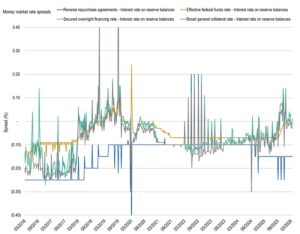
Source: Haver Analytics, Federal Reserve, PIMCO calculations as of April 1, 2026
WHAT DOES THIS MEAN FOR MARKETS IN GENERAL?
Probably not much, if implementation occurs gradually and with ongoing monitoring. Large banks will still be required to hold part of their assets in highly liquid securities. However, granting them greater flexibility outside of required reserves would likely involve a shift from those reserves toward Treasury securities. Banks would seek to maximize yields within the new regulatory framework, and now that the Treasury yield curve is upward sloping, they have an incentive to swap reserves for liquid, higher-yielding Treasury securities. Various academic models linking Treasury supply to the term premium investors require to hold such securities suggest a limited impact on yields. The Treasury could also steer issuance toward short-term maturities to limit market impact.
Overall, this suggests that changes in reserves held by banks could be absorbed by markets without significant repercussions – like watching paint dry.
1 Alyssa G. Anderson, Alessandro Barbarino, Anthony M. Diercks, and Stephen Miran, “A User’s Guide to Reducing the Federal Reserve’s Balance Sheet.” Federal Reserve Finance and Economics Discussion Series (March 2026).
2 Gara Afonso, Darrell Duffie, Lorenzo Rigon, Hyun Song Shin, “How Abundant Are Reserves? Evidence from the Wholesale Payment System.” Federal Reserve Bank of New York, Staff Report No. 1040 (November 2022).


