THE ATTACK BY THE USA AND ISRAEL ON IRAN AND TEHRAN’S RESPONSE
The joint attack by the USA and Israel on Iran on February 28 targeted the highest figures of the Tehran regime, starting with Iran’s Supreme Leader, Khamenei, up to the head of the armed forces Mousavi. As we write, attacks on Iranian military infrastructure are ongoing. Tehran has launched missiles and drones against Israel, UAE, Qatar, Kuwait, Bahrain, Jordan, and Saudi Arabia, not limiting itself to US bases but also hitting civilian infrastructure, such as the airports of Dubai, Abu Dhabi, and Doha, and ports in Oman. The attempt seems to be to destabilize the entire region, putting pressure on the Sunni monarchies so that they become spokespersons for the demand to reduce American military pressure.
THE ROLE OF THE STRAIT OF HORMUZ
The Pasdaran, the Iranian Revolutionary Guards, have declared the Strait of Hormuz closed, a vital hub for the transit of energy raw materials (worldwide, 20% of oil and 20% of liquefied gas); other Iranian sources have implied that there is no intention to obstruct commercial traffic. This (intentional?) ambiguity has led maritime operators to suspend commercial traffic in the Persian Gulf, regardless of Iranian military capabilities. Some refineries in Saudi Arabia have been hit, which has declared the closure of these facilities.
CONFLICT DEVELOPMENTS AND MACROECONOMIC AND GEOPOLITICAL SCENARIOS
Regarding possible developments in Iran, recent communications from the American administration seem to follow the approach used in Venezuela: not so much a regime change, but rather facilitating the establishment of a new administration supported by the existing apparatuses rooted for almost 50 years in the Islamic Republic, such as the Revolutionary Guards, the army, the police, and the clergy. The survival of the regime’s apparatuses, and effectively the regime itself, could be considered a “victory” in Iranian rhetoric, just as “victory” could be for the United States and Israel the decapitation of the leadership and having inflicted very significant damage to the military infrastructure and likely the nuclear program (the declared objective of this campaign). In the current framework, it is difficult to imagine an expansion of the conflict, given that no actor capable of providing significant military/political support to Tehran is immediately identifiable. In fact, Russia does not have the possibility of intervention due to its military commitment in Ukraine, while China traditionally does not have a militarily active role in the Middle East.
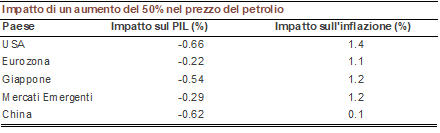
Recent events immediately alter investor confidence, with an increase in the risk premium. Secondly, the crisis of confidence may involve economic operators who could slow down consumption and investments. From a purely macroeconomic point of view, the current situation—rising energy prices and obstruction of commercial traffic—constitutes a supply shock with possible stagflationary implications. This is especially true for Europe, which immediately feels the impact of rising gas prices. If the current situation lasts long, there would also be a problem for Asian economies, led by China, which are highly dependent on oil coming from the Persian Gulf.
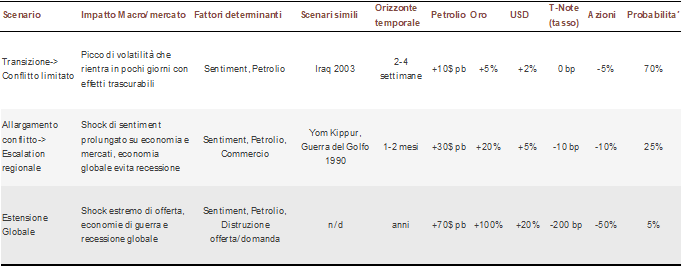
The table below summarizes the range of possible scenarios with market implications, trying to estimate the probabilities of these scenarios. It is worth remembering that, following Trump’s announcement of sending a substantial military contingent to the region, markets had begun to anticipate the possibility of a conflict, as evident from the movements in recent weeks of oil, gold, and interest rates.
The scenario we consider most likely is a transition towards a regime more cooperative with the United States, certainly interested in extending control over the flow of fossil fuels by a supplier so far closely linked to China (as is also the case with Venezuela). Within this evolution are included hypotheses of a rapid backtrack by the regime willing to negotiate, up to scenarios of deeper transformation of the leadership, likely following a more violent and prolonged internal and external confrontation.
The remaining hypotheses are: a wider conflagration of the Middle Eastern chessboard (25%) in which other countries get sucked into the war confrontation with an extension of the conflict well beyond the 2-4 weeks hypothesized by the US administration; and finally, the expansion of the conflict to other countries outside the Persian Gulf (5%).