Investments in technology – particularly in software, hardware, and infrastructure related to artificial intelligence – continue to represent an important driver of economic growth in the United States. Despite this, part of the public debate remains anchored in the fear that broader AI diffusion could end up replacing human labor, increasing unemployment. In the short term, it is plausible that AI evolution will surpass the simple chatbot model to reach more advanced systems, “autonomous agents” capable of operating as a scalable set of junior analysts in various professional fields. Should this prospect materialize, the impact on the economic system would be significant. Rather than replacing the workforce, however, we believe such tools could amplify productivity, offering businesses access to virtually unlimited operational capacity and fostering the emergence of new activities and professions that are currently hard to imagine.
AI growth and the redefinition of labor demand
Preliminary data suggest that AI adoption is already at an advanced stage. According to the Federal Reserve Bank of St. Louis’s Real-Time Population Survey, by August 2025 over 50% of the US working-age population reported using AI tools, an increase of 10 percentage points compared to the previous year. The use of generative AI at work reached 37.4%, with greater diffusion among workers with university education. At the corporate level, 10% of companies have already integrated generative AI into production processes, while a significantly larger share has experimented with its use in at least one function. Compared to previous waves of innovation, generative AI appears to have already significantly impacted employment composition.
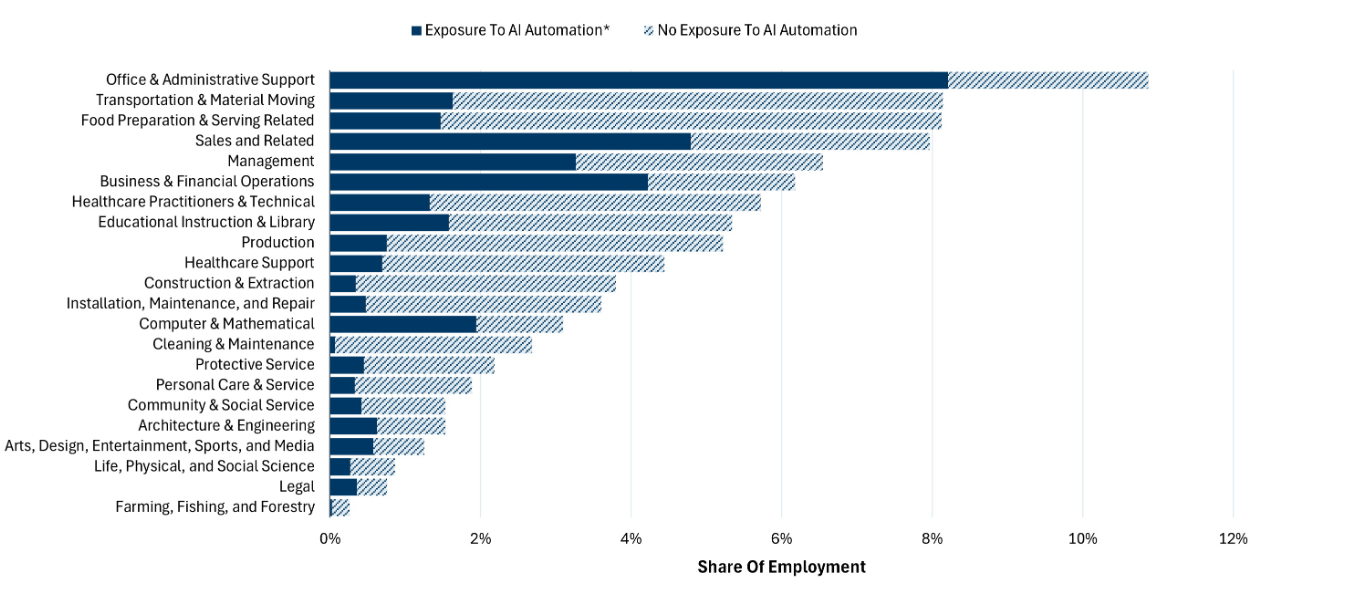
Job postings requiring AI skills have increased by 80% in the IT sector and by 31% in professional, scientific, and technical services. Not coincidentally, these sectors report both the highest levels of adoption and the largest labor productivity gains since the start of the pandemic. At the same time, signals of transition are emerging in the labor market: the unemployment rate among recent graduates is rising, and demand for traditional junior positions appears to be declining. Some estimates indicate that about 34% of current jobs could see over half of their activities automated by generative AI, particularly in administrative and technological roles (see Figure below).
From chatbots to autonomous agents
Already today, the most advanced chatbots offer performance comparable to that of an intern: they can conduct research, produce content, and improve results based on feedback. However, unlike a human worker, they operate in seconds, have access to enormous amounts of data, and are continuously available. The most recent evolution concerns the development of autonomous agents. Since late 2024, systems like OpenAI’s Operator are capable of performing operations on behalf of the user, including online interactions and transactions. These agents can plan trips, book services, and adapt to individual preferences inferred from past interactions. In the corporate environment, such tools are already used in functions like customer service, order management, and operational support. They can complete documents, organize information, and coordinate activities. More advanced solutions, such as those developed by Anthropic, introduce multi-agent systems capable of tackling complex problems by analyzing them from different perspectives and delivering structured results. The implications are significant: the use of AI agents can reduce organizational inefficiencies, improve information flow, and cut costs related to coordination problems typical of human structures. Unlike traditional teams, these systems are not subject to burnout or internal barriers. It is therefore plausible to imagine future organizations where networks of AI agents consistently support or integrate various company departments.
The cost collapse
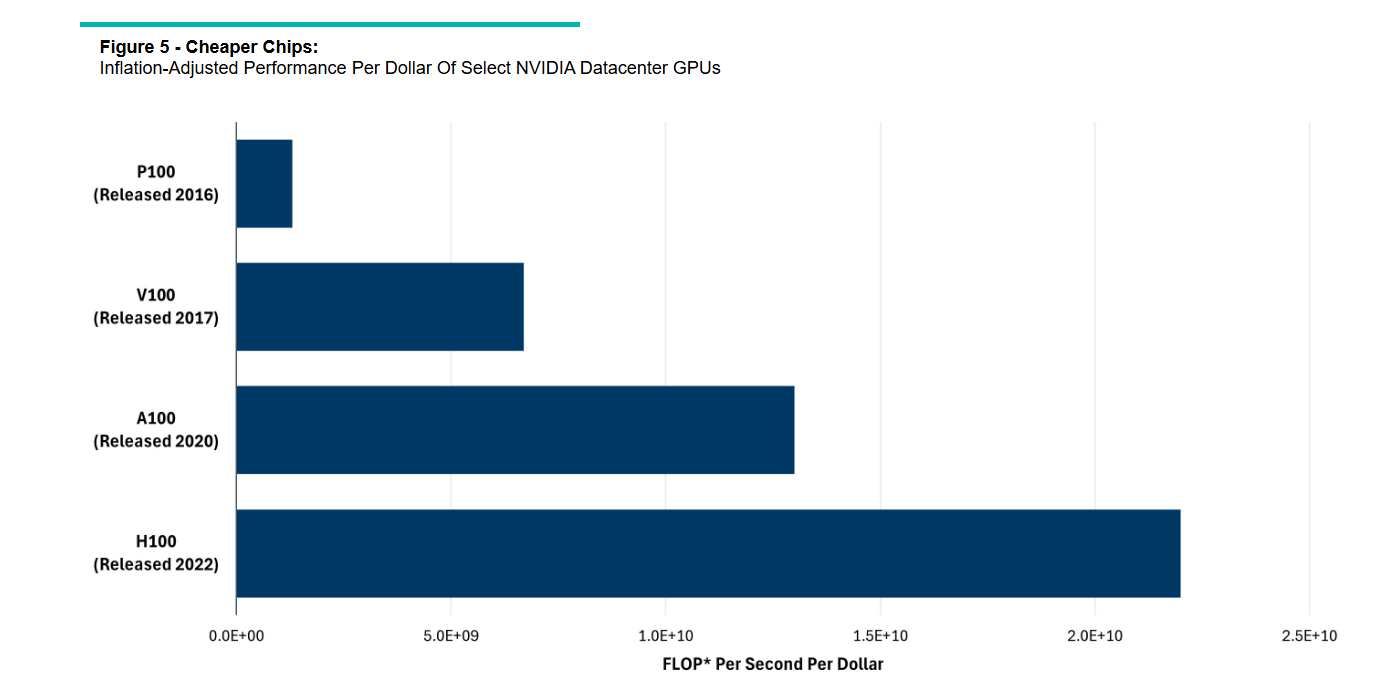
A crucial element concerns cost evolution. In the past, AI adoption required significant investments in infrastructure, specialized skills, and maintenance. Today, this picture is rapidly changing. The inference cost of advanced language models has drastically decreased: from about $20 per million tokens in November 2022 to only $0.07 in October 2024, a ninefold annual reduction. For the most advanced models, the decline is even more marked, with reductions up to 900 times on an annual basis. Training costs are also decreasing, with an estimated 30% annual reduction for the necessary hardware, while performance per dollar continues to grow thanks to GPU advances (see Figure below).
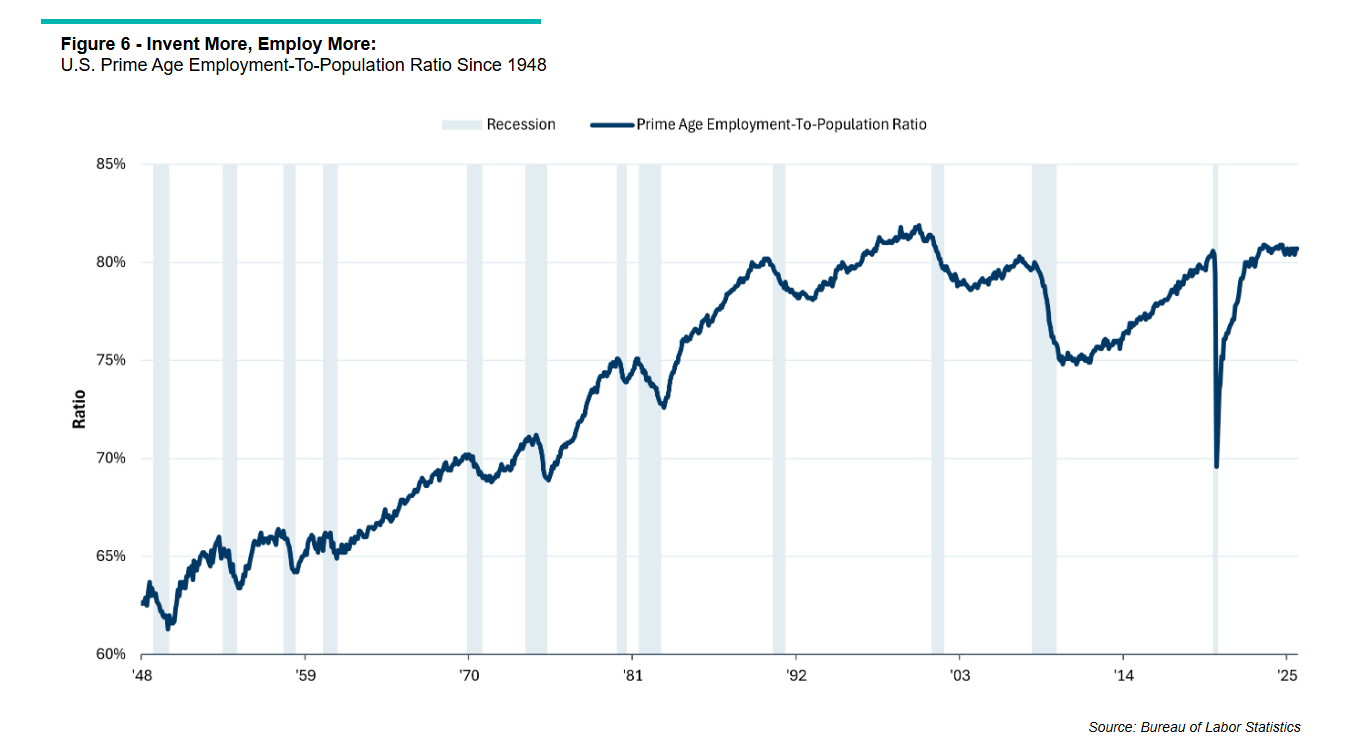
Concerns about job losses often reflect the “fixed quantity of labor” fallacy, i.e., the idea that the overall volume of employment is immutable. Economic history shows the opposite: technological innovation tends to expand the size of the economy, generating new employment opportunities over time (see Figure below). Disruptive technologies such as electricity, steam engines, computers, and the Internet have profoundly transformed production systems, sometimes causing short-term dislocations but producing significant long-term productivity gains and new employment.
In the short term, AI is destined to replace repetitive activities and reduce labor demand in specific segments. In the long term, however, it will contribute to the creation of new professions and the raising of average skill levels. AI-based tools will also enable non-specialized workers to perform more complex tasks, for example in programming or data analysis. Moreover, the productivity increase resulting from AI could represent a structural response to the slowdown in demographic growth in advanced countries. In this sense, AI could help mitigate the risk that “rich countries run out of workers before jobs.” In an economy increasingly oriented towards autonomous AI systems, people will be able to focus on higher value-added activities, resulting in increased overall production and a transformation of the very nature of work.
Finally, the idea that only office jobs are exposed to automation may prove shortsighted: AI evolution, integrated with robotics, could over time extend its impact to manual activities as well, further redefining the boundaries of human work.