


2025 was the year of Donald Trump’s return to the White House. The Trump administration, in its second term, implemented a series of economic policies – primarily those related to trade tariffs – that marked a sharp break with the past. The discontinuity concerns the methods and approach adopted, but not the issues placed at the center of Trump’s policies. His policies represent an attempt to address four structural challenges of the US economy:
- The state of the real economy and, more specifically, the decline of the manufacturing sector;
- The trade deficit;
- The public deficit and debt;
- The international role of the dollar.
In these pages, we will attempt a first assessment of the results of the Trump presidency – more than a year after the new administration took office – in relation to the four themes listed above. This is necessarily a preliminary assessment, both due to the uncertainty still surrounding the final outcome of some measures (starting with the extent of tariffs actually applied to numerous countries), and because the effects of the adopted policies are destined to unfold over the long term.
Nonetheless, we believe that the experience of 2025 is sufficient for an initial evaluation of the effectiveness of the Trump administration’s policies. The table below collects – in relation to the macro themes indicated above – various key economic and financial indicators, in order to compare the performance of the American economy last year with that of the previous year, the last of the Biden presidency. We will then proceed to analyze the various indicators in depth, to finally draw general conclusions.
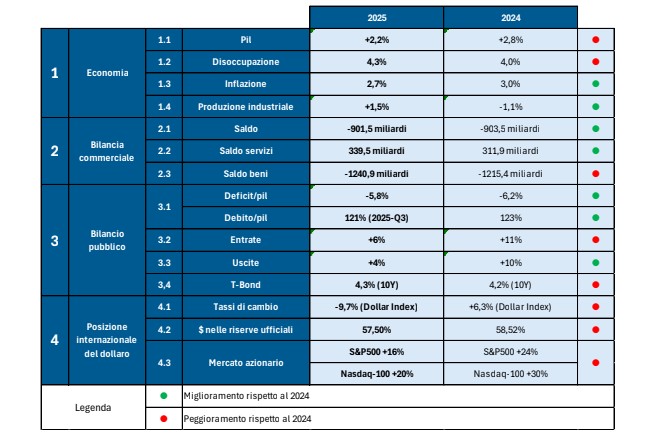
The picture emerging from the analysis of the main indicators of the US economy in 2025 is certainly not the general collapse predicted by some critics of Trump’s policies. On the contrary, some items show an improvement in the situation. This is the case for:
- Inflation, down compared to the 2024 average despite the potentially inflationary impulse of tariffs;
- Industrial production, which returned to growth after more than two years of contraction;
- Trade balance, which remains deeply negative, but has stopped following the rapid deficit growth trajectory recorded in 2024, thanks in particular to the slowdown in the growth rate of the goods deficit.
- Public deficit and debt, for which slight improvements compared to the values recorded in 2024 should be noted: from 123% of GDP in 2024 to 120% in 2025 (regarding this last figure, it should be noted that the final data for the entire 2025 is not yet available).
- Public budget expenditures, which grew at a rate significantly lower than that of 2024.
On the other hand, in other areas 2025 recorded worsening trends compared to 2024. Among these:
- GDP growth, which decreased from 2.8% to 2.2%, but remained at more than positive levels.
- The labor market, with the unemployment rate rising from 4.0% to 4.3%, following the same slow deterioration trajectory of general labor market conditions recorded in 2024.
- Public budget revenues, which grew at a slower pace (+6% vs +11%) compared to 2024 despite the contribution of tariffs and, above all, due to slower economic growth.
- Average interest rates on Treasuries increased – albeit marginally – despite the simultaneous easing of policy rates by the Fed.
- The percentage weight of the dollar in central bank reserves, which continued – albeit with a slight variation – the now multi-year downward trend.
- Stock market performance, with the annual return of the country’s main index – the S&P 500 – decreasing from 24% to 16%. These are more than positive results for investors, but for foreign investors they are offset by the simultaneous depreciation of the dollar (-15% against the euro).
Thus, while the forecasts of those expecting catastrophic consequences for the American economy have been disproved by the facts, even supporters of Trump’s policies do not see all their expectations confirmed.
A complete judgment on the effectiveness or otherwise of the economic policies implemented by the Trump presidency will necessarily require a multi-year horizon. The strategic objectives of the policies enacted – primarily the import substitution through a protectionist trade policy – can in fact only be achieved over the course of years, during which, however, the Trump administration will face significant risks on multiple fronts, starting with commercial or regulatory countermeasures by countries or areas targeted by tariffs.
Further uncertainties concern the performance of US stock markets, essential in recent years also for sustaining consumption. It is currently uncertain whether the likely downsizing of high-tech stocks in the AI universe will take the form of a sector rotation towards defensive stocks or will drag down the entire American stock market. It is worth adding that the ongoing war in the Middle East significantly amplifies the uncertainty of prospects, even in the short term, both in relation to financial markets and the economy more generally.


