While market attention remains focused on the conflict in the Middle East, some significant dynamics are emerging in equities that should not be overlooked. A particularly interesting theme is the relative performance between the United States and Europe, which changes significantly depending on the time horizon considered. Since the end of 2024 – and over the last six months – European stocks have outperformed US ones. This trend partly reflects the initial enthusiasm following the Republicans’ electoral victory, which then diminished after Liberation Day.
Even more significant is the movement in relative valuations. Between 2016 and 2024, there was a progressive revaluation of US equities, supported by robust economic growth and a strong improvement in profitability, especially in the technology sector. Since mid-2024, however, a rather marked reversal has been recorded, with a reduction in the relative valuations of the United States compared to Europe.
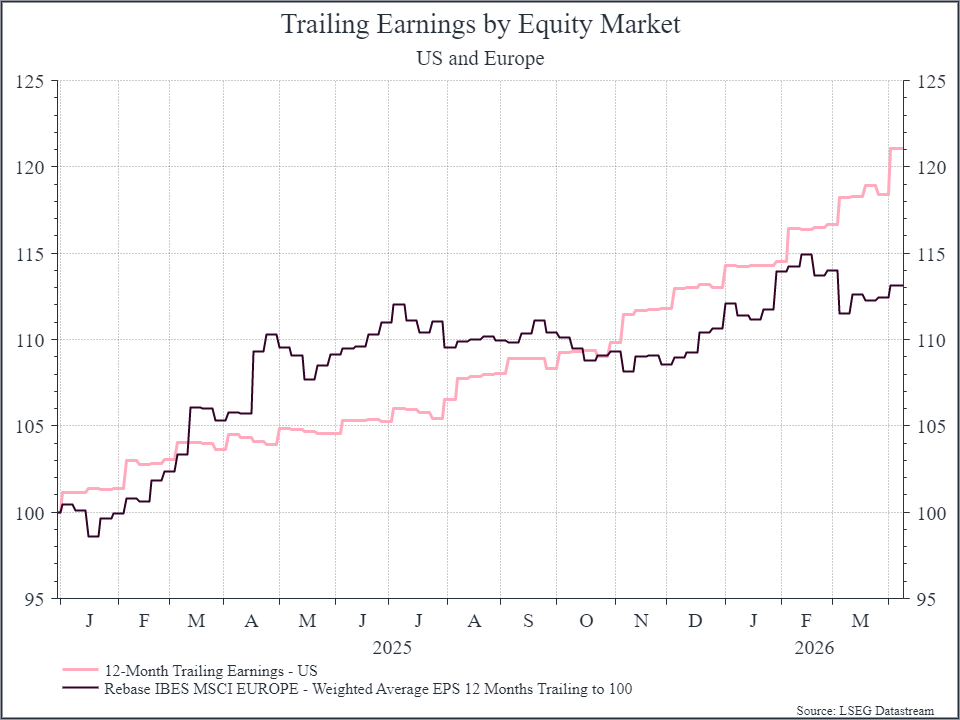
This change is due both to the better performance of European indices and to the fact that US companies have continued to show stronger earnings growth compared to European ones (see chart below). In the Old Continent, in fact, earnings growth in 2025 has been rather modest, without preventing the upward movement of the indices.
In summary, US stocks have seen a significant reduction in their relative valuations compared to Europe, but still maintain a rather consistent valuation premium, justified by a history of stronger growth, higher profitability, and still favorable expectations, also in light of the strong focus on Artificial Intelligence. Analysts forecast robust earnings growth both in the United States and Europe over the course of the year, but these estimates could prove optimistic in case of a global economic slowdown. In such a scenario, US earnings could prove more resilient – as already observed in 2025 – and, together with currently lower relative valuations, make US equities progressively more attractive in the coming months.