



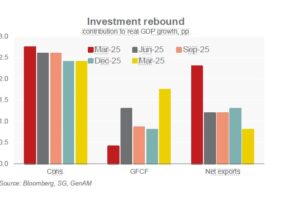
China started the year with solid economic momentum, showing resilience beyond expectations in the first quarter. GDP growth in the first quarter accelerated to 5.0%, driven mainly by a rebound in infrastructure investments, while consumption remains weak. Manufacturing partly offset the fragility of consumer services, but the most recent data indicate that the recovery in domestic demand has stalled, as evidenced by the slowdown in retail sales and the high level of household savings. Significant imbalances between supply and demand therefore persist.
BEIJING’S PRUDENT APPROACH
On the economic policy front, the authorities maintain a cautious and selective approach. The growth target for 2026, revised to 4.5-5%, reflects a clear preference for quality of growth over quantity. The April Politburo did not announce new stimulus measures, instead emphasizing the “strong resilience and vitality” of the economy, despite increasing external uncertainties.
Investment rebound
Source: Bloomberg
THE ENERGY AND TRADE ISSUE
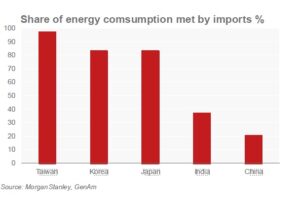
China is also less vulnerable to rising energy prices compared to other Asian countries, thanks to lower dependence on oil imports, the presence of strategic reserves, the ability to rely on coal, and the capping of domestic fuel prices. In a context of contained inflation, the impact of the energy shock appears manageable, although in the medium term a significant risk comes from a possible cooling of global demand, with negative effects on exports.
Energy consumption share for imports
Source: Morgan Stanley
TRUMP-XI AND DECOUPLING
Finally, Beijing maintains a low profile on the conflict with Iran and is unlikely to change this stance ahead of the Trump–Xi meeting. While it could gain greater negotiating leverage, a significant breakthrough in bilateral relations appears unlikely. Only limited and sectoral agreements (agriculture, rare earths, semiconductors) are possible, while the process of gradual decoupling between the United States and China remains a consolidated structural trend.


