

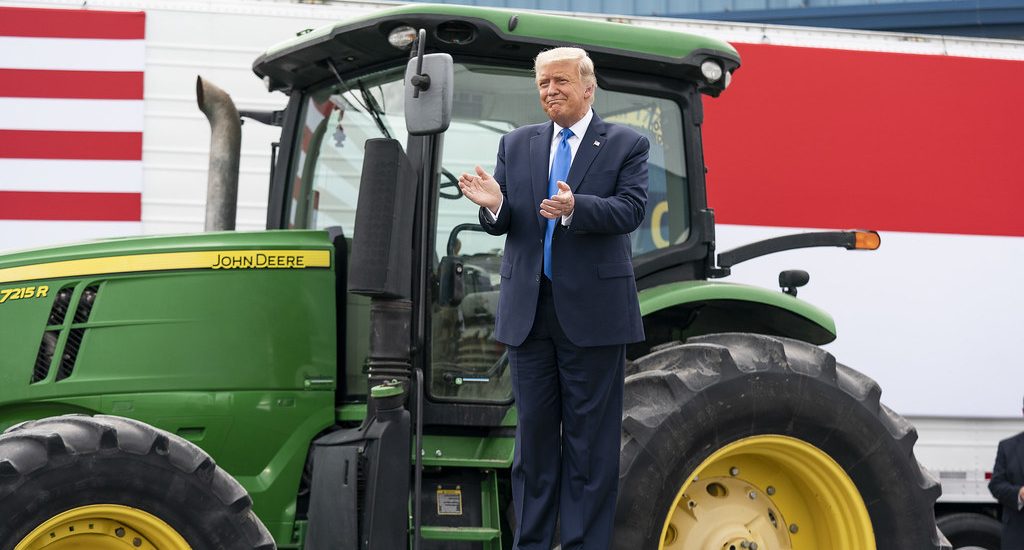

For Sam Watson, farming has always been a gamble. Raised in southern Georgia, he learned the risks early on: farmers invest millions every year and a drought or sudden disease can wipe out profits. Today, however, he believes the odds of success are worse than in his father’s time. [..] “We used to only pray for rain,” he says. “Now we also pray about geopolitics.”
Donald Trump has waged several wars in his second term, but two have been particularly damaging for Americans: his trade war with the world and the real conflict with Iran. Every American industry producing goods has suffered when the President imposed tariffs and other countries responded with retaliations. Now, with the unresolved conflict in Iran and the Strait of Hormuz still blocked, the same businesses face higher costs. Few have suffered as much as farmers – writes The Economist.
RISING COSTS AND STRUGGLING BALANCES
Even before Trump’s inauguration, the sector was grappling with record costs. In just five years, land prices rose by 6%, seeds by 18%, labor by 50%, and interest by 73%. When the president announced radical tariffs during last year’s “Liberation Day,” already fragile budgets became impossible to manage. With the surge in steel and aluminum prices, machinery costs also increased. John Deere stated it absorbed $600 million in tariff-related costs in 2025, expecting that to double this year.
INTERNATIONAL RETALIATIONS AND PRICE IMPACT
Countries targeted by Trump did not stand idly by. China dealt the hardest blow, blocking American soybean farmers and drastically reducing cotton purchases. […] Analysis suggests that agriculture was hit by retaliatory tariffs harder than any other U.S. industry. By mid-2025, while prices for electronics and chemical producers had risen by 2-3%, agricultural prices increased by about 10%.
THE COST OF HORMUZ
The war in Iran is exacerbating tensions right at the start of the planting season. Unlike other sectors, farmers depend on diesel, whose price has jumped 40% since the end of February. But the conflict dealt a second blow: a third of the world’s fertilizer supply passes through the Strait of Hormuz; its closure caused prices to skyrocket. Preston Jimmerson, a Georgian farmer, explains that chemicals account for 30% of his costs: “Taking fertilizer away from a crop is like taking oxygen away from a human being.”
SOCIAL AND ECONOMIC CRISIS IN RURAL AREAS
Even if the harvest season goes well, crop prices have remained almost unchanged for years. For many, the accounts no longer add up. In 2025, farm bankruptcies increased by 46%. […] Stress sometimes manifests in darker ways: an auctioneer from Illinois reports that in difficult years, more tractors come up for sale from families of farmers who have taken their own lives.
In rural areas of the South and Midwest, farmers support an entire network of local businesses. When agriculture suffers, the entire local economy suffers. In Georgia, the crisis is already evident: restaurant tables remain empty and families no longer have money for extra expenses. A recent survey suggests that 27% of rural residents find it “impossible” to cover an unexpected $1,000 expense.
POLITICAL SUPPORT AND CONTRADICTIONS
It would be easy to blame Trump for the decline, since he promised to lower prices and revive rural areas. But rural America does not do that. The president’s approval rating is higher among rural voters than any other group. Most think he is doing a good job and say they trust the administration, while asking for help to recover losses caused by foreign policy.
SUBSIDIES AND AN UNCERTAIN FUTURE
Industry organizations are pushing for a new stimulus package. This week the House of Representatives is expected to vote on the “Farm Bill,” which could nearly double subsidies to farmers by 2027, bringing them to $41 billion. “I don’t know a single farmer who really wants handouts,” says Jayden Jorgensen, a young farmer from Iowa. “But if we don’t take them, we fall behind everyone else.”
A HARD TO BREAK BOND
Despite uncertainty about the future, a rare optimism remains. Sam Watson is not sure it will make sense to plant another crop next year, yet he continues to work all night to preserve his way of life. “I don’t know what drugs are like, but I imagine farming is similar,” he says. “It’s not good for you, but it gets in your blood and becomes addictive.”
(Excerpt from the foreign press review curated by eprcomunicazione)


