There is not just one fashion capitalism. Behind seemingly homogeneous numbers lie profoundly different models, reflecting opposing industrial structures, corporate cultures, and financial logics. This is clearly shown by the Mediobanca Area Studies report on the 75 largest global multinationals in the sector.
TWO MODELS, ONE INDUSTRY
The contrast is clear: on one side Europe, dominated by luxury and stable ownership structures; on the other North America, more oriented towards sportswear, lifestyle, and financial markets.
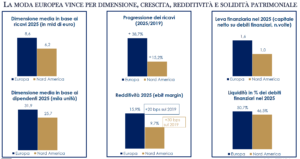
The gap in 2025 is evident in the numbers. European companies generate 62% of the total sample revenue, compared to 29% for North American ones. Not only that: they are larger (average revenues of 8.6 billion versus 6.2), more profitable (operating margin of 15.9% versus 9.7%), and grow more in the long term (+38.7% between 2019 and 2025 versus +15.2%).
Is this the triumph of the European model? Not exactly.
Comparison between Europe and North America
Source: Mediobanca Area Studies
THE ADVANTAGE OF LUXURY (WHICH IS SLOWING DOWN)
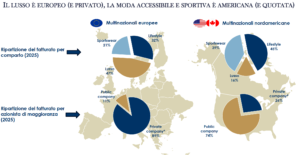
Europe has built its leadership on a specific lever: luxury. In 2025, 47% of the aggregated revenues of European multinationals come from this segment, compared to a much smaller share in the United States.
This is where the global champions are concentrated: LVMH, with over 80 billion in revenues, Hermès, the world leader in profitability with an operating margin of 41.1%, Chanel, Kering. A system founded on heritage, family control, and a long-term vision.
This model has ensured a rare combination of growth and profitability over the years. But today it shows the first signs of fatigue. In 2025, the luxury sector records a contraction of 2.1%, interrupting a long expansion phase.
The issue is structural: luxury remains the most profitable segment, but it is no longer sufficient to drive the entire system alone.
THE AMERICAN MODEL: LOWER MARGINS, LARGER MARKET
On the other side of the Atlantic, the model is different. North American multinationals are more exposed to lifestyle segments (45% of revenues) and sportswear (39%), with less dependence on luxury, which remains marginal compared to its weight in Europe.
Nike, Adidas – European headquartered but with a model close to the American one –, VF Corporation, Deckers: here the competitive advantage is not so much price but scale, distribution, and the ability to capture broader consumption trends. Not surprisingly, Nike remains one of the global leaders with 39.4 billion euros in revenues in 2025, while Adidas stands at 24.8 billion, confirming the centrality of sportswear in the global system.
The ownership structure is also different. North American companies are almost all publicly traded and more exposed to market logics. The ratio of buybacks to net capital reaches 16.8%, compared to just 1% for European companies. This translates into greater pressure on short-term results but also greater financial flexibility. However, the average size of companies remains smaller than European ones (6.2 billion in revenues versus 8.6), as does operating profitability (9.7% versus 15.9%).
The flip side is profitability itself: lower and more volatile, but also less dependent on a single segment and therefore structurally more diversified.
THE REVENGE OF THE (AMERICAN) STOCK MARKET
Looking at industrial fundamentals, Europe dominates. But in financial markets, the picture changes. After years of European outperformance driven by luxury, the first quarter of 2026 marks a sharp reversal. North American multinationals return to growth on the stock market (+1.5%), while European ones fall by 21.1%, returning to 2021 levels.
This is an important signal. Markets are beginning to price in the slowdown of luxury and reward more diversified and scalable models. It is not a definitive overtaking but indicates a change in investor expectations.
FRANCE AND ITALY: WHO REALLY WINS IN FASHION
Within Europe, the most interesting comparison is between France and Italy. The two countries represent two variants of the same model but with very different results.
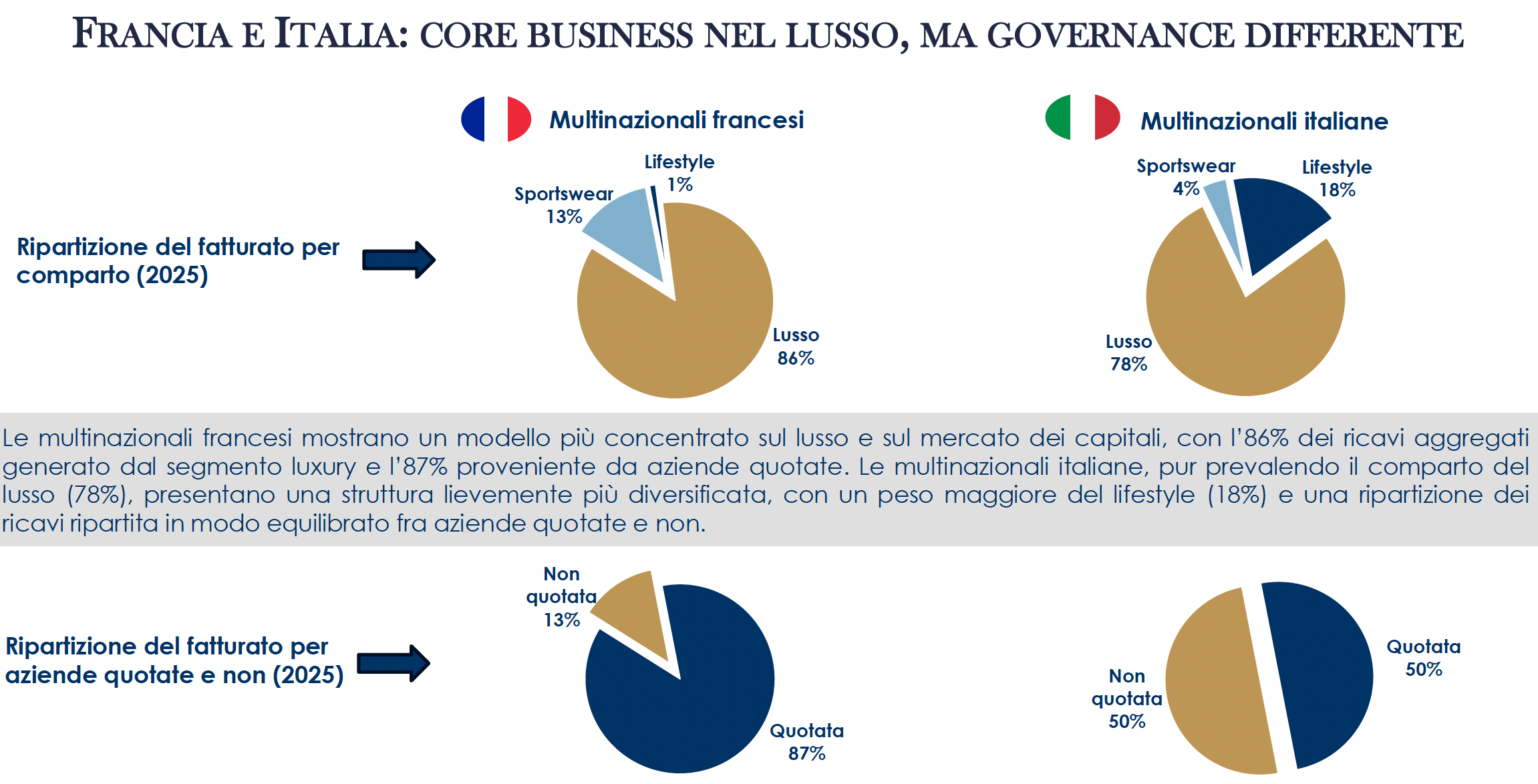
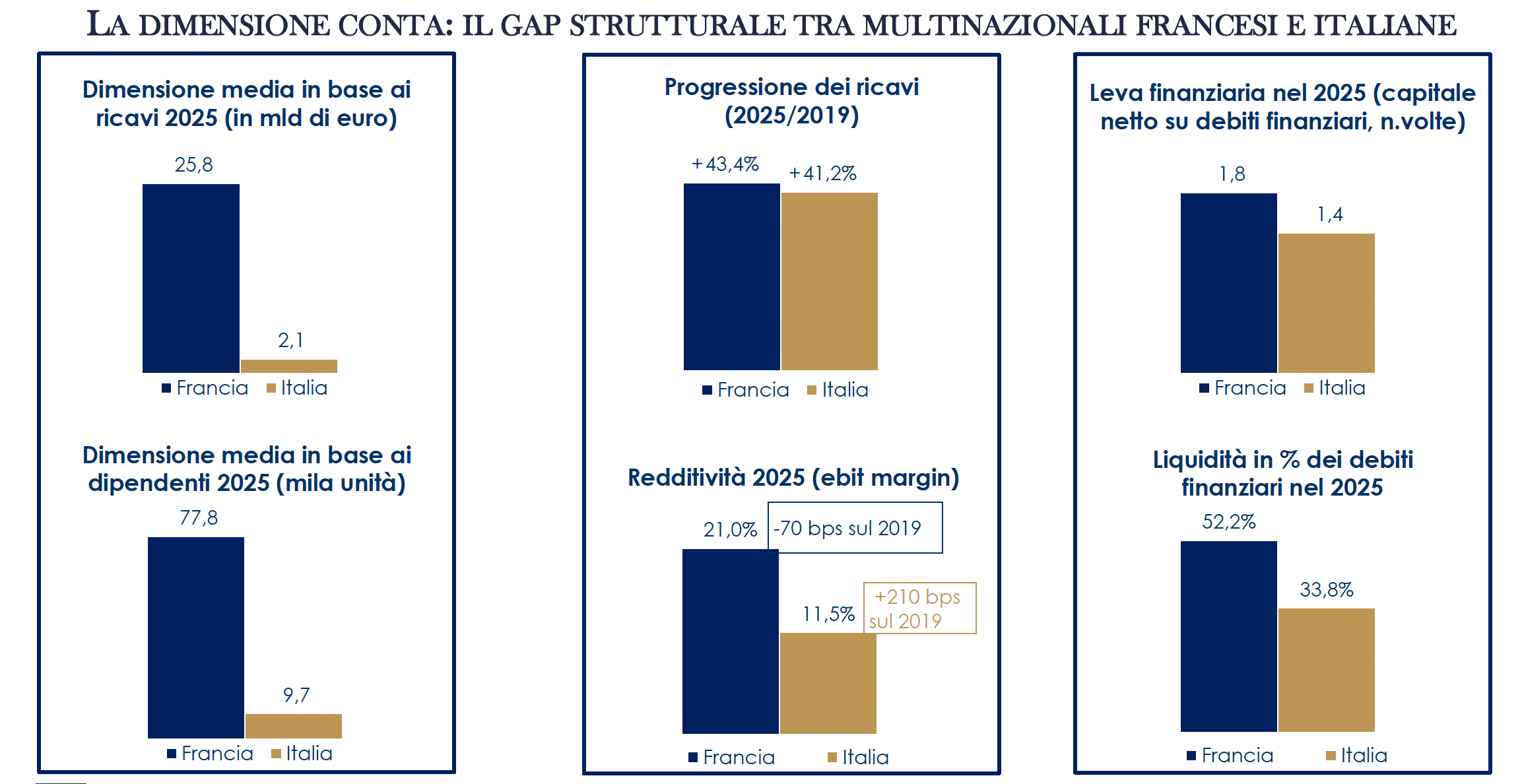
France dominates in size. Its multinationals have average revenues of 25.8 billion versus 2.1 billion for Italian ones, and significantly higher profitability (21% versus 11.5%). The system is highly concentrated and capital market-oriented, with 87% of revenues generated by listed companies.
Italy, on the other hand, is more fragmented. It has more companies (14 in the sample) but much smaller in size. It is more diversified, with a greater presence in lifestyle, and invests more in proportion to revenues (8.1% versus 4.7%).
It is not a matter of quality but of size. And this is the real competitive battleground.
France and Italy compared
Source: Mediobanca Area Studies
M&A: THE NEW GEOGRAPHY OF POWER
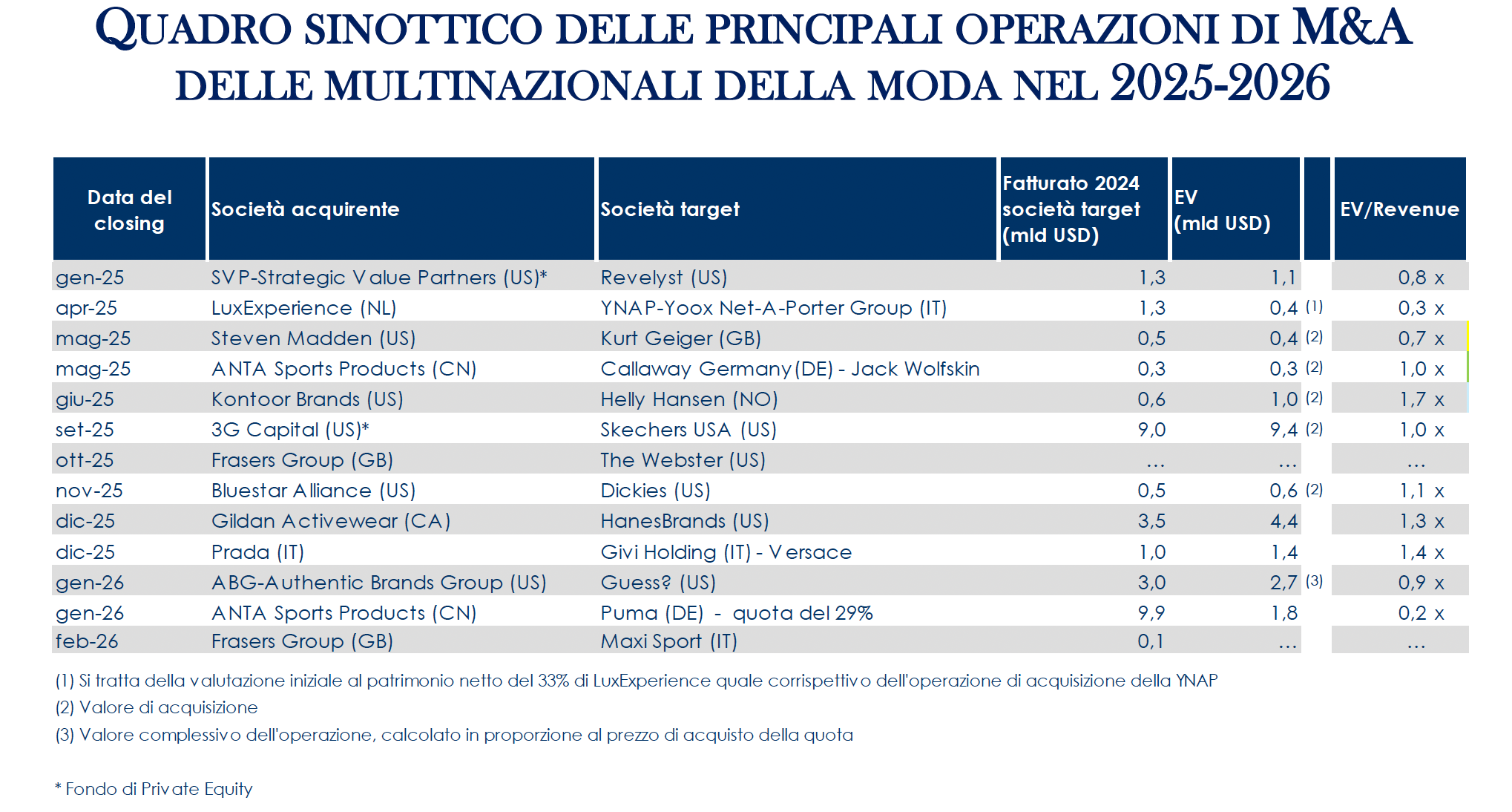
In a more complex and less expansive context, pressure for consolidation is growing. The 2025-2026 biennium has been particularly dynamic on the extraordinary operations front.
Among the main deals are the acquisition of Versace by Prada and that of HanesBrands by Gildan (both in December 2025), ANTA’s entry into Puma with a 29% stake in January 2026, and the delisting of Skechers by 3G Capital in September 2025.
These are not isolated episodes. They signal a new phase, where organic growth slows and building scale, brand portfolios, and global presence through acquisitions becomes more important.
Consolidation thus becomes a competitive tool, not just a financial one.
Main M&A operations in the 2025-26 biennium
Source: Mediobanca Area Studies
TOWARDS A HYBRID MODEL
The emerging picture is that of a sector in transformation. Europe maintains an industrial advantage, thanks to luxury, profitability, and financial solidity. The United States, for their part, hold a financial advantage and greater adaptability to market changes.
Neither model is self-sufficient. European luxury must face the limit of growth based on prices, while the American model must strengthen brand value to improve profitability.
The balance point could be a hybrid model: scale and market on one side, identity and value on the other.