

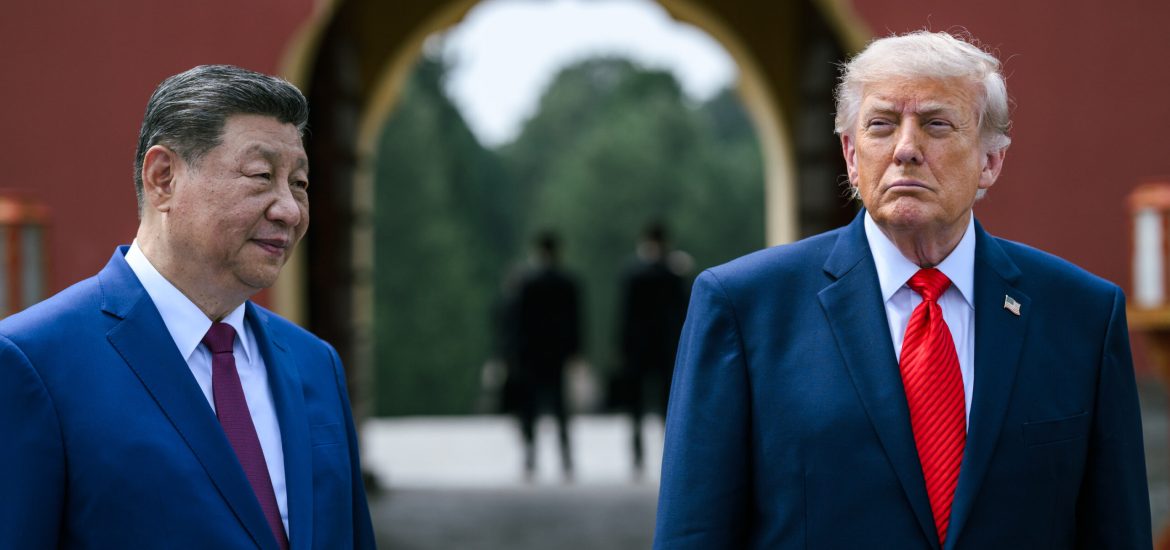

Anglo-Saxon media described the Trump-Xi summit as a summit full of pomp and friendly gestures, but marked by Chinese firmness on Taiwan, virtually no results on Iran, and the clear impression of a relationship between superpowers now on the same level.
Overall, according to the analyses made by the media we considered, it was a summit useful to stabilize bilateral relations without resolving the deep fractures dividing the two countries.
THE ATMOSPHERE OF THE TRUMP-XI SUMMIT IN BEIJING
The Hill speaks of a summit marked by “great splendor” but balanced by “obvious tensions” over Iran and Taiwan.
Trump appeared visibly pleased by the grandeur, praising the roses of Zhongnanhai as “the most beautiful roses anyone has ever seen.”
Yet, according to Reuters and Guardian, behind the impeccable ceremonies one could sense the position of an American president weakened by the conflict with Tehran and forced to face a host fully aware of his own strength.
Time highlights how Trump was “put back in his place” already in the first private talks, with Xi immediately putting the Taiwan issue on the table.
PERSONAL INTERACTIONS
NPR records how Trump called Xi “a great leader,” “a man I deeply respect,” “a friend,” going so far as to say he seemed “straight out of Hollywood central casting.”
On the return flight, the White House chief defended his counterpart’s words on American decline but attributed them to the Biden era.
CNN and Bloomberg highlight that while the US president appeared deferential and seeking personal rapport, his counterpart remained more sober, speaking of a “once-in-a-century transformation” and proposing that China’s resurgence and “Make America Great Again” could proceed “hand in hand.”
THE WARNING ON TAIWAN
All media report that Xi called Taiwan “the most important issue in China-US relations,” warning that mishandling it would lead to “clashes and even conflicts,” putting the entire relationship “in grave danger.”
Time describes Trump as “strangely silent and uncomfortable” on the topic, responding only that “China is beautiful.”
Axios and Guardian note that the warning on Taiwan came in an otherwise friendly context, useful to strongly reaffirm Beijing’s red lines.
IRAN DOSSIER
The Hill speaks of “scant tangible progress” on the war in Iran, observing that the Chinese side barely mentioned the Islamic Republic.
Trump reported that Xi expressed willingness to help and promised not to supply weapons to the ayatollahs, but without concrete commitments.
Yue Su of the Economist Intelligence Unit cited by CNBC and Patricia Kim of the Brookings Institution cited by Reuters highlight, however, the limits of Chinese influence on Tehran.
Time adds that Beijing has gained indirect advantages from the chaos, earning soft power in the Global South while Washington appears as a “bullying warmonger.”
TRADE AGREEMENTS
Trump claimed the purchase of 200 Boeing planes, with the possibility of rising to 750 orders, purchases of agricultural goods worth billions, and greater opening of the Chinese market.
However, Reuters, BBC and Axios highlight the absence of official confirmations from Beijing and disappointing precedents. Time cites Chong Ja Ian of the National University of Singapore on this point: “The front-page numbers will look very impressive (…) but we’ve seen this movie before.”
Xi promised that “China’s door will open more,” but without binding details.
THE RELATIONSHIP SCENARIO
Time and Bloomberg explicitly speak of a “changing of the guard,” with Xi treating Trump as an equal to his American counterpart. In this regard, Sung Wen-ti of the Australian National University, cited by Time, states that “China has clearly established itself as an equal to the United States.”
Similarly, Bloomberg reports the words of Richard McGregor of the Lowy Institute, who says “China is now a competitor on equal footing with the United States.”
The Hill and Guardian conclude that both sides can claim a stabilization of the relationship, but without the major results Trump would have wanted.
A SUMMIT WITHOUT BREAKTHROUGHS
In summary, Anglo-Saxon media describe a summit more oriented towards image and managing immediate tensions than concrete results. The Donald sought quick deals to sell at home, while Xi skillfully consolidated his status as leader of a country now on the same level as the one led by his counterpart.
A clear signal of how the relationship between the two superpowers is evolving towards a more balanced and structural competition.


