



Although U.S. Treasuries posted their best monthly performance in over a year in February, with 10-year yields approaching 4%, we are not convinced that Treasuries will extend their gains in the coming months. If anything, we believe yields are more likely to reverse course and rise again. The reason is U.S. growth or, more specifically, the possibility that the U.S. economy expands at a faster pace than currently priced in by the markets.
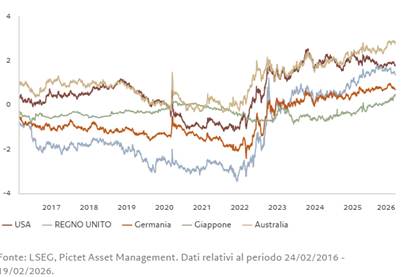
Figure 1 shows that real bond yields in the United States – which reflect the bond market’s expectations for U.S. economic growth – have fallen in recent months, contrary to the global trend. This development suggests that markets expect some convergence between the performance of the U.S. economy and that of their slower-growing developed world counterparts.
While acknowledging that this scenario could indeed materialize, we believe the bond market is overly pessimistic about U.S. economic prospects, perhaps overlooking the potential upside from the capital spending boom related to Artificial Intelligence. Similarly, the shift in real yields also suggests an acceleration of growth in Europe and other developed economies, a scenario we also find unlikely. Taking this into account, we have maintained an underweight position in U.S. Treasuries.
Fig. 1 – The U.S. economy may be stronger than real yields suggest
Elsewhere, we remain convinced that the rally in local currency emerging market bonds will continue for at least several months. Central to our investment thesis is the expectation of ongoing improvement in economic conditions across the emerging world. Our economists forecast GDP growth of over 4% in emerging markets, far outpacing the 1.7% expansion expected in developed countries. Our models show a wider growth gap, consistent with the appreciation of emerging market currencies against the dollar, one of the main sources of return for local currency emerging market bonds. The decline in inflationary pressures also supports the asset class’s short-term outlook. The fact that average CPI inflation in emerging markets has fallen to 3.1% makes local currency bonds particularly attractive, as they combine unusually high real yields with potential for further currency appreciation.
Regarding currencies, we expect the dollar to remain weak, not only against emerging market currencies – particularly those of Latin America – but also against the euro and Swiss franc.
GLOBAL MARKET OVERVIEW: LONG LIVE HALO
The AI-led equity market pullback continued at a brisk pace in February. The U.S. equity market lagged others, with European, Japanese, and emerging market stocks posting strong gains as investors sought to understand the impact of generative AI on existing companies.
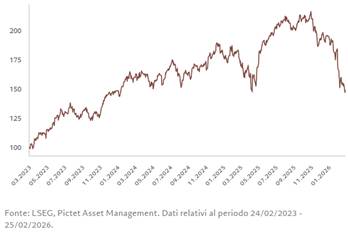
U.S. stocks fell by nearly 1% during the month as investors moved away from companies perceived as vulnerable to AI disintermediation – many of which had dominated markets in recent years (see Fig. 2). Anything easily revolutionized by AI – bespoke software providers, professional services, sales platforms – is suddenly under scrutiny and considered riskier. Few have forgotten what happened to Blockbuster when the streaming era began.
Investors are instead seeking companies that own hard-to-replace physical assets or operate in heavily regulated sectors that are difficult to disintermediate. These Halo stocks – from the English “Heavy asset, low obsolescence,” characterized by tangible assets and low obsolescence – represent a larger share of markets outside the U.S., while in the U.S., for example, software has a much greater weight. Consequently, Eurozone stocks gained over 3% in local currency during the month, the UK market rose about 7%, and Japan nearly 10%. Swiss and emerging market stocks also gained over 5%. The contrast between positive and negative forces lifted the overall equity market by 1.5% over the month.
Fig. 2 – Sharp slowdown in the software sector
This divergence within the market is particularly evident at the sector level. Materials stocks gained 10% during the month, utilities 9%, industrials 7%, consumer staples 8%, and real estate – last year’s big laggard – rose 6.5%. In contrast, communication services fell more than 4%, the IT sector declined 1%, and financials lost just over 0.5%. Concerns about U.S. economic prospects and worries about AI’s potential impact on worker replacement weighed on consumer discretionary, down 3%.
Economic uncertainty supported government bonds, with U.S. Treasuries gaining about 3%, eurozone bonds rising nearly 2%, and UK Gilts up 2.5%. Corporate bonds showed moderate performance, with a slight increase over the month, with the U.S. capturing market extremes: high yield rose only 0.1%, while investment grade increased 1%. The dollar showed mixed performance: up versus developed market currencies but down against emerging market currencies. The pound, for example, lost 2%, while the Brazilian real rose 2.1%


